Executive Overview
As Large Language Model (LLM) deployments transition from experimental prototypes to mission-critical production systems, engineering teams inevitably confront a harsh economic and architectural reality: inference gets slow and expensive as traffic scales. Requests queue silently behind grueling multi-token generations, finite GPU high-bandwidth memory (HBM) fills rapidly with cached attention states, and enterprise compute hardware spends a staggering proportion of its active cycle waiting idly on memory bus reads rather than executing math.
Inference optimization is no longer an auxiliary engineering concern; it is a core operational discipline. However, the ecosystem is currently saturated with a dizzying array of overlapping, highly specialized interventions. Some techniques target memory bandwidth and footprint; others optimize compute utilization; while still others fundamentally alter how concurrent requests are scheduled against shared hardware resources. Every single optimization technique carries implicit, rigid assumptions about the nature of the underlying workload. Deploying a technique without validating its foundational assumptions frequently leads to bloated engineering complexity, diminished model accuracy, or—ironically—worse end-user latency.
This article provides an authoritative, methodical framework for matching specific LLM inference optimization techniques to the actual performance bottlenecks of your workload. By traversing a rigorous six-question decision tree, engineering architects can strip away guesswork, bypass counter-productive optimizations, and implement targeted solutions ranging from prefix caching and PagedAttention to speculative decoding and prefill-decode disaggregation.
Detailed Chronology and Architectural Evolution of Inference Bottlenecks
To understand why modern LLM inference optimizations are structured the way they are, we must trace the evolution of how models are served in production environments.
Phase 1: The Naive Serving Era and Static Batching
In the early days of transformer deployment, models were served using paradigms inherited from traditional computer vision or smaller NLP models. Requests were grouped into static batches. This approach introduced a crippling architectural flaw: transformers generate tokens autoregressively—one single token at a time.
If a batch contained four requests, and three of them generated short 10-token responses while the fourth required a sprawling 500-token explanation, the entire GPU allocation had to wait for the slowest request to finish. The compute hardware sat idle or underutilized for 98% of the generation cycle. Furthermore, the Key-Value (KV) cache memory was provisioned contiguously based on the maximum possible sequence length ($N_max$) for every single request. If an incoming prompt only used 10% of its allocated window, the remaining 90% of that memory block was locked out, severely capping maximum concurrent batch sizes.
Phase 2: The Memory-Bandwidth Wall and Dynamic Scheduling
As models scaled into tens and hundreds of billions of parameters, compute became secondary to memory bandwidth. During the autoregressive generation phase, the GPU must fetch the entire model weight matrix from HBM into SRAM for every single token generated, yet it performs very little arithmetic per parameter compared to the prefill phase. This memory-bound state led to the invention of continuous (in-flight) batching, which dynamically inserts new requests and retires completed sequences at every decoding iteration, eliminating idle bubble time.
Concurrently, memory fragmentation problems were resolved via virtual memory-inspired abstractions like PagedAttention, which treats KV cache memory like operating system virtual memory pages. This completely eliminated internal and external memory fragmentation, allowing serving engines to pack significantly more concurrent requests into limited GPU VRAM.
Phase 3: Modern Disaggregation and Hybrid Paradigms
Today, modern AI infrastructure demands architectural separation of concerns. In large-scale deployments, the heavy, compute-bound "prefill" phase (processing the input prompt) and the memory-bound "decode" phase (generating tokens autoregressively) contend fiercely for the exact same GPU resources. This contention spikes Time-to-First-Token (TTFT) and Inter-Token Latency (ITL) simultaneously.
State-of-the-art production environments now leverage prefill-decode disaggregation (split-wise architectures), routing prompts to specialized compute nodes and passing the resulting KV cache across high-speed fabric networks to dedicated memory-optimized decode nodes. Mastering this hierarchy requires a systematic diagnostic approach.
Supporting Context & Metrics: Decoding the Optimization Arsenal
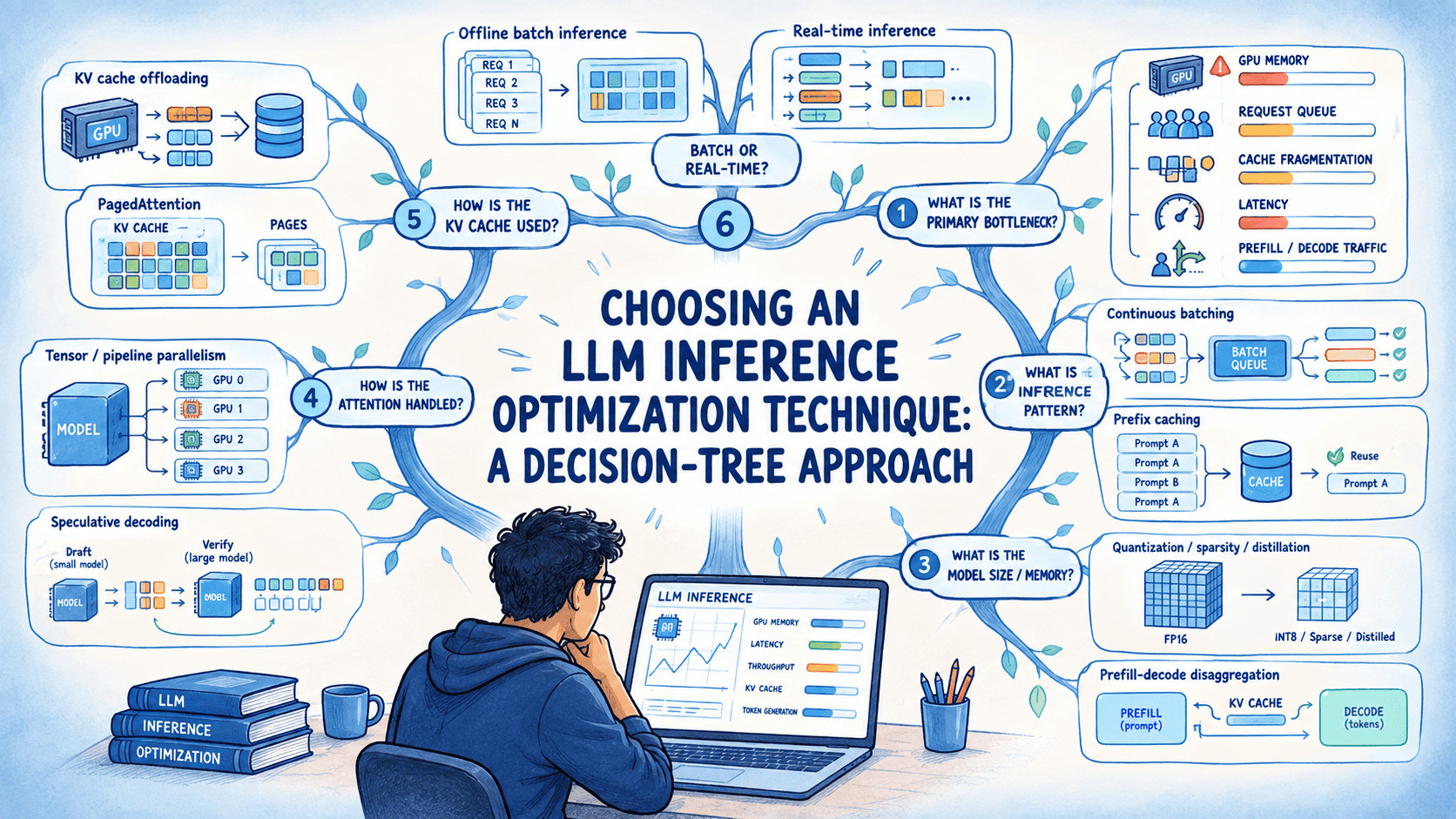
Before walking through the decision tree, we must catalogue the primary optimization techniques available in the modern serving stack and understand their underlying assumptions, best-use cases, and inherent trade-offs.
| Technique | Core Assumption | Best-Use Scenario | Primary Trade-off |
|---|---|---|---|
| Quantization / Sparsity / Distillation | Model exceeds hardware memory limits or latency budgets; accuracy degradation is tolerable. | Models too large for target hardware or strict time-to-market latency bounds. | Incurred accuracy loss; quantized activations are significantly harder to optimize than weights. |
| Prefix Caching | Multiple requests share identical starting prompt sequences; recomputing them is redundant. | Chatbots, multi-agent frameworks, and RAG pipelines with recurring system prompts. | Breaks down instantly upon any character-level mismatch in the shared prefix. |
| Continuous (In-Flight) Batching | Traffic arrives asynchronously with highly variable, unpredictable output lengths. | High-concurrency production APIs mixing short classifications with long text generation. | Minimal downside; largely dependent on serving engine feature activation. |
| PagedAttention | KV cache memory is heavily fragmented or over-provisioned, capping maximum batch size. | Workloads experiencing sudden Out-Of-Memory (OOM) errors despite available GPU headroom. | Introduces a minor page-table lookup overhead during attention calculation. |
| Speculative Decoding | Decode phase is the primary bottleneck; a lightweight draft model can accurately guess subsequent tokens. | Latency-sensitive, single-user interactive applications (e.g., real-time coding assistants). | Requires a suitable draft model; performance plummets if draft acceptance rates are low. |
| Prefill-Decode Disaggregation | Simultaneous prefill and decode execution creates resource contention, degrading TTFT and ITL. | Large-scale enterprise production clusters processing massive concurrent loads. | Heavy networking and routing complexity; cost of moving KV caches across nodes. |
| Tensor / Pipeline Parallelism | The monolithic model cannot fit within the memory footprint of a single discrete device. | Massive frontier models (e.g., 70B+ parameters) requiring multi-GPU or multi-node scale. | Inter-device communication overhead and pipeline bubbles reducing peak FLOPS. |
| KV Cache Offloading | GPU memory is exhausted by cache; CPU RAM or NVMe can temporarily store inactive states. | Long-context applications (e.g., 128k+ token windows) with sporadic access patterns. | Severe latency penalties when fetching offloaded cache entries back to GPU HBM. |
| Offline Batch Inference | Zero interactive requirements; total aggregate throughput outweighs per-request latency. | Large-scale data processing, synthetic data generation, and batch text transformation. | Completely unusable for real-time user-facing applications. |
Navigating the Six-Question Inference Optimization Decision Tree
To eliminate architectural paralysis, evaluate your workload by stepping sequentially through the following six diagnostic questions. Each branch points directly to either an actionable intervention or the subsequent diagnostic query.
                  [ START: Analyze Workload Bottleneck ]
                                    │
                                    ▼
                      Q1: Does the Model Fit? ──NO──► [ Quantization / Parallelism ]
                                    │ YES
                                    ▼
                 Q2: Are Prompts Shared? ──YES──► [ Prefix Caching ]
                                    │ NO
                                    ▼
            Q3: Variable Output Lengths? ──YES──► [ Continuous Batching ]
                                    │ NO
                                    ▼
              Q4: Is KV Cache Fragmented? ──YES──► [ PagedAttention ]
                                    │ NO
                                    ▼
             Q5: Is Decode Latency Vital? ──YES──► [ Speculative Decoding ]
                                    │ NO
                                    ▼
            Q6: Prefill/Decode Contention? ──YES──► [ Disaggregation ]
Question 1: Does the Model Fit Comfortably on Your Target Hardware?
Before auditing your serving software stack, examine the fundamental footprint of the model weights. A model that barely squeezes into GPU VRAM leaves virtually zero headroom for the dynamic KV cache. This caps your maximum batch size at negligible levels, regardless of how sophisticated your request scheduler might be.
- If the model is too large (or if inference remains strictly compute-bound even at a batch size of one): Implement model-level compression immediately. Explore Quantization (e.g., GPTQ, AWQ, FP8, or INT4), structural Sparsity, or knowledge Distillation. These techniques operate independently of the serving runtime and dictate the baseline capacity of your hardware footprint.
- If the model fits with healthy headroom: Proceed to Question 2.
Question 2: Do Your Requests Share Repeated Prompt Structures?
Analyze your inbound traffic composition. Modern interactive applications rarely operate in isolation. Chat applications retransmit the entire conversational history on every turn; multi-agent frameworks reuse identical system instructions across thousands of sub-task invocations; and Retrieval-Augmented Generation (RAG) pipelines frequently prepend uniform system guardrails to vastly different retrieved context blocks.
- If a meaningful percentage of your traffic shares an identical prefix: Prefix Caching is your highest-leverage optimization. By retaining and indexing the computed KV states of static prefixes, the engine bypasses redundant attention computations entirely. Crucial implementation note: Prefix caching demands exact character-for-character matching. Always front-load static system instructions and place variable user content at the absolute tail of the prompt.
- If your prompts are entirely unique with minimal structural overlap: Proceed to Question 3.
Question 3: Are Requests Arriving Concurrently With Variable Output Lengths?
Examine how your traffic arrives at the API gateway. A customer support bot generating a single-sentence acknowledgment alongside a software engineering assistant generating a 400-line Python script will finish at vastly different times, even if initiated simultaneously. Under naive batching paradigms, the system wastes massive compute cycles stalling the pipeline for the longest-running request.
- If your traffic mixes short and long generations in overlapping bursts: Enable Continuous (In-Flight) Batching. This mechanism retires completed sequences instantly at the token level, injecting new inbound requests into the active batch without waiting for global batch boundaries. Most modern enterprise engines (e.g., vLLM, TensorRT-LLM, SGLang) have continuous batching enabled by default.
- If your traffic is already uniformly batched with minimal idle overhead: Proceed to Question 4.
Question 4: Is KV Cache Fragmentation Limiting Your Batch Size?
Inspect your memory allocation metrics. Legacy inference engines allocate fixed, contiguous blocks of VRAM per request, sized strictly for the theoretical maximum sequence length. When short prompts are processed, this reserved memory sits dark and unused, artificially choking overall concurrency.
- If your GPU memory shows high wastage or premature OOM errors due to allocation caps: Implement PagedAttention. By chunking the KV cache into discrete, non-contiguous physical memory pages managed via a virtual page table, memory utilization approaches theoretical maximums. Verify whether your current serving stack supports paged memory before writing custom configurations.
- If memory fragmentation is not your limiting constraint: Proceed to Question 5.
Question 5: Is Per-Token Decode Latency Your Primary Performance Metric?
Determine whether your business KPI prioritizes high aggregate throughput or low inter-token latency (ITL) for real-time human consumption.
- If you need faster token streaming for interactive single-user experiences: Deploy Speculative Decoding. A lightweight, highly efficient draft model predicts multiple prospective tokens ahead of schedule, which the massive target model verifies in a single parallelized forward pass. When the draft model’s predictions align with the target, multiple sequential decode steps collapse into a single hardware cycle. Trade-off: If your draft model exhibits a low acceptance rate, validation overhead will degrade performance. In such cases, bypass this and proceed to Question 6.
- If throughput or batch efficiency is more critical than single-stream streaming speed: Proceed to Question 6.
Question 6: Are Prefill and Decode Contending for the Same GPU at Scale?
This is an architectural tipping point reserved for hyper-scale production deployments. As traffic scales into thousands of requests per second, massive input prompts (prefill) and long token generation streams (decode) fight bitterly for the same memory bandwidth and compute units, spiking both Time-to-First-Token (TTFT) and Inter-Token Latency (ITL) simultaneously.
- If prefill spikes are actively degrading downstream decode latency: Architect a Prefill-Decode Disaggregation pipeline. Physically separate your cluster into dedicated prefill nodes (optimized for massive parallel matrix multiplication) and dedicated decode nodes (optimized for memory bandwidth). Pass the computed KV cache across high-speed fabric networks from prefill to decode units.
- If your scale does not justify distributed multi-node complexity: Rely on standard continuous batching and prefix caching, or evaluate Offline Batch Inference if real-time responsiveness is not required.
Recognizing and Resolving Common Inference Optimization Pitfalls
Even with a rigorous decision tree, production environments present subtle failure modes. Below are five frequent symptoms of misapplied optimizations, their root causes, and immediate remedial actions.
| Symptom | Root Cause Analysis | Corrective Action |
|---|---|---|
| Prefix cache hit rate is near zero despite identical prompts. | Non-deterministic JSON serialization or dynamic user metadata (timestamps, UUIDs) placed at the head of the prompt string. | Restructure prompts to rigidly front-load static text; enforce strict deterministic key ordering in payload serialization. |
| Batch size refuses to scale despite abundant free VRAM. | PagedAttention is disabled in the serving engine, or page block sizes are improperly configured for the model’s hidden dimension. | Explicitly audit serving engine startup flags rather than relying on default configurations. |
| Speculative decoding is slower than standard baseline execution. | The draft model’s semantic alignment is poor, resulting in an unacceptably low token acceptance rate (< 50%). | Switch to a draft model trained specifically on the target model’s output distribution, or disable speculative decoding. |
| Prefill-decode disaggregation increased overall latency. | The production workload is too small, or traffic consists primarily of short, cache-heavy requests creating network overhead bottlenecks. | Fall back to local, co-located prefill-decode nodes; reserve disaggregation strictly for high-throughput enterprise thresholds. |
| Quantization failed to deliver expected throughput gains. | Only model weights were quantized while activations remained in FP16, forcing the GPU to dequantize on-the-fly during compute. | Profile kernel execution times using profiling suites (e.g., NVIDIA Nsight) to ensure full end-to-end activation quantization. |
Future Outlook: The Next Frontier of LLM Inference
As we look toward the horizon of generative AI infrastructure, the boundary between hardware design and software optimization continues to blur. Emerging architectural paradigms are poised to reshape how we think about inference bottlenecks:
- Native Sparse and Mixture-of-Depths (MoD) Architectures: Future foundation models will dynamically route tokens through subsets of layers based on semantic complexity, fundamentally altering how continuous batching and compute allocation are managed at the runtime level.
- Optical and Compute-in-Memory (CiM) Hardware: Next-generation silicon aims to bypass the memory bandwidth wall entirely by performing multiply-accumulate operations directly inside memory arrays, reducing the heavy reliance on KV cache offloading and sophisticated page-table abstractions.
- Compiler-Driven Automated Co-Design: Rather than manual decision trees, future serving runtimes will leverage real-time profile-guided compilation (PGC) to dynamically fuse kernels, rewrite attention mechanisms, and re-architect parallelization strategies on the fly based on live traffic fluctuations.
Wrapping Up
Choosing an optimal LLM inference optimization technique is an exercise in ruthless root-cause analysis. Model size, prompt overlap, traffic concurrency, memory fragmentation, and the delicate tension between aggregate throughput and per-user latency each point toward a distinct architectural intervention.
Rarely does a production-grade system rely on a silver bullet; instead, robust AI engineering demands a deliberate, layered composition of these techniques tailored precisely to your workload’s unique DNA. By diagnosing your bottlenecks with precision, you can scale your LLM infrastructure efficiently, sustainably, and cost-effectively.