Executive Overview
The paradigm of artificial intelligence is undergoing a profound structural shift. For years, the foundational architecture of Large Language Models (LLMs) has relied on stateless, request-response interactions. Every prompt execution operated within an isolated vacuum, completely severed from past interactions once the context window flushed. While this stateless design excels at answering single-shot queries, it fundamentally breaks down when deployed for autonomous AI agents. Modern deployment scenarios require systems to retain context over days, track intricate user preferences, navigate multi-step workflows, and continuously self-correct based on previous errors.
To overcome these operational limitations, developers are increasingly turning to advanced memory engineering. Agent memory is no longer an auxiliary feature; it has emerged as a core architectural layer. By decoupling information storage from the volatile model context window, developers can provide AI agents with persistent, structured, and retrievable knowledge bases.
However, implementing agent memory is not a one-size-fits-all endeavor. The architecture requires a careful orchestration of diverse memory types—ranging from ephemeral working memory to persistent episodic and semantic networks. Furthermore, navigating the landscape requires an understanding of how leading frameworks like Letta, Mem0, Graphiti, and Cognee handle state changes, retrieval optimization, and multi-agent synchronization. This article explores the structural anatomy of agent memory, evaluates effective versus flawed design patterns, analyzes leading framework architectures, and charts the future of memory-aware AI agents.
Detailed Chronology: The Evolution of Agentic State Management
To fully understand why modern AI memory stacks are engineered the way they are, it is helpful to trace the technical evolution of how language models have handled state over the past several years.
Phase 1: Stateless Inception and Raw Context Padding (2020–2022)
During the early years of commercial LLM APIs, developers relied entirely on brute-force context padding. To simulate "memory" within a chat interface, every single historical turn of a conversation was appended to the current API request. As dialogues grew longer, developers hit hard limits imposed by restrictive context windows (initially 2,048 to 4,096 tokens). This approach was computationally expensive, highly prone to attention degradation ("lost-in-the-middle" phenomenon), and completely untenable for long-term task execution.
Phase 2: The Vector Search Boom (2023)
As context windows expanded slightly and vector embeddings matured, the industry pivoted toward Retrieval-Augmented Generation (RAG) paradigms adapted for agentic workflows. Developers began vectorizing conversation histories and external documents, dropping retrieved chunks directly into the prompt context. While this unlocked vast amounts of historical data, it introduced semantic noise. Agents frequently retrieved chunks that were textually similar but logically irrelevant to the immediate task, leading to fragmented reasoning and hallucinations.
Phase 3: The Emergence of Specialized Cognitive Architectures (2024–2025)
Recognizing that a flat vector database could not replicate human-like cognitive operations, researchers introduced multi-tiered memory models inspired by cognitive psychology. Systems began decoupling memory into distinct functional layers: working memory for active computational scratchpads, episodic memory for temporal logs of past runs, semantic memory for dynamic facts, and procedural memory for learned operational patterns. Frameworks began shifting from simple text-retrieval utilities to active, self-editing state managers.
Phase 4: Production-Grade Graph and Bi-Temporal Memory at Scale (2026 and Beyond)
Today, the state of the art has advanced into graph-based, bi-temporal, and multi-agent memory engineering. Modern frameworks do not just store text; they map relationships between entities, track how facts change over time, and allow multiple autonomous agents to share and synchronize a unified memory fabric without falling victim to memory poisoning or unbounded storage inflation.
Supporting Context & Metrics: The Mechanics of the Agent Memory Stack
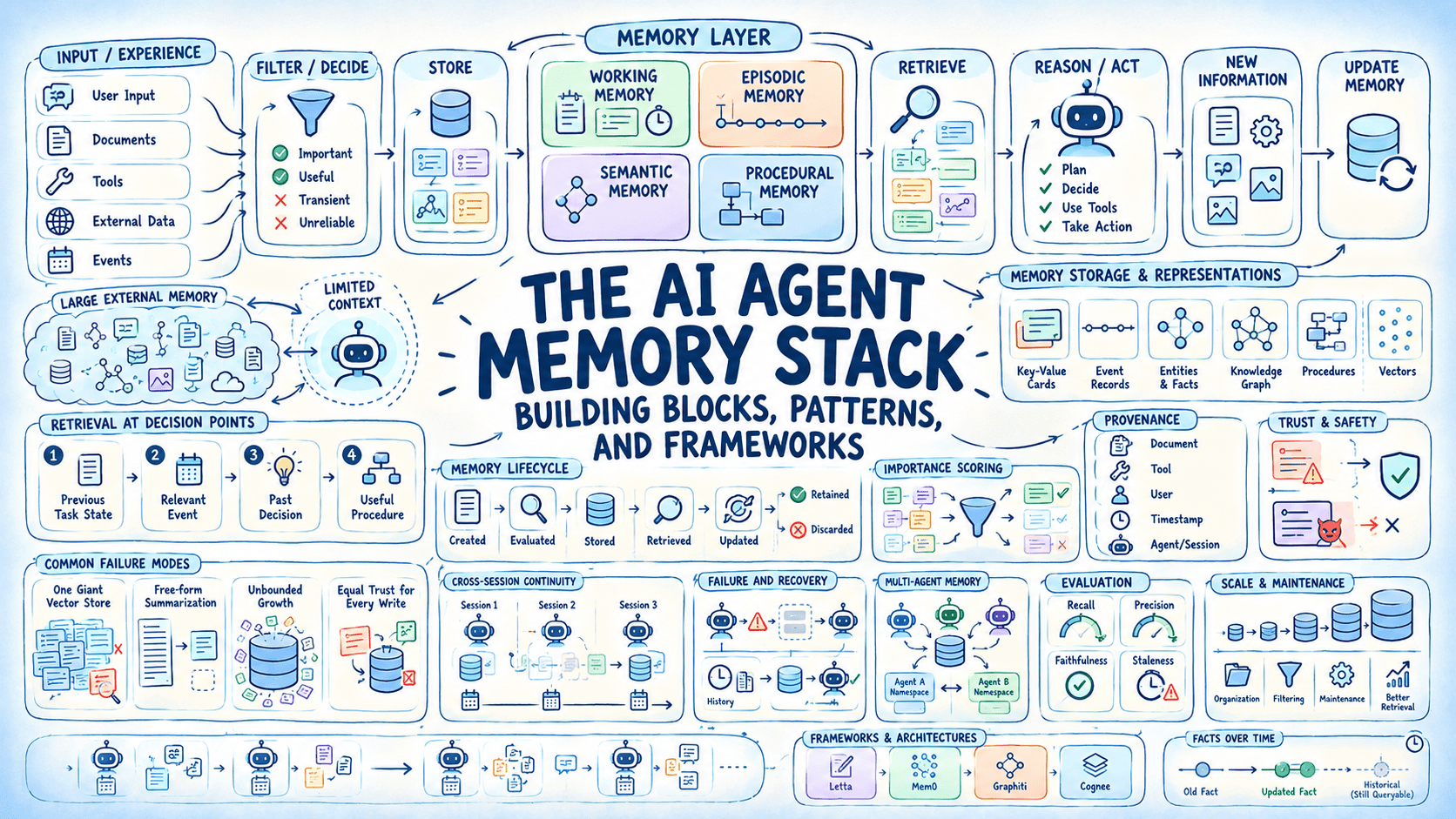
Before examining how architectural frameworks operationalize these concepts, it is essential to deconstruct the fundamental building blocks of the agent memory stack.
Why Agents Fail Without Persistent Memory
In complex enterprise environments, an AI agent rarely operates in a single execution step. Consider a financial auditing agent or a multi-day scientific research assistant. Without memory, these systems suffer from several critical vulnerabilities:
- Redundant Computation: Repeating tasks or re-fetching data because the agent cannot recall it generated those results an hour prior.
- Preference Amnesia: Forgetting user-specific constraints, formatting rules, or risk tolerances across distinct sessions.
- Error Recurrence: Falling into recurring loops of failed tool calls because the system possesses no episodic record of prior failures and dead ends.
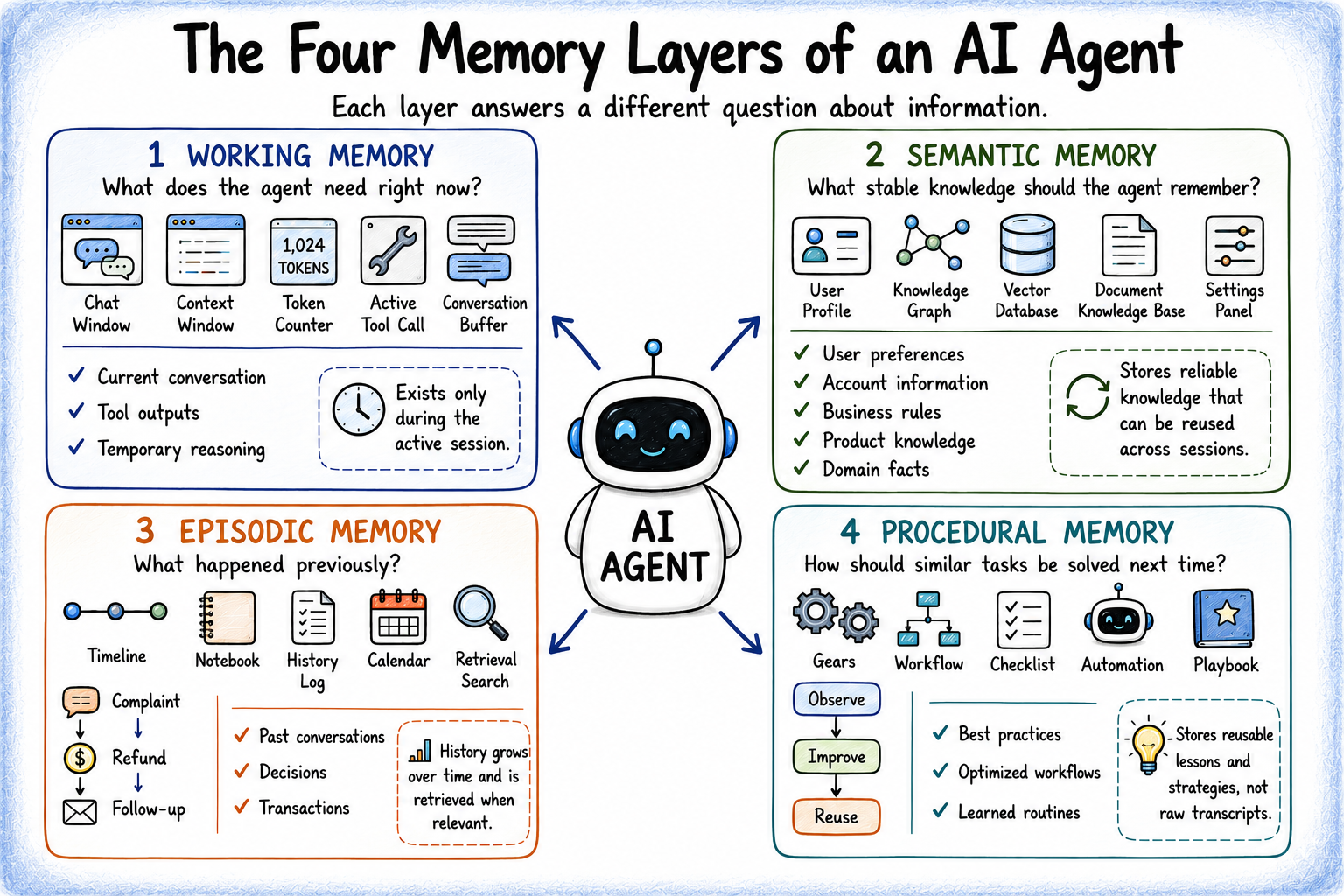
The Four Pillars of Agent Memory
Agent memory is categorized into four distinct types, each governed by unique storage models and retrieval strategies:
| Memory Type | What It Holds | Storage Layer | Retrieval Method |
|---|---|---|---|
| Working | Active task state, intermediate scratchpad values, immediate variables | In-memory RAM or short-lived key-value store (e.g., Redis) | Direct lookup by unique key |
| Episodic | Chronological record of past interactions, task runs, and historical decisions | Time-ordered event log or vector store | Semantic similarity search combined with temporal filtering |
| Semantic | Objective truths, entity facts, and user preferences that update over time | Key-value stores or structured entity tables | Exact attribute lookup, hybridized with vector similarity |
| Procedural | Operational playbooks, successful action patterns, and known failure modes | Prompt templates, system instructions, or fine-tuned weights | Pattern matching or direct structural injection |
A Practical Scenario: The Multi-Step Research Assistant
To visualize how these layers interact, consider a research agent tasked with gathering data, extracting claims, and drafting reports over a three-day period.
Upon initializing a step, the agent queries its working memory to check active variables. If it uncovers a complex historical trend, it queries episodic memory to review how similar datasets were handled in past runs. Critical entity definitions (e.g., company balance sheets, regulatory definitions) are pulled from semantic memory.
Throughout the process, if a specific tool call fails, the failure mode is logged into procedural or episodic memory with an associated penalty score. If the agent crashes halfway through its workflow, the ephemeral working state is safely discarded, but the episodic record of completed milestones remains intact. Upon reboot, the agent resumes execution seamlessly without starting from scratch.
Official Statements and Industry Insights
As memory engineering moves to the forefront of AI systems development, industry leaders and researchers have increasingly emphasized its critical role in production deployments.
Dr. Harrison Chase, creator of LangChain, highlighted the paradigm shift in agent design during a recent technical briefing:
"We have moved past the era where treating an LLM as a stateless function call is sufficient. Autonomous agents require structured, stateful environments. If an agent cannot reliably remember what it did yesterday, update its internal worldview when facts change, and discard noise before it pollutes the context window, it will never transition from a clever demo to a reliable enterprise worker."
Echoing the necessity of structured memory layers over flat vector approaches, enterprise data architects note that naive RAG implementations are rapidly reaching their limits. According to engineering publications from MongoDB:
"Multi-agent systems require rigorous memory engineering because information contention and context degradation multiply exponentially as more agents join a workflow. Without graph-based relationship tracking and strict trust validation, agents quickly succumb to memory poisoning—where hallucinated or adversarial inputs are stored as ground truth and propagated across the entire agent swarm."
Framework Architectures and Comparative Analysis
To implement these memory paradigms in production, developers rely on specialized architectural frameworks. Each framework makes distinct engineering tradeoffs regarding storage models, retrieval patterns, and how it handles fact mutation over time.
1. Letta (Formerly MemGPT)
Letta approaches agent memory by treating the LLM as an operating system. It introduces the concept of "self-editing memory blocks."
- Memory Model: Structured text blocks residing within the agent’s control space that the model can directly read, append to, and rewrite via tool calls.
- Handling Fact Changes: The LLM itself identifies logical contradictions within its stored blocks and dynamically executes updates to keep its internal state accurate.
2. Mem0
Mem0 focuses on optimized vector-based memory with intelligent entity extraction layers.
- Memory Model: Hybrid vector store coupled with entity-aware extraction pipelines that isolate user-specific and system-wide attributes.
- Handling Fact Changes: New memories are continuously injected, reconciled, and retrieved alongside existing historical entries using a scoring mechanism that prioritizes recency and relevance.
3. Graphiti
Graphiti is engineered for temporal-spatial reasoning, leveraging graph databases to map complex relationships.
- Memory Model: Bi-temporal knowledge graphs featuring strictly typed relationships between entities, preserving both valid-time and transaction-time dimensions.
- Handling Fact Changes: Instead of overwriting old data, Graphiti invalidates older relationship edges while keeping historical states fully queryable for auditing and retrospective analysis.
4. Cognee
Cognee bridges unstructured data and structured retrieval by constructing multi-layered representations.
- Memory Model: Extraction pipeline that simultaneously constructs graph, vector, and relational database layers from raw source inputs.
- Handling Fact Changes: Rebuilds memory representations systematically, utilizing temporal modes to track how structural relationships evolve across different operational epochs.
Design Strategies: What Works vs. What Fails
| Design Approach | Operational Risk / Why It Fails |
|---|---|
| Embedding Everything into One Flat Vector Store | Retrieves items that are semantically similar but logically irrelevant; flattens relational data and obscures critical entity connections. |
| Free-Form Summarization for Compression | Strips away specific numbers, numerical constraints, and edge-case details; risks codifying hallucinated summaries as verified facts. |
| Unbounded Memory Growth | Causes irrelevant historical entries to compete with active task data, driving up API token costs and degrading retrieval accuracy. |
| Uncritically Trusting Every Write | Introduces vulnerability to memory poisoning, where malicious, contradictory, or erroneous inputs are saved and treated as immutable truth. |
Future Outlook: The Next Frontier of Agent Memory
As we look toward the horizon of autonomous artificial intelligence, the engineering of agent memory will continue to evolve rapidly. Several critical trends are poised to define the next generation of memory-aware systems:
- Bi-Temporal Knowledge Graphs as Standard: The industry is rapidly moving away from flat vector stores toward bi-temporal graphs (such as Graphiti and Cognee integrations). As agents take on high-stakes enterprise tasks in finance, legal, and healthcare, the ability to query what the agent knew at a specific exact timestamp—and why it made a decision based on the state of its knowledge graph at that moment—will become a strict regulatory requirement.
- Autonomous Memory Garbage Collection: Future frameworks will implement sophisticated, background-running reinforcement learning agents whose sole job is to prune, consolidate, and verify memory stores. These background janitor agents will evaluate the utility score of stored episodic and semantic items, purging noise before it degrades system performance.
- Federated Multi-Agent Memory Fabrics: As enterprise deployments scale from single agents to multi-agent swarms, decentralized memory synchronization will become paramount. Systems will require cryptographic or cryptographic-like provenance tracking to ensure that agent-to-agent memory sharing does not introduce systemic bias, loops, or malicious data injection.
- Hardware-Accelerated Memory Retrieval: As vector and graph memory stores scale to tens of millions of nodes per enterprise deployment, database-level optimizations and specialized memory hardware will integrate directly with agent runtimes to deliver sub-millisecond retrieval latencies.
Ultimately, mastering agent memory engineering is the definitive bridge between experimental AI prototypes and resilient, autonomous enterprise workers. By abandoning the illusion of stateless design and embracing structured, multi-layered, and bi-temporal memory architectures, developers can build AI systems that do not just process data, but genuinely learn, adapt, and remember over time.