Executive Overview
The agentic AI space has undergone a monumental maturation phase. What was characterized as fragile, experimental scaffolding in 2023 has rapidly evolved into a robust, crowded ecosystem of serious orchestration frameworks. These platforms come equipped with strong opinions on how artificial intelligence agents should think, coordinate, and recover from failures. For software architects and engineering leaders tasked with designing production systems, this is no longer about tinkering with toy projects. Instead, it is a critical architectural decision that will shape enterprise capabilities for years to come.
Yet, a pervasive challenge plagues modern technical evaluations: most framework comparisons measure the wrong metrics. GitHub stars, leaderboard benchmark scores, and superficial "time-to-hello-world" rankings offer almost zero insight into how a framework will behave when a production workflow hits an obscure edge case at 2:00 AM on a Sunday. A framework designed for open-ended collaborative research will quickly collapse under the strict regulatory demands of a compliance pipeline. Conversely, a framework optimized for deterministic, state-machine branching will feel like bureaucratic overhead for a lightweight conversational assistant.
To cut through the noise, this guide introduces a structured decision-tree approach. By systematically analyzing your workload’s actual requirements against architectural trade-offs, engineering teams can bypass marketing hype and select the precise orchestration framework tailored to their production environment.
Detailed Chronology: The Evolution of Agentic Orchestration
To understand why the agentic AI landscape looks the way it does today, it helps to examine the rapid evolutionary timeline that brought us to this point.
Phase 1: The Monolithic Prompt Era (2022–Early 2023)
In the early days of large language models, application architecture was deceptively simple. Developers relied on single-turn completions or basic prompt chains. Systems like LangChain’s early abstractions provided convenience wrappers, but agents were essentially glorified prompt loops. If a model failed to generate the correct tool call, the entire application typically crashed or hallucinated wildly, lacking any native mechanism for self-correction, state recovery, or dynamic task delegation.
Phase 2: The Emergence of Autonomous Scaffolding (Mid 2023–2024)
As models grew more capable—sparked by the release of advanced reasoning models and function-calling capabilities—developers began experimenting with multi-agent paradigms. Early projects like AutoGen and initial iterations of crew-based frameworks proved that splitting labor across specialized personas could dramatically improve task outcomes. However, these early systems were notoriously brittle. They lacked production-grade durability, making it nearly impossible to pause a workflow, inject human approvals, or inspect intermediate states without rewriting core application logic.
Phase 3: The Production and Standardization Wave (2025–2026)
By 2026, the industry recognized that multi-agent systems are fundamentally distributed systems. Consequently, framework design shifted dramatically toward reliability, state management, and type safety. Projects like LangGraph introduced graph-based state machines to handle long-running, durable workflows. Concurrently, lightweight, developer-centric libraries like PydanticAI and the OpenAI Agents SDK emerged to bridge the gap between strict software engineering practices and LLM orchestration. Today, developers can choose from specialized tools engineered specifically for state machines, virtual org charts, conversational debaters, or type-safe pythonic pipelines.
Supporting Context & Metrics: When Do You Actually Need Multi-Agent Systems?
Before diving into framework selection, engineering teams must ask a foundational, sobering question: Does your task actually require multiple agents?
The single most common architectural mistake developers make is introducing orchestration complexity before it is warranted. A single agent equipped with well-defined tools and a precise system prompt can handle an astonishingly wide range of production tasks. Single-agent systems are exponentially easier to debug, monitor, and reason about than their multi-agent counterparts.
Triggers for Multi-Agent Complexity
You should only reach for a multi-agent framework when a single agent hits an unyielding systemic limitation. The most common enterprise triggers include:
- Context Window Saturation: The task requires gathering and synthesizing vast amounts of information that would overflow a single agent’s context window or degrade its attention span.
- Specialized Toolsets & Personas: Different phases of the workflow require contradictory prompt configurations, security permissions, or specialized tool access (e.g., a secure database query tool versus an open-web scraping tool).
- Adversarial Validation: Quality assurance demands an explicit separation of concerns, such as a generator agent creating code and a completely separate reviewer agent aggressively auditing it for security flaws.
- Asynchronous Parallelism: Workloads must be executed concurrently across multiple domains before being synthesized into a final deliverable.
If none of these triggers apply, build a single-agent system first. Add orchestration layers later only when concrete performance bottlenecks demand it.
The Decision Tree: Narrowing the Orchestration Field
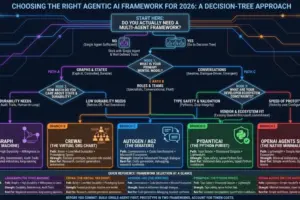
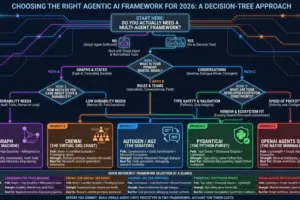
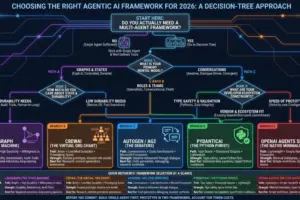
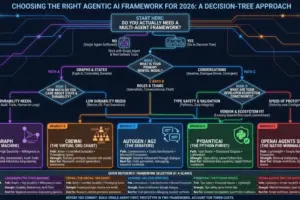
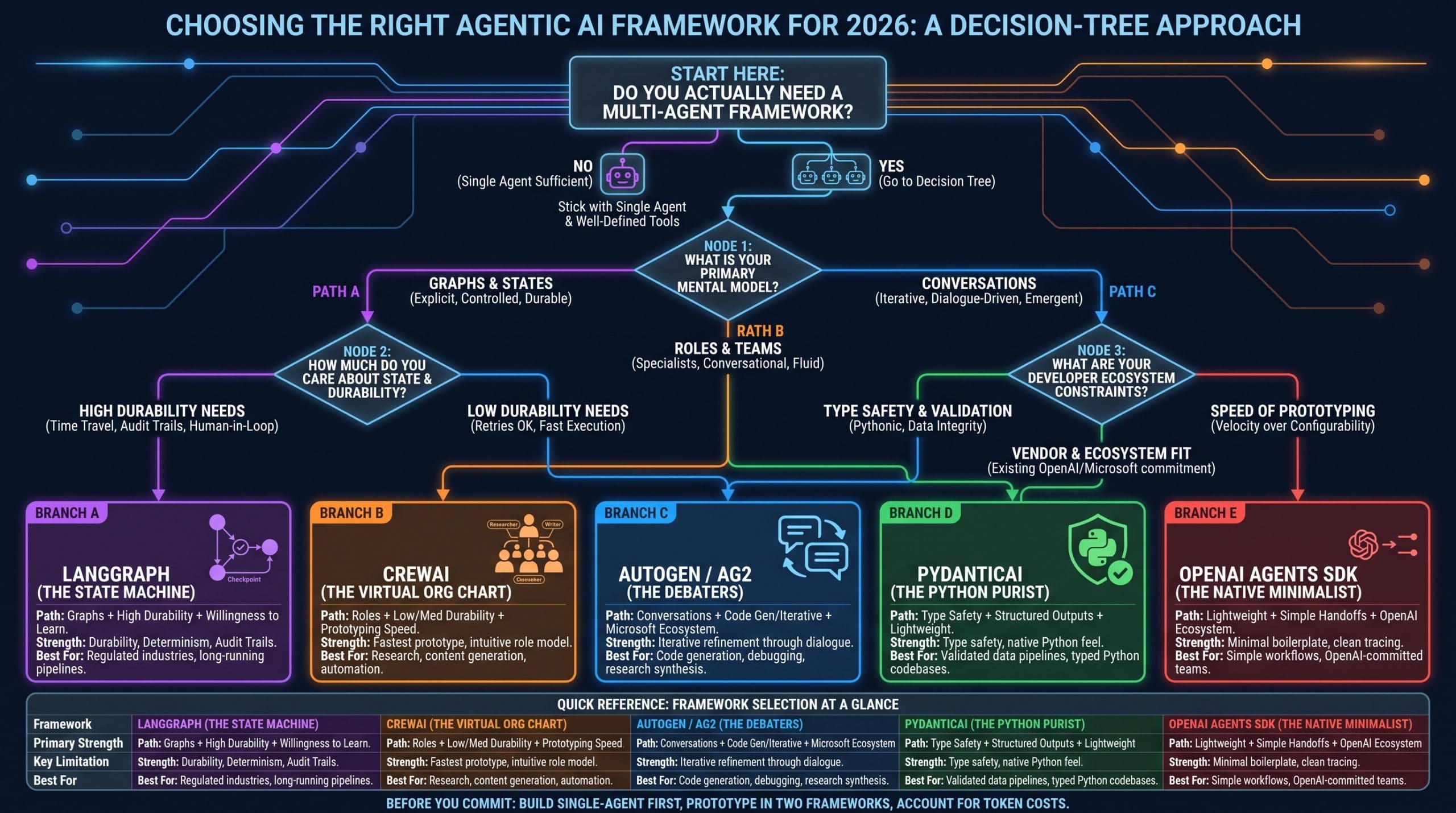
If your workload genuinely demands multi-agent coordination, navigate the following three decision nodes to determine your optimal framework path.
Node 1: What Is Your Primary Mental Model?
How do you and your team naturally conceptualize the workflow?
- Option A: Graphs and States. Your workflow has explicit steps, rigid transitions, and strict failure-handling requirements. You need to know precisely what happens when a step fails, requires a retry, or halts for human-in-the-loop approval.
- Option B: Roles and Teams. Your workflow mirrors a human organization—specialized contributors like researchers, writers, and editors handing off tasks sequentially. Coordination is fluid and conversational.
- Option C: Iterative Conversations. Your workflow relies on dialogue-driven refinement, where agents debate, critique, and revise outputs until a quality threshold is met.
Node 2: How Much Do You Care About State and Durability?
- High Durability Needs: Workflows run for minutes or hours. You must be able to pause execution, inspect intermediate states, roll back errors, collect audit trails for regulatory compliance, and execute human sign-offs. Essential for finance, healthcare, and legal domains.
- Low Durability Needs: Workflows execute in seconds or minutes. If a failure occurs, restarting the entire pipeline from scratch is computationally and financially trivial.
Node 3: What Are Your Developer Ecosystem Constraints?
- Strict Type Safety: Your team writes heavily typed Python, and data integrity at function boundaries is non-negotiable.
- Vendor Ecosystem Alignment: Your infrastructure is deeply embedded in platforms like Microsoft Azure or OpenAI, where native integrations outweigh framework neutrality.
- Prototyping Velocity: You need to transition from a conceptual whiteboard sketch to a functional prototype in hours, making speed more valuable than granular configuration.
The Five Framework Branches
                    [ Do You Need Multi-Agent? ]
                                 │
                        Yes ─────┴───── No ──> [ Build Single Agent ]
                                 │
                   [ What is Your Mental Model? ]
            ┌────────────────────┼────────────────────┐
     [ Graphs & States ]  [ Roles & Teams ]  [ Conversations ]
            │                    │                    │
      (High Durability)   (Fast Prototype)     (Iterative Dialogue)
            │                    │                    │
            ▼                    ▼                    ▼
       [ LangGraph ]         [ CrewAI ]         [ AutoGen / AG2 ]
            │
            ├─────── [ Python / Type Safety? ] ────> [ PydanticAI ]
            │
            └─────── [ OpenAI Native Stack? ] ─────> [ OpenAI Agents SDK ]
Branch A: LangGraph (The State Machine)
- Path: Graph-based mental model + High durability needs + Willingness to invest in a learning curve.
- Overview: Developed as part of the LangChain ecosystem, LangGraph models workflows as explicit directed graphs. Nodes represent functional tasks, edges represent transitions, and state is maintained via a typed dictionary that can be persisted at any checkpoint.
- Key Advantages: Supports "time travel"—the ability to pause execution mid-stream, inspect state at any node, modify parameters, and resume. Human-in-the-loop approval gates and immutable audit trails are first-class citizens. It is the premier choice for regulated sectors like banking compliance, medical diagnostics, and legal automation.
- Trade-offs: LangGraph demands verbosity. Defining state schemas, wiring edges, and configuring checkpointers requires substantial boilerplate. Initial setup takes significantly longer than opinionated competitors.
Branch B: CrewAI (The Virtual Org Chart)
- Path: Role-based mental model + Low-to-medium durability needs + Prioritizing prototyping speed.
- Overview: CrewAI structures multi-agent collaboration around the organizational metaphor of a team. Developers define agents with distinct roles, backstories, and goals, assign tasks, and let a coordinated crew tackle the objective.
- Key Advantages: Exceptional developer ergonomics. The conceptual model maps intuitively to human knowledge work, allowing teams to spin up working multi-agent prototypes in under two hours.
- Trade-offs: The metaphor introduces control limitations. Because coordination relies on natural language task handoffs rather than rigid graph state transitions, constraining a misbehaving or looping agent is challenging. It is unsuited for enterprise workflows requiring strict determinism.
Branch C: AutoGen / AG2 (The Debaters)
- Path: Conversational mental model + Code generation or iterative refinement workflows + Microsoft ecosystem alignment.
- Overview: AutoGen (formalized under governance as AG2) is built on conversational multi-agent dynamics. Agents converse in natural language to converge on solutions—such as a coding agent generating a script, an execution agent testing it, and a critique agent suggesting patches in an infinite refinement loop.
- Key Advantages: Unmatched capability in iterative code generation, debugging, and research synthesis. It boasts deep integration with enterprise infrastructure, particularly Microsoft Azure OpenAI services.
- Trade-offs: Conversational drift can introduce unpredictability. Managing termination conditions and avoiding circular dialogues requires meticulous system prompt engineering and guardrail design.
Branch D: PydanticAI (The Python Purist)
- Path: Lightweight tool execution + Strict type safety and validation + Structured data outputs.
- Overview: PydanticAI takes a minimalist stance, bringing FastAPI-style developer experiences to AI agents. Developers define agents with typed inputs and outputs, declare tools using Pydantic models, and let built-in validation layers enforce data integrity.
- Key Advantages: For Python-heavy engineering teams, PydanticAI feels entirely native. There are no heavy graph abstractions to learn or opaque multi-agent metaphors to navigate.
- Trade-offs: PydanticAI is intentionally un-opinionated regarding long-form orchestration and state persistence. Teams requiring complex, durable multi-agent orchestration must supply their own underlying infrastructure.
Branch E: OpenAI Agents SDK (The Native Minimalist)
- Path: Lightweight tool execution + Simple handoffs + Heavy commitment to the OpenAI ecosystem.
- Overview: The OpenAI Agents SDK provides an ultra-clean, minimal-boilerplate path to deploying agentic workflows when exclusively utilizing OpenAI APIs. Built-in tracing offers immediate observability without complex configuration overhead.
- Key Advantages: Unbeatable speed-to-production for straightforward, linear multi-agent handoffs within the OpenAI developer ecosystem.
- Trade-offs: Strict vendor lock-in. Migrating away from OpenAI models or building provider-agnostic architectures requires fighting the framework. Furthermore, it is not engineered for complex branching or stateful checkpointing.
Quick Reference: Framework Selection at a Glance
| Framework | Primary Strength | Key Limitation | Ideal Production Use Case |
|---|---|---|---|
| LangGraph | Durability, determinism, audit trails | Steep learning curve, verbose setup | Regulated industries, long-running processes |
| CrewAI | Rapid prototyping, intuitive role metaphor | Harder to constrain misbehaving agents | Research pipelines, content generation, automation |
| AutoGen / AG2 | Iterative refinement via dialogue | Conversational drift in rigid pipelines | Code generation, data analysis, Microsoft stacks |
| PydanticAI | Type safety, native Python feel | Not a full orchestration framework | Validated data pipelines, typed enterprise codebases |
| OpenAI Agents SDK | Minimal boilerplate, clean tracing | Vendor lock-in, limited orchestration complexity | Simple workflows within the OpenAI ecosystem |
Official Statements and Industry Consensus
Industry leaders and principal architects increasingly emphasize operational resilience over raw capability when selecting agentic frameworks. In recent engineering roundtables, enterprise AI leads have stressed that "an agentic system is only as good as its failure recovery mechanisms."
According to systems architects at major financial institutions, regulatory compliance demands that every autonomous decision be traceable, deterministic, and reversible. Frameworks that treat state as an afterthought are increasingly dismissed in favor of architectures that prioritize state serialization and deterministic graph routing. Conversely, startup engineering leads consistently highlight developer velocity, noting that early-stage products benefit immensely from declarative role frameworks where time-to-market outweighs granular auditability.
Future Outlook
As we look toward the remainder of 2026 and beyond, the agentic AI landscape will continue to consolidate. Several key trends are projected to shape the next generation of orchestration tools:
- Standardized Inter-Agent Protocols: As different frameworks mature, the industry is moving toward standardized communication protocols, allowing agents built in LangGraph to seamlessly hand off tasks to agents running in PydanticAI or proprietary enterprise runners.
- Deterministic-Probabilistic Hybridization: Future frameworks will increasingly bridge the gap between hardcoded software logic (deterministic state machines) and probabilistic reasoning (LLM decision-making), minimizing hallucinations in critical operational environments.
- Native Observability and Cost Governance: With multi-agent token consumption scaling non-linearly, upcoming frameworks will bake real-time cost throttling, token budgeting, and automated circuit breakers directly into the orchestration core.
Final Recommendations Before You Commit
- Build Single-Agent First: Validate your core business logic with a single agent before introducing multi-agent coordination overhead.
- Prototype in Dual Frameworks: If your requirements sit on the border of two framework branches, spend a day prototyping the identical workflow in both to expose hidden edge cases.
- Account for Token Multipliers: Multi-agent architectures multiply token consumption exponentially. Factor parallel execution costs into your financial models before committing to a sprawling agent crew.
Ultimately, the right framework is not the one with the most GitHub stars or the flashiest marketing; it is the tool that makes your specific failure modes easiest to prevent, monitor, and recover from. Define your constraints first, and let your architectural requirements dictate the path.