Executive Overview
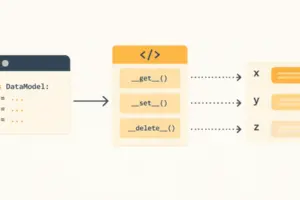
In the realm of advanced Python programming, mastering object-oriented design patterns is what separates the novice scripter from the seasoned software architect. Among Python’s most potent yet underutilized mechanisms is the descriptor protocol. Descriptors form the foundational low-level engine that governs how object attributes are accessed, assigned, and deleted. By implementing special methods such as __get__, __set__, __delete__, and __set_name__, developers can intercept attribute operations at the class level and inject custom logic, encapsulation, and state management without cluttering client code with repetitive boilerplate.
To demonstrate the transformative power of descriptors, this deep-dive tutorial explores a simulated real-world application: a data-tracking backend for a fictional high-end Japan tourism platform. Rather than relying on repetitive @property decorators, manual getters, and verbose setters, we will harness descriptors to construct three essential patterns of controlled attributes:
- Validated Attributes: Enforcing strict type and range constraints on input data.
- Computed Attributes: Dynamically deriving values (such as real-time currency conversions) on the fly.
- Lazily Loaded Attributes: Deferring expensive operations—like database queries or API calls—until the data is explicitly requested, caching the result thereafter.
By the conclusion of this guide, you will possess a comprehensive, production-ready understanding of how descriptors operate under the hood, empowering you to write cleaner, safer, and highly reusable Python codebases.
Detailed Chronology and Conceptual Evolution
To fully appreciate why descriptors are vital to modern Python architecture, we must examine their evolution within the language. In early versions of Python, attribute access was relatively opaque. The introduction of new-style classes in Python 2.2 formalized the descriptor protocol, unifying how functions, staticmethods, classmethods, and properties work.
The descriptor protocol relies on the concept of binding. When an attribute is looked up on an object, Python checks the object’s class dictionary (__dict__). If the value found is an object that implements any of the descriptor methods (__get__, __set__, or __delete__), Python invokes that method, overriding the default dictionary lookup.
The Protocol Breakdown
__get__(self, obj, objtype=None): Controls attribute retrieval. It receives the descriptor instance (self), the instance the attribute is accessed upon (obj), and the owner class (objtype). If accessed directly from the class rather than an instance,objisNone.__set__(self, obj, value): Intercepts attribute assignment. This distinguishes "non-data descriptors" (which only implement__get__) from "data descriptors" (which implement__set__or__delete__). Data descriptors take precedence over an instance’s__dict__entries during lookups.__delete__(self, obj): Governs attribute deletion, allowing developers to clean up resources or prevent unauthorized deletions.__set_name__(self, owner, name): Introduced in Python 3.6, this method automatically informs the descriptor of its assigned variable name within the owner class (e.g.,'rating'), eliminating the need to manually pass string names during instantiation and preventing name collisions through private name-mangling conventions.
Supporting Context & Architecture: The Japan Tourism Engine
To ground these theoretical concepts in reality, we build a domain model for a bespoke travel service specializing in Japanese itineraries. Managing travel packages involves handling user ratings (which must fall within strict boundaries), pricing conversions between Japanese Yen (JPY) and United States Dollars (USD), and heavy database queries for multi-day itineraries across cities like Kyoto and Tokyo.
1. Building Validated Attributes through Descriptors
Data integrity is paramount in software engineering. Accepting malformed inputs—such as a negative tour rating or a string where a floating-point number is expected—can cascade into runtime exceptions down the line.
Using the ValidatedRating descriptor, we encapsulate validation logic cleanly. When a user assigns a rating to a tour package, the descriptor intercepts the assignment via __set__, checks the data type, ensures it falls within acceptable boundaries (e.g., 1.0 to 5.0), and stores it safely in a private instance variable.
class ValidatedRating:
    def __init__(self, min_val=1.0, max_val=5.0):
        self.min_val = min_val
        self.max_val = max_val

    def __set_name__(self, owner, name):
        # Automatically capture the attribute name (e.g., 'rating')
        self.public_name = name
        self.private_name = f"_name"

    def __get__(self, obj, objtype=None):
        if obj is None:
            return self
        return getattr(obj, self.private_name)

    def __set__(self, obj, value):
        if not isinstance(value, (int, float)):
            raise TypeError(f"self.public_name must be a number.")
        if not (self.min_val <= value <= self.max_val):
            raise ValueError(f"self.public_name must be between self.min_val and self.max_val.")
        setattr(obj, self.private_name, float(value))
2. Building Computed Attributes through Descriptors
In many enterprise applications, certain attributes should never be stored directly because they depend on fluctuating external states or other internal fields. Consider pricing: storing both JPY and USD values introduces synchronization bugs if a base price changes without updating the converted price.
A computed descriptor solves this by calculating values dynamically on read access while rejecting direct write attempts, effectively creating a clean, read-only property interface.
class ComputedUSDPrice:
    def __init__(self, exchange_rate=0.0067):  # 1 JPY = ~0.0067 USD
        self.exchange_rate = exchange_rate

    def __set_name__(self, owner, name):
        self.name = name

    def __get__(self, obj, objtype=None):
        if obj is None:
            return self
        # Fetch the base JPY price dynamically from the parent object
        jpy_price = getattr(obj, 'price_jpy', 0)
        return round(jpy_price * self.exchange_rate, 2)

    def __set__(self, obj, value):
        raise AttributeError(f"self.name is a computed read-only attribute.")
3. Building Lazily Loaded Attributes through Descriptors
Performance optimization is critical when dealing with expensive I/O operations, such as parsing massive JSON configurations, executing heavy SQL queries, or fetching live Shinkansen (bullet train) schedule timetables.
A lazily loaded descriptor delays execution until the attribute is explicitly referenced for the first time. Upon initial access, it performs the heavy operation, caches the result directly inside the instance’s __dict__ under the attribute’s name, and returns the payload. Subsequent accesses completely bypass the descriptor logic because Python checks the instance dictionary first for data descriptors.
import time

class LazyItinerary:
    def __set_name__(self, owner, name):
        self.name = name

    def __get__(self, obj, objtype=None):
        if obj is None:
            return self

        print(f"[System] Simulating expensive database query for obj.destination itinerary...")
        time.sleep(1)  # Simulate network/database latency

        # Generate the heavy payload
        itinerary = (
            f"Day 1: Arrival in obj.destination, check-in.n"
            f"Day 2: Guided temple tour and local street food tasting.n"
            f"Day 3: Shinkansen departure."
        )

        # Cache it directly on the object's dictionary.
        # Next time obj.itinerary is called, Python finds it here instantly!
        obj.__dict__[self.name] = itinerary
        return itinerary
Putting It All Together: Implementation and Execution
With our three specialized descriptors fully defined, we can now assemble them into our core domain class, JapanTour. Each descriptor acts as a declarative guardian for its respective attribute at the class level.
class JapanTour:
    # Attach our descriptors at the class level
    rating = ValidatedRating(min_val=1.0, max_val=5.0)
    price_usd = ComputedUSDPrice()
    itinerary = LazyItinerary()

    def __init__(self, destination, price_jpy, rating):
        self.destination = destination
        self.price_jpy = price_jpy
        self.rating = rating  # This triggers ValidatedRating.__set__
When we instantiate a JapanTour object, the descriptor protocol immediately secures data integrity during initialization. Let’s run a comprehensive test script to observe validation, computation, and lazy loading in action:
# 1. Initializing the tour (Triggers rating validation)
tour = JapanTour(destination="Kyoto", price_jpy=45000, rating=4.8)

# 2. Testing the Validator
print(f"Destination: tour.destination")
print(f"Initial Rating: tour.rating")

try:
    tour.rating = 6.0
except ValueError as e:
    print(f"Validation caught error: e")
Execution Output:
Destination: Kyoto
Initial Rating: 4.8
Validation caught error: rating must be between 1.0 and 5.0.
Next, we evaluate our computed pricing descriptor alongside our lazy itinerary loader:
# 3. Testing the Computed Property
print(f"Price (JPY): ¥tour.price_jpy")
print(f"Price (USD): $tour.price_usd")

# 4. Testing the Lazy Loader
print("n--- Requesting Itinerary (First Time) ---")
print(tour.itinerary)

print("n--- Requesting Itinerary (Second Time) ---")
print(tour.itinerary)
Execution Output:
Price (JPY): ¥45000
Price (USD): $301.5

--- Requesting Itinerary (First Time) ---
[System] Simulating expensive database query for Kyoto itinerary...
Day 1: Arrival in Kyoto, check-in.
Day 2: Guided temple tour and local street food tasting.
Day 3: Shinkansen departure.

--- Requesting Itinerary (Second Time) ---
Day 1: Arrival in Kyoto, check-in.
Day 2: Guided temple tour and local street food tasting.
Day 3: Shinkansen departure.
As demonstrated in the output log, the system log message only appears during the initial request for tour.itinerary. On the subsequent call, Python retrieves the cached value directly from the instance’s dictionary, bypassing the descriptor entirely and ensuring optimal runtime performance.
Future Outlook
The descriptor protocol represents one of Python’s most elegant abstractions, bridging the gap between simple property access and complex metaprogramming. While libraries such as Django, Pydantic, and SQLAlchemy rely heavily on descriptors under the hood to manage database models, schema validations, and field mappings, developers can leverage these same techniques in everyday domain modeling.
As Python continues to evolve, patterns emphasizing declarative programming, immutability, and runtime safety will remain central to robust software architecture. By mastering descriptors, developers gain unprecedented control over object lifecycles, enabling the creation of scalable, self-validating, and high-performance applications that stand the test of time.