Executive Overview
For nearly a decade, the architecture of generative language models has been defined by a singular paradigm: autoregressive, token-by-token prediction. From the early iterations of OpenAI’s GPT series to contemporary open-weights architectures, the mechanism of text generation has remained fundamentally sequential. A model reads a prefix, predicts the single most probable next token, appends it to the context window, and repeats the process until a termination token is reached. While extraordinarily powerful, this serial dependency introduces a massive computational bottleneck, particularly during long-form generation, where every token requires a fresh forward pass through billions of parameters.
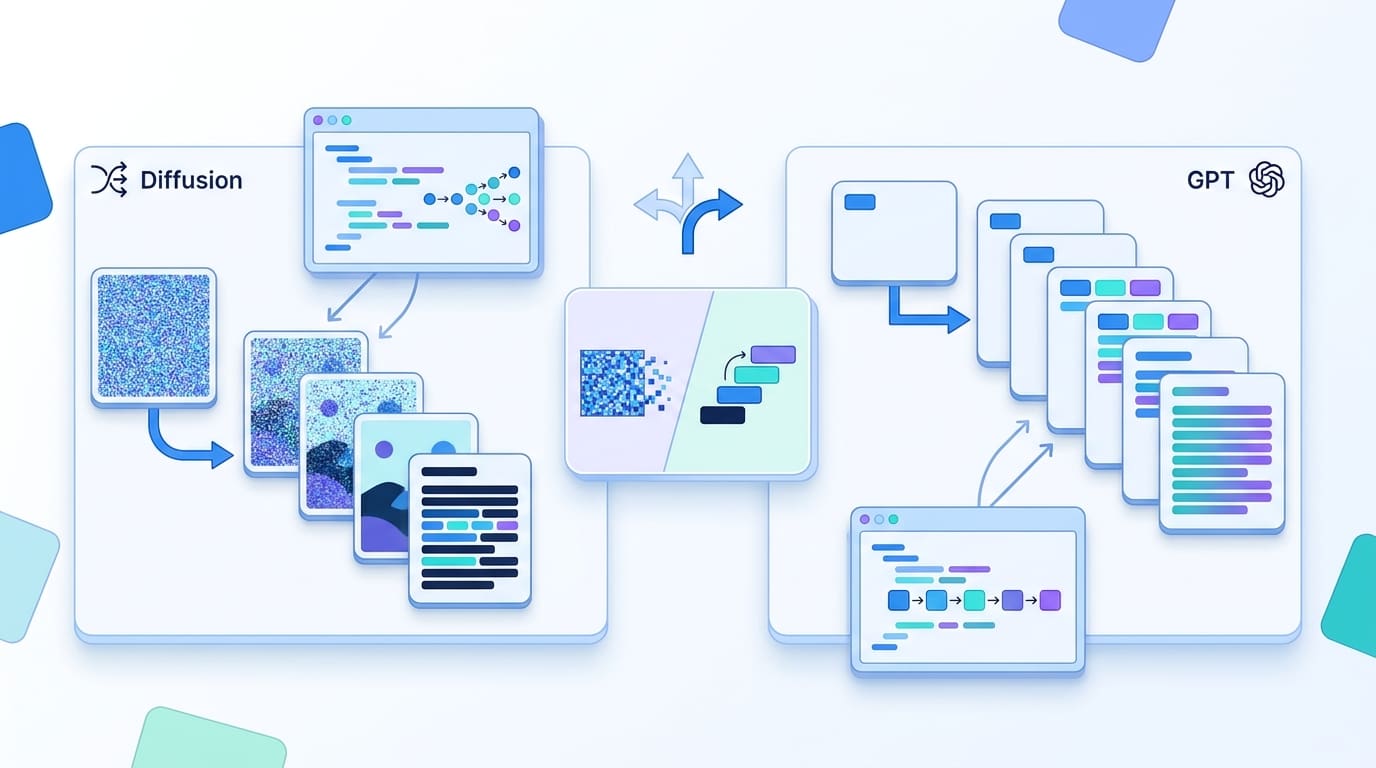
Enter diffusion language models—a paradigm shift imported from the domain of generative computer vision and reimagined for discrete text. Rather than building a sentence linearly from left to right, diffusion language models operate on a canvas of uncertainty. They begin with a fully or partially masked sequence and iteratively refine, unmask, and correct tokens across multiple positions simultaneously.
Driven by recent breakthroughs such as LLaDA, Mercury, Gemini Diffusion, and Google’s DiffusionGemma, the artificial intelligence research community is taking a hard look at a provocative question: Do language models even need to generate one token at a time? This article explores the mechanics of diffusion language models, contrasts them with traditional autoregressive systems, unpacks the mathematical and structural differences, and evaluates the major challenges facing this burgeoning paradigm.
Detailed Chronology and Technical Evolution
The journey of diffusion models from pixel-based graphics engines to linguistic architectures is one of the most fascinating trajectories in modern machine learning.
The Image Diffusion Foundation
Diffusion models are not inherently new. Their modern renaissance began with the landmark 2020 paper, Denoising Diffusion Probabilistic Models (DDPM), which demonstrated that generative models could surpass Generative Adversarial Networks (GANs) in image synthesis quality and training stability. Image diffusion operates by taking clean continuous data ( x_0 ), systematically corrupting it by adding Gaussian noise over multiple timesteps ( t ) until it resembles pure static, and then training a neural network to reverse the process step-by-step.
[Clean Image x₀] ---> [Add Noise (Forward Process)] ---> [Gaussian Noise x_t]
      ^                                                            |
      |------------------ [Denoising (Reverse Process)] <----------|
The Discrete Data Barrier
While continuous-valued pixels readily accept Gaussian noise, applying this exact mathematical formulation to natural language proved exceptionally difficult. Language is discrete; it is comprised of categorical token IDs from a vast vocabulary. Adding a fraction of standard Gaussian noise to a token ID like 4892 does not yield a "nearby" or related word; it produces nonsense.
For years, researchers struggled to bridge the gap between continuous diffusion spaces and discrete token distributions. Early attempts required complex embedding-space round-trips, often resulting in degraded text quality and catastrophic semantic drift.
The 2025–2026 Breakthrough
The paradigm shifted dramatically between 2025 and 2026 with a wave of architectural innovations that bypassed the continuous-space trap by utilizing masked diffusion. Instead of adding Gaussian noise to token embeddings, these models corrupt text by stochastically replacing tokens with a special [MASK] token.
- Early 2025: Models like LLaDA (Large Language Diffusion Models) and Mercury demonstrated that masked diffusion could scale effectively to competitive linguistic benchmarks.
- Mid-2025: DeepMind introduced Gemini Diffusion, signaling that major industry labs were aggressively exploring non-autoregressive decoding at scale.
- 2026: Google released DiffusionGemma, cementing the architecture’s transition from theoretical computer science curiosity to a practical, enterprise-grade frontier model category.
These developments have ignited a fierce debate across AI research labs, challenging the long-held dogma that autoregression is the only viable path to coherent, high-level natural language generation.
Autoregressive vs. Diffusion: Core Mechanics
To understand why diffusion language models are turning heads, we must dissect the fundamental differences in how autoregressive (GPT-style) and diffusion architectures process and generate information.
The Autoregressive Paradigm
Autoregressive models estimate the probability distribution of a sequence by factoring it into conditional probabilities. Given a discrete text sequence ( x = (x_1, dots, x_N) ), the joint probability is expressed as:
$$p(x) = prod_i=1^N p(x_i mid x1, dots, xi-1)$$
During training, autoregressive models utilize teacher forcing, processing all token positions in parallel across the sequence. However, during inference, the model is bound by strict causal dependencies. To generate token ( x_t ), the system must have already computed tokens ( x1 ) through ( xt-1 ). This serial bottleneck means generation time scales linearly with sequence length: generating a 1,000-token response requires 1,000 sequential forward passes.
The Masked Diffusion Paradigm
In contrast, a masked diffusion language model treats generation as an iterative refinement task. It initializes an output canvas filled with unknown placeholders and progressively unmasks and updates tokens over a series of refinement rounds. Rather than moving strictly from left to right, the model can populate multiple non-contiguous positions simultaneously.
| Round | Autoregressive Output (GPT-style) | Masked Diffusion Output |
|---|---|---|
| 1 | The | [MASK] [MASK] [MASK] [MASK] |
| 2 | The cat | The [MASK] sat [MASK] |
| 3 | The cat sat | The cat sat [MASK] |
| 4 | The cat sat down | The cat sat down |
While both architectures rely heavily on the Transformer backbone, their training objectives and inference-time execution loops are fundamentally opposed. Autoregressive models extend a sequence; diffusion models refine a sequence from noise to clarity.
How Diffusion Models Actually Work in Text
The inner workings of text diffusion can be broken down into three core phases: the forward noising process, the training objective, and the inference-time denoising sampler.
1. The Forward Process (Masking)
In image diffusion, the forward process is defined mathematically as:
$$x_t = sqrtbaralpha_t, x_0 + sqrt1-baralpha_t, epsilon$$
Where ( x_0 ) is the clean data, ( x_t ) is the corrupted state at noise level ( t ), and ( epsilon ) is Gaussian noise.
In text diffusion, the forward process is conceptualized as a corruption schedule governed by a masking probability. Given a clean text sentence:
"Machine learning models can generate text."
The forward process applies a noise level ( t in [0, 1] ), independently replacing tokens with [MASK] tokens based on ( t ). At ( t = 0 ), the sentence is fully pristine. At ( t = 1 ), every token is masked. A moderately corrupted intermediate state might look like this:
"Machine
[MASK]models[MASK]generate[MASK]."
2. Training the Denoiser
During training, the model is fed sequences corrupted at varying noise levels ( t ) (randomly sampled between 0 and 1). The model’s objective is to act as a universal denoiser: it evaluates the corrupted sequence and attempts to predict the original, uncorrupted tokens that belong in the masked positions. By training across all possible noise levels, the network learns the underlying syntactic, semantic, and structural grammar of the language, enabling it to reconstruct missing text from any degree of partial completion.
3. Inference and Sampling
At inference time, the generation pipeline operates via an iterative sampling algorithm:
- Initialization: The model begins with a sequence consisting entirely of
[MASK]tokens (or a prompt combined with trailing mask tokens). - Probability Estimation: The model evaluates the entire sequence in a single forward pass, outputting a vocabulary probability distribution for every unresolved position.
- Commitment & Revision: Using confidence-based metrics or temperature sampling, the model commits high-confidence predictions to the sequence while leaving ambiguous positions masked for subsequent rounds. Advanced samplers even allow for revision—remasking previously committed tokens if the evolving context demands structural correction.
- Termination: The loop repeats across a fixed or adaptive number of steps until all
[MASK]tokens are successfully resolved.
Supporting Context & Performance Metrics
While the theoretical elegance of non-autoregressive generation is compelling, practical adoption depends on empirical performance across throughput, latency, and sample quality.
Computational Efficiency and Speedups
The primary motivation behind exploring diffusion language models is inference acceleration. Because a diffusion model can resolve multiple tokens per forward pass, the total number of sequential network calls can be decoupled from the token length of the output.
- Sub-linear Scaling: While a 512-token response in an autoregressive model requires 512 sequential passes, a diffusion model utilizing a well-optimized multi-step sampler can generate the same sequence in a fraction of the steps (e.g., 10 to 30 refinement rounds).
- Parallel Speculation: Diffusion models naturally support parallelized block generation, making them exceptionally attractive for speculative decoding frameworks and edge-device hardware constrained by memory bandwidth.
Quality Trade-offs
Despite their speed advantages, early-generation text diffusion models historically suffered from semantic incoherence, local repetition loops, and formatting fragility. However, open-weights releases like LLaDA and Google’s DiffusionGemma have closed the performance gap significantly, achieving competitive scores on standard benchmarks (such as MMLU and GSM8K) while retaining non-autoregressive generation capabilities.
Official Statements and Industry Perspectives
The emergence of diffusion language models has sparked a lively discourse within the artificial intelligence research community regarding the future of foundational model design.
Leading researchers at institutions exploring non-autoregressive architectures emphasize that the shift is fundamentally about compute allocation:
"Autoregressive models force an unnatural constraint onto generation—treating language strictly as a temporal stream. Diffusion teaches us that text generation can be treated as a global optimization problem, where the model constantly refines its global hypothesis of what a document should look like rather than myopically staring at the next word."
At the same time, industry veterans remain pragmatic about the engineering hurdles required to productionize non-autoregressive systems. Critics point out that autoregressive KV-caching is a heavily optimized, highly mature engineering stack across modern hardware accelerators like NVIDIA H100s and Blackwell chips. Transitioning enterprise infrastructure to support iterative multi-step diffusion samplers requires rewriting core inference engines (such as vLLM and TensorRT-LLM) to support dynamic unmasking loops rather than causal attention masks.
Future Outlook: Hybrid Architectures and the Road Ahead
Are diffusion language models destined to completely replace GPT-style autoregressive models? Most industry experts argue against a binary replacement narrative.
Instead, the future likely points toward hybrid architectures and specialized deployment pipelines. We may see systems where:
- Autoregressive models handle real-time conversational streaming and strict instruction-following where strict left-to-right control is paramount.
- Diffusion models power ultra-fast batch generation, creative writing, long-form document synthesis, and code completion tasks where global structural coherence can be solved concurrently.
As research into samplers, noise schedules, and discrete diffusion mathematics matures, the artificial intelligence landscape is broadening. The monopoly of token-by-token generation is officially being contested, opening a new chapter in how machines learn to speak, write, and reason.
References & Further Reading
- Denoising Diffusion Probabilistic Models (DDPM) — Ho et al., 2020. arXiv:2006.11239
- LLaDA: Large Language Diffusion Models — Research paper on scalable masked diffusion for text, 2025. arXiv:2502.09992
- Mercury: Non-Autoregressive Language Generation — Technical overview, 2025. arXiv:2506.17298
- Google DeepMind: Gemini Diffusion — Official model architecture notes. DeepMind Gemini Diffusion
- Google: DiffusionGemma — Open-weights diffusion model release, 2026. DiffusionGemma Documentation