Artificial
Executive Overview
The intersection of Hollywood storytelling and Silicon Valley innovation has yielded some of the most compelling cinematic examinations of the modern era. The latest entry into this high-stakes genre is Luca Guadagnino’s provocative new feature film, Artificial. Chronicling the meteoric rise of OpenAI, the film charts its evolution from an idealistic nonprofit research lab into a commercial powerhouse, complete with the dizzying corporate drama surrounding the brief firing and swift rehiring of co-founder and CEO Sam Altman.
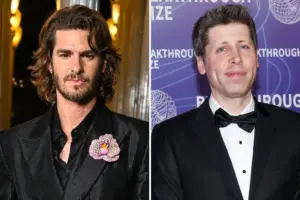
At the center of this cinematic exploration is Academy Award-nominated actor Andrew Garfield, who takes on the challenging role of Altman. While Garfield’s nuanced portrayal cuts deep, stripping away the polished public relations veneer to reveal a complex and controversial tech titan, the actor’s personal journey with the subject matter is far more labyrinthine.
Speaking recently at an exclusive AMPAS screening and Q&A session at the Academy Museum in Los Angeles, Garfield pulled back the curtain on his initial, profound fascination with Altman. Long before stepping into the shoes of the OpenAI chief, Garfield found himself captivated by Altman’s poise, apparent altruism, and seemingly unshakeable ethical commitments. Yet, as the real-world implications of artificial intelligence unfold on a global scale—and as the realities of tech hegemony come to light—Garfield’s perspective has evolved into a mixture of cautious introspection, artistic warfulness, and deep-seated existential concern.
This comprehensive report examines Garfield’s transformation, his candid reflections on Altman’s public persona, the strange real-world anomalies of filming Artificial outside Altman’s San Francisco home, and the broader societal stakes of art attempting to mirror the rapid, unregulated expansion of artificial intelligence.
Detailed Chronology: From Congressional Hearings to the Cinematic Lens
To understand Garfield’s performance in Artificial, one must trace the timeline of public perception that shaped both the actor’s initial fascination and Luca Guadagnino’s directorial vision.
The Illusion of Altruism
For Andrew Garfield, the pivot from casual observer to deeply invested admirer began in the public eye, specifically during high-stakes government oversight hearings.
"The first time I saw Sam, he was testifying in front of Congress and he was saying incredibly righteous stuff," Garfield recounted to the audience at the Academy Museum.
At the time, Altman presented himself not as a titan of industry guarding a corporate moat, but as an advocate for human welfare. He spoke candidly about transparency, acknowledged the existential risks of generative AI models, and casually dropped statements that disarmed critics.
“He was very, very casually saying, ‘No, I don’t have any equity in OpenAI. I’m just doing this because I love the technology and I’m passionate and I actually care about human beings,’” Garfield recalled.
For an artist looking for depth, complexity, and ideological conflict, this persona was magnetic. Garfield admitted that he saw in Altman elements of courage and modern heroism. He was particularly struck by Altman navigating hostile political environments:
"I thought it was also just incredibly courageous for an out gay tech genius to be sat in front of Republican congressmen who probably don’t believe in his right to exist. So all of these things were adding up for me, and I was in such deep admiration of him. I was like, ‘Oh, we need more of these.’"
The illusion deepened when Garfield learned that Altman practiced meditation under Jack Kornfield, a renowned Buddhist teacher. To the actor, this intersection of cutting-edge computing and spiritual grounding suggested a man whose priorities were aligned with universal good. “I was like, ‘This guy might be like my future best friend,’” Garfield confessed with a hint of self-deprecation. “He’s genuinely great and he seems to really have his values and priorities in the right place.”
The Reality Check and Artificial
As production on Artificial commenced under Guadagnino’s direction, the gulf between the public mythos of OpenAI’s leadership and the gritty, behind-closed-doors reality of corporate governance became apparent. The film focuses heavily on the institutional whiplash of OpenAI’s formative years—most notably the shocking November 2023 board coup that saw Altman ousted for a brief, chaotic weekend before being reinstated with a reorganized board.
Garfield stopped short of directly condemning Altman for the discrepancies between his early rhetoric and the aggressive commercialization that followed the launch of ChatGPT and subsequent multibillion-dollar partnerships (most notably with Microsoft).
“He convinced me that he was nothing but purely altruistic, which, I mean, it’s all playing out. I’m not gonna comment on those things,” Garfield noted carefully. “We all are seeing what’s happening and we can all have our own feelings and opinions of that.”

Supporting Context & Metrics: The Intersection of Art, Tech, and Reality
The making of Artificial was not just a standard Hollywood production; it was an exercise in navigating an active, rapidly shifting corporate landscape where the subjects of the film are active participants in contemporary culture. This created bizarre friction between the narrative being filmed and the real-world actions of the people inspiring it.
The San Francisco "Waving" Controversy
One of the most surreal anecdotes surrounding the production involves a reported interaction between the actor and the real-life executive. In a previous interview with GQ, Sam Altman claimed that during the filming of Artificial outside his San Francisco residence, he and Garfield exchanged waves.
When questioned about the anecdote, Garfield expressed total bewilderment, flatly denying that any such interaction occurred.
"No, I saw that interview and I replayed it a few times to try and discern what he was actually saying, because I was very confused by that. I never had any interaction with him," Garfield stated.
The actor painted a starkly different picture of that day on set:
"I’ve never seen him in real life. We were shooting outside of his house. It was an eerie day, for sure. We were told that he wasn’t home and his security people were there. I think I saw one security guard. But, no, I never saw Sam, so he maybe mistook someone else for me. I have no idea, but I’ve never waved at Sam. I’ve never seen him. I was curious about that."
Despite playing Altman and spending months internalizing his mannerisms, vocal cadence, and public history, Garfield never reached out to the tech executive during pre-production. Speaking to Variety earlier in the year, Garfield admitted to the logistical disconnect:
"I wouldn’t know how to. I don’t have his number. I don’t have his email. But I’m sure that he’d be able to reach me if he wants to. I’d be very excited and curious to talk with him if he would ever want to do that."
Official Statements and Industry Perspectives
The cultural anxiety surrounding artificial intelligence extends far beyond the plot of Artificial. As creative industries face existential threats from generative models capable of replicating human voices, likenesses, and writing styles, actors and filmmakers find themselves on the front lines of a technological revolution they did not ask for.
Garfield’s reflections during the AMPAS Q&A tapped into a visceral fear shared by many in the creative community:
"It’s terrifying… I feel like if enough artists and if enough people who have power can regulate, can be a part of a conversation of making sure that we aren’t just giving our future away, lose all of our autonomy, I think we’ll be maybe OK? I don’t know. I think that is about as hopeful as I can be."
This sentiment underscores the dual responsibility felt by the cast and crew of Artificial. The film is not merely a biographical drama about a tech executive; it is a cautionary tale about the velocity of innovation outpacing human wisdom, ethics, and regulatory safeguards. By stepping into the psyche of a man driving that acceleration, Garfield has placed himself at the center of a vital cultural dialogue.
Future Outlook: Navigating the Age of AI in Cinema
As Artificial makes its way to audiences through screenings and theatrical releases, its cultural footprint is bound to expand. The film arrives at a time when public sentiment toward Silicon Valley’s hyper-ambitious AI initiatives is increasingly polarized. The initial honeymoon phase of generative AI—characterized by wonder at text-to-image generators and conversational bots—has given way to sober second thoughts regarding copyright theft, workforce displacement, misinformation, and the concentration of immense power in the hands of a very few unelected executives.
For Andrew Garfield, the experience of examining Sam Altman’s psyche has left him with more questions than answers. Whether Altman and Garfield will ever share that elusive cup of coffee or phone call remains to be seen. What is certain, however, is that the cultural reckoning depicted in Artificial—and mirrored in the actor’s own journey from awe to apprehension—is only just beginning.
In an era where technology threatens to blur the lines between authentic human expression and synthetic replication, performances like Garfield’s serve as a vital anchor. Through empathy, critical inquiry, and uncompromising artistic integrity, cinema continues to hold up a mirror to the architects of our digital future—demanding accountability long before the credits finally roll.