Executive Overview
In the rapidly evolving landscape of enterprise artificial intelligence, retrieval-augmented generation (RAG) has emerged as the architectural blueprint for grounding large language models (LLMs) in proprietary, domain-specific data. Yet, as organizations deploy RAG systems at scale, a silent point of failure frequently undermines their accuracy: document chunking.
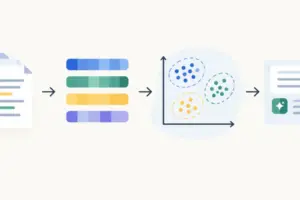
When building a RAG pipeline, developers routinely confront documents that vastly exceed the context window limits or effective attention spans of embedding models and LLMs. The standard remedy is chunking—segmenting vast corpuses into digestible, bite-sized fragments. However, treating chunking as a mere configuration parameter—a simple matter of setting arbitrary token limits and overlap metrics—is a critical engineering misstep.
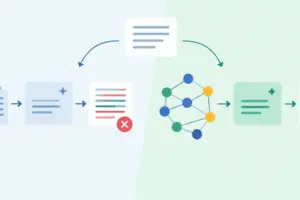
Poor chunk boundaries can rupture semantic continuity, causing vector search mechanisms to miss the precise passages that answer user queries, or worse, returning fragments that are mathematically relevant yet stripped of the vital surrounding context required for accurate generation. Because reranking algorithms and prompt-tuning methodologies cannot fully reconstruct semantics lost during premature document splitting, the quality of your retrieval pipeline is bound by the integrity of your initial preprocessing.
This comprehensive guide establishes a rigorous, decision-tree-based methodology for selecting the ideal chunking strategy. By systematically analyzing the intrinsic properties of your source documents and the operational demands of your retrieval tasks, engineering teams can optimize the balance between semantic fidelity, retrieval precision, computational latency, and operational expenditure.
Detailed Chronology: The Evolution of Document Segmentation in RAG
To understand why modern RAG systems require sophisticated chunking strategies, it is valuable to examine the technical evolution of document processing within natural language processing pipelines.
Phase 1: The Era of Static Tokenization (2020–2022)
In the early days of vector search and dense passage retrieval, text segmentation was primitive. Developers relied almost exclusively on Fixed-Size Chunking. Documents were sliced strictly by character counts or token thresholds, with minor overlaps added via sliding windows to patch over arbitrary mid-thought cuts. While computationally inexpensive and universally applicable, this brute-force approach treated text as a homogenous stream of bytes, completely ignoring structural elements like paragraphs, sentence boundaries, headers, and syntactic relationships.
Phase 2: Structural and Semantic Awareness (2023–2024)
As enterprise applications demanded higher accuracy, simple token chunking proved inadequate for complex documents such as legal contracts, scientific papers, and code repositories. This realization sparked the development of Document-Based Chunking (leveraging Markdown, HTML, and AST parsers) and Recursive Chunking, which established hierarchical fallback mechanisms (splitting by paragraphs, then sentences, then words). Concurrently, Semantic Chunking emerged, utilizing embedding distance metrics to detect natural topic shifts sentence by sentence, ensuring that boundaries respected conceptual shifts rather than arbitrary length constraints.
Phase 3: Context-Aware and Intelligent Architectures (2025–Present)
Today, state-of-the-art RAG architectures utilize advanced paradigms designed to handle highly heterogeneous data corpuses and multi-layered retrieval tasks. Innovations such as Late Chunking (which preserves global document context within chunk embeddings using long-context models), Hierarchical Chunking (serving both macro and micro queries from multi-layered indices), LLM-Based Chunking (using foundational models to locate logical breakpoints), and Agentic Chunking (dynamically routing documents to specialized parsing agents) represent the cutting edge of information retrieval engineering.
Supporting Context & Metrics: Unpacking Chunking Assumptions
Every chunking strategy is underpinned by specific assumptions regarding document structure and information distribution. Selecting a strategy that violates these assumptions introduces unnecessary computational overhead without yielding improvements in retrieval performance.
Comparative Strategy Matrix
| Strategy | Core Structural Assumption | Primary Computational Tradeoff | Ideal Enterprise Use Case |
|---|---|---|---|
| No Chunking | Content is self-contained and fits entirely within the model context. | None; skips preprocessing entirely. | Short FAQ entries, product summaries, API config files. |
| Fixed-Size Chunking | Boundary placement is trivial because overlap mitigates mid-thought breaks. | Ignores document semantics entirely. | Rapid prototyping where raw speed supersedes precision. |
| Recursive Chunking | Paragraph and sentence delimiters are safe proxies for semantic meaning. | Less precise than meaning-aware methods. | General-purpose default for uniform, well-formatted text. |
| Document-Based Chunking | Native structural elements (headers, tags, code blocks) mirror logical semantics. | Fails when authoring practices violate structural consistency. | Markdown documentation, HTML web pages, source code repositories. |
| Semantic Chunking | Topic shifts can be detected mathematically via sentence embedding distance. | Requires threshold tuning; vulnerable to noise. | Narrative text, reports, and articles with unpredictable topic transitions. |
| Late Chunking | A fragment’s true meaning depends on the overarching document context. | Requires specialized long-context embedding models. | Technical specifications, legal agreements, cross-referenced literature. |
| Adaptive Chunking | Information density varies wildly across different sections of a single document. | Increases indexing and retrieval complexity. | Manuals and textbooks with uneven distribution of technical concepts. |
| Hierarchical Chunking | Downstream systems must answer both broad summarization and granular detail queries. | Demands dual-index maintenance and synchronization. | Enterprise knowledge bases with multi-tiered user intent. |
| LLM-Based Chunking | Foundational models capture logical breakpoints invisible to static heuristics. | Maximum compute cost and latency per ingested document. | High-stakes legal, financial, and medical document processing. |
| Agentic Chunking | Ingestion corpuses are heterogeneous, requiring dynamic, document-specific routing. | Requires preliminary routing logic and execution overhead. | Mixed enterprise repositories containing reports, transcripts, and code. |
The Decision-Tree Framework: Selecting Your Strategy
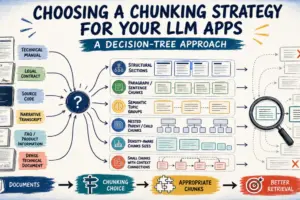
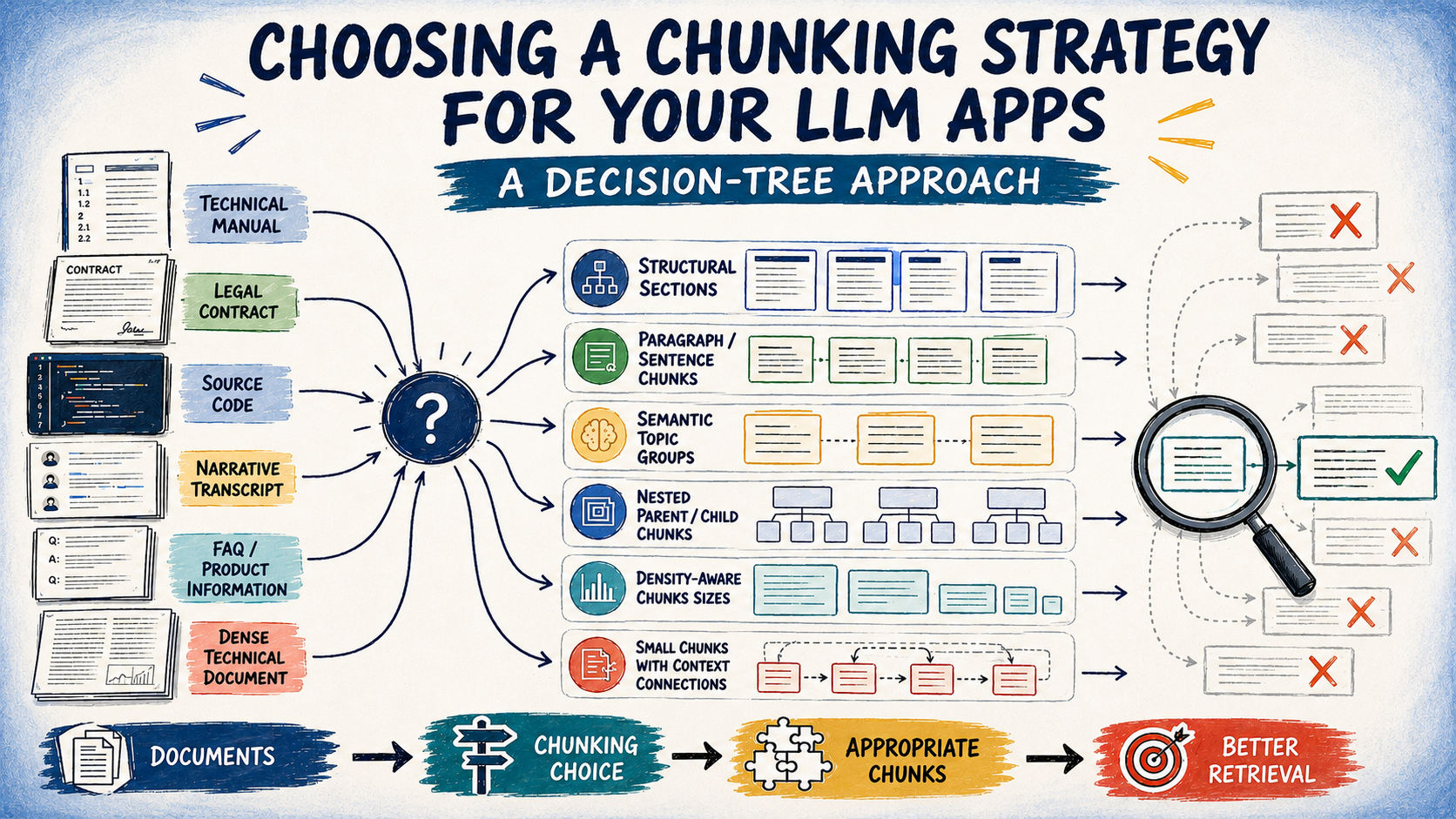
To eliminate guesswork, engineering teams should evaluate their data pipelines using a structured, six-step decision tree. Each sequential query narrows the valid strategy space based on concrete document properties and task requirements.
[Start Document Ingestion]
       │
       ▼
Q1: Fits context window & single topic? ──(Yes)──► [No Chunking]
       │
     (No)
       │
       ▼
Q2: Reliable internal structure? ───────(Yes)──► [Document-Based Chunking]
       │
     (No)
       │
       ▼
Q3: Requires global document context? ──(Yes)──► [Late Chunking]
       │
     (No)
       │
       ▼
Q4: Variable density or multi-granularity?──(Yes)─► [Adaptive / Hierarchical]
       │
     (No)
       │
       ▼
Q5: Quality > Cost & Latency? ──────────(Yes)──► [LLM or Semantic Chunking]
       │
     (No)
       │
       ▼
Q6: Heterogeneous document collection? ──(Yes)──► [Agentic Chunking]
       │
     (No)
       ▼
[Recursive or Fixed-Size Default]
Question 1: Does the Document Need Chunking at All?
- Condition: The source material is concise, self-contained, addresses a single subject, and fits effortlessly within your embedding model and LLM context limits (e.g., FAQ entries, product descriptions, localized configuration snippets).
- Action: Embed the document whole and skip chunking. Artificially fragmenting inherently atomic information only introduces unnecessary retrieval overhead and vector pollution.
- Fallback: If the content exceeds context length or spans multiple distinct subjects, advance to Question 2.
Question 2: Does the Document Have a Clear Internal Structure?
- Condition: The content contains reliable structural markup—such as Markdown headings, HTML tags, PDF section dividers, tables, or programming language syntax (functions, classes).
- Action: Deploy Document-Based Chunking. Parse the document according to its native schema to keep sections, tables, and functional blocks intact.
- Fallback: If structural markup is missing, inconsistent, or poorly maintained by authors, advance to Question 3.
Question 3: Do Chunks Need Context From Elsewhere in the Document?
- Condition: The text exhibits profound cross-references or long-range dependencies—such as legal contracts that define terms in Section 1 and invoke them in Section 12, or technical specifications whose terminology relies on definitions established pages earlier.
- Action: Implement Late Chunking. Embed the complete document through a long-context embedding model first, then derive chunk-level representations from that global matrix. This ensures individual chunks retain a mathematical trace of the overarching document.
- Fallback: If individual segments can stand alone without semantic degradation, advance to Question 4.
Question 4: Does Information Density Vary, or Do You Need Multiple Levels of Granularity?
- Condition: Your corpus exhibits drastically fluctuating information density (requiring Adaptive Chunking), or your retrieval system must field both broad, thematic queries and hyper-specific factual lookups from the exact same index (requiring Hierarchical Chunking, where small child chunks link to larger parent contexts).
- Action: Configure adaptive or hierarchical indexing pipelines to match these multi-tiered operational requirements.
- Fallback: If the document density is relatively uniform and single-tier retrieval suffices, advance to Question 5.
Question 5: Does Retrieval Quality Matter More Than Cost and Latency?
- Condition: You are operating in a high-stakes domain where retrieval accuracy is paramount and computational budgets permit higher ingestion costs.
- Action: If budget permits and precision is critical, utilize LLM-Based Chunking to have a language model identify atomic propositions and logical breakpoints. If you require semantic awareness at a lower cost point, deploy Semantic Chunking via embedding distance thresholds.
- Fallback: If speed, throughput, and low operational expenditure are your primary directives, advance to Question 6.
Question 6: Is This One Document Type, or a Heterogeneous Collection?
- Condition: Your enterprise data lake is a chaotic mixture of diverse file formats—structured reports, narrative transcripts, raw code, and unstructured memos—where a single chunking rule will inevitably fail across formats.
- Action: Employ Agentic Chunking. Deploy an intelligent routing agent that inspects each incoming document, determines its genre and structure, and dynamically invokes the optimal chunking algorithm.
- Fallback: If your collection is reasonably uniform, use Recursive Chunking as an industry-standard default. For rapid prototyping where speed completely eclipses quality, fall back to Fixed-Size Token Chunking.
Recognizing and Mitigating Common Chunking Pitfalls
Even meticulously engineered pipelines frequently encounter runtime anomalies once exposed to messy production data. Recognizing the symptoms of faulty chunking allows engineering teams to implement corrective measures swiftly.
Enterprise Troubleshooting Matrix
| Symptom | Underlying Root Cause | Corrective Engineering Action |
|---|---|---|
| Mid-Sentence / Mid-Table Fracturing | Applying structure-blind chunking algorithms to structured documents. | Migrate from fixed-size chunking to recursive or document-aware parsing. |
| Erratic Chunk Counts Across Files | Miscalibrated similarity thresholds in semantic chunking engines. | Tighten distance thresholds or implement LLM fallback for outlier documents. |
| Wildly Disparate Chunk Sizes | Unreliable document headers that fail to track genuine topic boundaries. | Combine document-based parsing with secondary recursive splitting inside oversized sections. |
| High Latency Without Accuracy Gains | Over-engineering with hierarchical or adaptive chunking on small, uniform corpuses. | De-escalate architecture back to standard recursive chunking. |
| Compute Budget Exhaustion | Redundant per-document LLM analysis executed on every pipeline ingestion run. | Implement aggressive caching layers for agentic and LLM-based parsing decisions. |
Future Outlook: The Next Generation of RAG Preprocessing
As we look toward the horizon of enterprise artificial intelligence, the boundaries between document ingestion, embedding generation, and reasoning are rapidly dissolving. Several emerging trends are set to redefine how RAG systems handle document segmentation:
- Native Long-Context Embedding Models: With context windows expanding to millions of tokens, the traditional necessity of aggressive chunking is shrinking for medium-sized documents. However, efficient retrieval over vast multi-gigabyte corpuses will still demand intelligent indexing, pushing the industry toward hybrid models that combine global attention with local vector search.
- Differentiable End-to-End Training: Rather than treating chunking as a heuristic preprocessing step decoupled from the embedding model and LLM, future architectures will feature end-to-end differentiable chunking modules optimized via reinforcement learning based on downstream generation success.
- Multimodal Chunking Fabrics: As enterprise data becomes increasingly multimodal—seamlessly blending text, complex vector graphics, financial tables, and embedded audio—chunking strategies must evolve into unified spatial-semantic parsers that preserve cross-modal relationships without information loss.
Conclusion
Choosing the optimal chunking strategy is not a trivial configuration task; it is a foundational architectural decision that dictates the ceiling of your RAG system’s retrieval performance. By moving away from arbitrary fixed-size defaults and adopting a structured, decision-tree-based methodology, engineering teams can systematically align document boundaries with semantic reality.
Always evaluate your chunking strategy against the empirical structure of your data, validate performance through rigorous retrieval testing, and scale complexity only when justified by concrete improvements in system accuracy. In the realm of enterprise AI, precision in preprocessing directly translates to authority in generation.