Executive Overview
In the rapidly evolving landscape of Retrieval-Augmented Generation (RAG), engineers frequently focus their optimization efforts on embedding models, vector database configurations, and Large Language Model (LLM) hyperparameter tuning. Yet, the foundational bottleneck in nearly all RAG pipelines occurs much earlier in the ingestion pipeline: document chunking.
When building systems that must ingest documents far exceeding standard context windows, the manner in which text is divided dictates the absolute upper bound of retrieval performance. Poor chunk boundaries routinely result in semantic fragmentation, where critical context is severed mid-sentence or isolated from necessary surrounding clauses. Consequently, vector search fails to locate the passage that directly answers a query, or worse, returns a fragment that is mathematically relevant via vector distance but functionally useless due to a complete lack of context.
Traditional approaches to chunking have relied on naive, one-size-fits-all heuristics—such as slicing arbitrary numbers of characters with a static overlap percentage. However, modern enterprise implementations demand a far more nuanced approach. Selecting an optimal chunking strategy requires treating text segmentation as an architectural decision tied directly to document structure, cross-document dependencies, information density, and the specific retrieval task at hand.
This technical brief provides a comprehensive architectural decision framework—operationalized through a structured decision tree—to help engineering teams systematically evaluate, select, and deploy the right chunking methodology for their data assets.
Detailed Chronology and Technical Evolution of Chunking Strategies
To understand the current state of RAG document preprocessing, it is valuable to trace how text segmentation has evolved alongside advancements in LLM context lengths and vector embedding spaces.
Phase 1: The Heuristic Era (Fixed-Size and Recursive Chunking)
In the early days of vector search and semantic retrieval, documents were treated primarily as streams of raw characters or tokens.
- Fixed-Size Chunking: Systems arbitrarily split text every $N$ tokens, utilizing a small sliding overlap (e.g., 10-20%) to patch over sentences severed by hard boundaries. While computationally cheap and simple to implement, this method assumes that boundary placement is largely inconsequential. In practice, it frequently splits semantic units, dividing subject-verb agreements across distinct vectors and confounding embedding spaces.
- Recursive Chunking: Recognizing the limitations of fixed boundaries, engineers introduced hierarchical separators. Recursive chunking applies a prioritized list of separators (typically paragraphs
nn, newlinesn, spaces, and characters) to systematically break text down until the resulting segment fits within a target token window. This provides a safe, general-purpose default that respects basic grammatical boundaries without requiring deep semantic parsing.
Phase 2: Structural and Semantic Awareness
As RAG applications scaled into domain-specific sectors—such as legal compliance, medical research, and complex software codebases—naive text splitting proved insufficient.
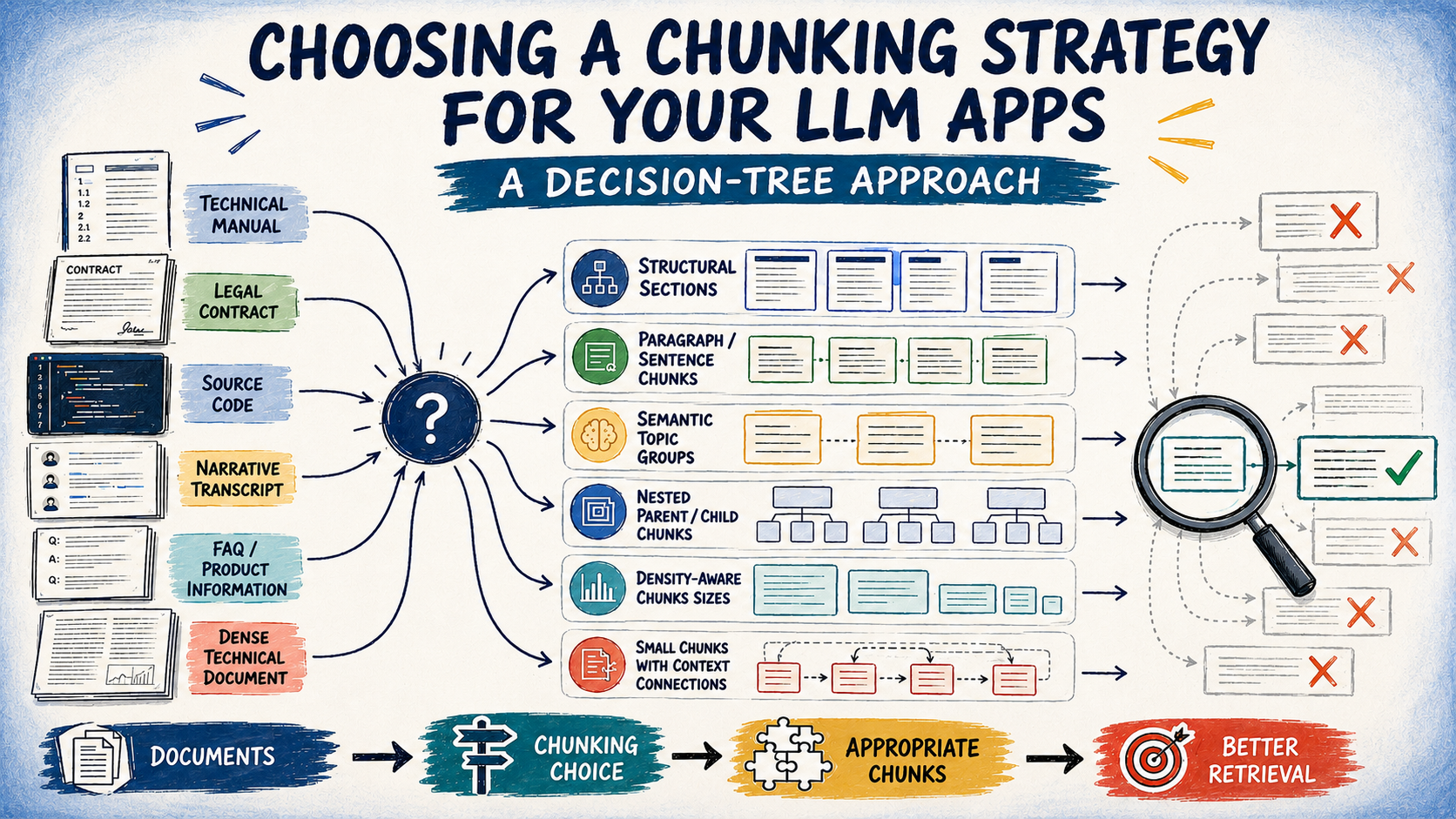
- Document-Based Chunking: Systems began parsing structural markup (Markdown headings, HTML tags, PDF section trees, and AST function boundaries) to preserve the author’s original logical units.
- Semantic Chunking: Advancing further into linguistic analysis, semantic chunking calculates the embedding distance between consecutive sentences. When the distance crosses a dynamic threshold indicating a topic shift, a boundary is established. This ensures that a single chunk remains unified around a singular thematic concept.
Phase 3: Contextual, Hierarchical, and Agentic Paradigms
Today, the state of the art in RAG engineering addresses complex contextual dependencies and heterogeneous enterprise data corpora through advanced paradigms:
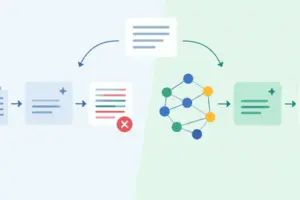
- Late Chunking: Addressing the reality that a chunk’s true meaning often relies on the broader document text, late chunking defers token-level embedding generation until the entire document has passed through a long-context transformer model.
- Hierarchical and Adaptive Chunking: Recognizing that queries range from broad summaries to hyper-specific data points, systems now generate multi-layered indices or dynamically adjust chunk sizes based on localized information density.
- Agentic Chunking: The modern pinnacle of ingestion engineering, where lightweight agentic loops inspect incoming documents individually and dynamically route them to the optimal parsing strategy based on structural composition.
Supporting Context & Core Assumptions: Matching Strategy to Document Structure
Every chunking strategy is fundamentally built upon specific assumptions about the nature of the source text. Deploying a strategy whose underlying assumptions conflict with the document’s structure introduces unnecessary architectural complexity without improving retrieval quality.
| Strategy | Core Underlying Assumption | Primary Risk of Mismatch |
|---|---|---|
| Fixed-size chunking | Boundary placement is unimportant; overlap patches mid-thought splits. | Slices critical clauses in legal contracts or code functions, destroying semantic clarity. |
| Recursive chunking | Paragraph and sentence boundaries reliably approximate meaning when structure is absent. | May still isolate definitions from their subsequent applications in dense technical prose. |
| Document-based chunking | Author-defined structures (headers, sections, APIs) map directly to semantic units. | Fails entirely when poorly formatted documents use headers purely for visual styling. |
| Semantic chunking | Topic shifts are consistently detectable sentence-by-sentence via embedding distances. | Unpredictable threshold sensitivity can lead to wildly erratic chunk counts. |
| Late chunking | A chunk’s meaning is inextricably bound to the context of the entire document. | Demands continuous access to high-compute, long-context embedding infrastructure. |
| Adaptive chunking | Information density varies wildly, requiring dynamic sizing rather than uniform blocks. | Adds substantial preprocessing latency and indexing complexity. |
| Hierarchical chunking | Enterprise users require simultaneous access to broad summaries and granular facts. | Requires maintaining synchronized parent-child indices within the vector database. |
| LLM-based chunking | Automated models can uncover logical breakpoints invisible to algorithmic parsers. | Prohibitive compute costs and latency scale linearly with corpus size. |
| Agentic chunking | Enterprise data collections are too heterogeneous for any single static rule set. | Requires robust agent orchestration and caching layers to control execution costs. |
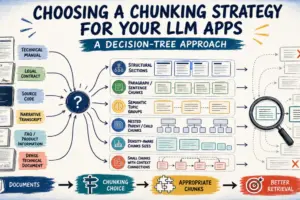
The Engineering Decision Tree for Chunking Strategy Selection
Rather than defaulting to a familiar configuration, engineering teams should evaluate their document corpora through a sequential six-question decision tree.
[Start: Ingest Document]
  │
  ├─► Q1: Fits context window & single topic? ──► YES ──► [Strategy: No Chunking]
  │     └─► NO
  │
  ├─► Q2: Reliable internal structure? ────────► YES ──► [Strategy: Document-Based]
  │     └─► NO
  │
  ├─► Q3: Cross-document/section dependencies? ─► YES ──► [Strategy: Late Chunking]
  │     └─► NO
  │
  ├─► Q4: Variable density or multi-granularity? ► YES ──► [Strategy: Adaptive / Hierarchical]
  │     └─► NO
  │
  ├─► Q5: High retrieval stakes & budget? ─────► YES ──► [Strategy: LLM-Based / Semantic]
  │     └─► NO (Optimize for Speed/Cost)
  │
  └─► Q6: Heterogeneous document collection? ──► YES ──► [Strategy: Agentic Chunking]
        └─► NO ──► [Strategy: Recursive / Fixed-Size Default]
Question 1: Does the Document Need Chunking at All?
- Condition: Content is short, highly self-contained, and covers exactly one subject (e.g., FAQ entries, product descriptions, short configuration files).
- Action: If the entire document fits comfortably within the LLM and embedding model’s context window without mixing distinct topics, skip chunking. Splitting already-coherent atomic units merely introduces vector retrieval overhead.
- Next Step: If the document exceeds safe token limits or covers multiple distinct subjects, proceed to Question 2.
Question 2: Does the Document Have a Clear Internal Structure?
- Condition: Source materials feature reliable structural markup, such as Markdown headers (
#,##), HTML tags, PDF structural trees, or programming language syntax (functions, classes). - Action: Deploy document-based chunking. Parse the document according to its native format to keep logical units—such as sections, paragraphs, tables, or code blocks—intact.
- Next Step: If the document structure is inconsistent, missing, or fails to reliably indicate thematic boundaries, proceed to Question 3.
Question 3: Do Chunks Need Context From Elsewhere in the Document?
- Condition: The text contains cross-references and dependencies spanning multiple sections (e.g., legal contracts defining a term in Section 1 and applying it in Section 8; technical specifications relying on earlier contextual definitions).
- Action: Implement late chunking. By passing the entire document through a long-context embedding model first and extracting token-level representations afterward, every resulting chunk retains a mathematical trace of the broader document’s context.
- Next Step: If chunks can stand independently without catastrophic loss of meaning, proceed to Question 4.
Question 4: Does Information Density Vary, or Do You Need Multiple Levels of Granularity?
- Condition: The corpus features sections of dense, highly technical prose alongside sparse narrative explanations, OR users will query the system for both high-level thematic summaries and hyper-specific data points.
- Action:
- If density varies wildly, use adaptive chunking to expand or contract boundaries based on information entropy.
- If dual granularity is required, deploy hierarchical chunking (linking small child chunks to broader parent chunks).
- Next Step: If information density is relatively uniform and a single granularity suffices, proceed to Question 5.
Question 5: Does Retrieval Quality Matter More Than Cost and Latency?
- Condition: A strict tradeoff between operational budget and retrieval accuracy.
- Action:
- If retrieval quality is paramount and compute budgets allow, utilize LLM-based chunking to let an intelligent model identify atomic propositions and logical breakpoints.
- If per-document LLM costs are prohibitive but topic shifts are unpredictable, utilize semantic chunking (measuring sentence embedding distance).
- If latency and cost are top priorities, proceed to Question 6.
Question 6: Is This a Uniform Corpus or a Heterogeneous Collection?
- Condition: The dataset mixes diverse document types—such as structured financial reports, unstructured narrative transcripts, and raw code repositories—where a single rule will fail across the board.
- Action:
- For mixed corpora, deploy agentic chunking, allowing an intelligent router to inspect and categorize each document before applying the matching extraction strategy.
- For reasonably uniform corpora, use recursive chunking as a robust, general-purpose default.
- For rapid, low-stakes prototyping where speed overrides semantic precision, fall back to fixed-size chunking.
Operational Troubleshooting: Recognizing Common Chunking Pitfalls
Even meticulously designed ingestion pipelines encounter runtime failures when confronted with real-world enterprise data. Monitoring diagnostic symptoms allows engineering teams to refine their preprocessing strategies proactively.
| Operational Symptom | Root Cause Analysis | Corrective Engineering Action |
|---|---|---|
| Chunks consistently cut mid-sentence or slice tables in half. | Applying a structure-blind, fixed-size method to heavily formatted documents. | Transition immediately to recursive or document-based parsing structures. |
| Semantic chunking yields wildly erratic chunk counts across uniform files. | Miscalibrated cosine distance thresholds for sentence-to-sentence variance. | Tighten distance thresholds or route outlier documents to LLM-based boundary detection. |
| Document-based chunks range from single lines to massive multi-page blocks. | Unreliable authorial use of headers (e.g., using headers purely for visual styling). | Combine document-based parsing with a secondary recursive pass inside oversized sections. |
| Hierarchical or adaptive chunking adds severe latency without improving RAG answers. | The target corpus is inherently small, uniform, and lacks complex structural depth. | Simplify the ingestion architecture by rolling back to standard recursive chunking. |
| Agentic chunking exhausts compute budgets on large-scale enterprise ingests. | Redundant per-document routing analysis performed repeatedly on static files. | Implement caching layers for strategy decisions or execute analysis at the collection/batch level. |
Future Outlook: The Next Generation of Document Ingestion
As large language model context windows expand past millions of tokens, theoretical debates surrounding micro-chunking sizes may appear transient. However, fundamental information retrieval principles dictate that precision and signal-to-noise ratios remain paramount. Cramming 500,000 tokens of raw text into an LLM context window—often referred to as "needle-in-a-haystack" retrieval—frequently degrades reasoning performance due to the well-documented "lost-in-the-middle" phenomenon.
Looking forward, the evolution of chunking is moving away from static geometric boundaries toward dynamic, context-aware semantic encapsulation. We anticipate widespread adoption of multimodal chunking strategies capable of natively parsing embedded tables, charts, and diagrams alongside dense prose. Furthermore, embedding models optimized specifically for late-interaction architectures (such as ColBERT-style token-level representations) will minimize the need for destructive text segmentation altogether.
Until those capabilities are universally commoditized, engineering teams must view chunking not as an arbitrary preprocessing checkbox, but as a critical architectural lever. By systematically auditing document structures, applying rigorous decision frameworks, and continuously monitoring retrieval failures, organizations can unlock unprecedented accuracy and reliability in their enterprise RAG deployments.