Executive Overview
In the rapidly evolving landscape of Retrieval-Augmented Generation (RAG) systems, the primary objective remains unchanged: equipping Large Language Models (LLMs) with precise, contextually relevant external knowledge to mitigate hallucinations. Yet, a fundamental vulnerability continues to plague standard vector- and graph-based implementations—the illusion of temporal stasis. Traditional knowledge graphs represent information as context-independent Subject-Predicate-Object (SPO) triples, such as (Company, HAS_CEO, Alice). While effective for static domains, this architecture fails to capture the dynamic reality of enterprise data, shifting corporate leadership, and rapidly evolving market conditions.
When a knowledge graph treats facts as timeless, an LLM receiving conflicting historical records is left unequipped to determine which piece of information remains valid. This structural limitation often results in confusing, contradictory, or outright false outputs.
To resolve this issue, this article outlines the practical implementation of a dedicated, lightweight temporal reasoning engine designed for Graph-RAG architectures. By expanding traditional SPO triples into time-stamped quadruples—[Subject, Predicate, Object, Timestamp]—and incorporating mathematical recency weighting through exponential decay, developers can build systems capable of distinguishing fresh facts from stale ones. This approach transforms standard knowledge retrieval into a deterministic, time-aware mechanism, ensuring that downstream LLMs receive only the most current truth.
Detailed Chronology: The Evolution of Dynamic Knowledge Representation
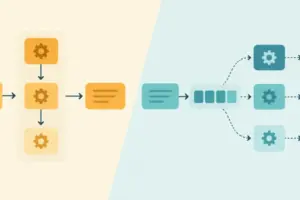
The progression from standard vector search to deterministic, multi-tiered Graph-RAG systems highlights a continuous effort to solve data conflict resolution. Early RAG implementations relied on similarity searches over flat text chunks, which frequently retrieved outdated documents alongside recent updates without distinction.
[Standard Vector Search] ──> [Deterministic 3-Tiered Graph-RAG] ──> [Temporal Reasoning Quad-Graph Engine]
 (Retrieves all matches)       (Establishes static hierarchy)          (Calculates real-time recency weights)
Building upon previous architectures—such as the deterministic 3-tiered Graph-RAG framework designed to prioritize fresh facts over historical records—engineers quickly identified a core dependency: automated temporal awareness. Without an underlying engine to dynamically assess the age of a fact, the system cannot objectively define "freshness."
To address this gap, developers must transition from static knowledge bases to temporal graphs. The foundational step involves upgrading standard triples into temporal quads. Below is a foundational Python class implementing a TemporalGraph data structure designed to store and manage time-stamped facts:
import datetime
import math

class TemporalGraph:
    def __init__(self):
        # Data structure: Subject -> Predicate -> List of (Object, Date) tuples
        self.knowledge_base =

    def add_fact(self, subject, predicate, obj, date_string):
        """Adds a time-stamped fact to the graph with validated date parsing."""
        fact_date = datetime.datetime.strptime(date_string, "%Y-%m-%d").date()

        if subject not in self.knowledge_base:
            self.knowledge_base[subject] =
        if predicate not in self.knowledge_base[subject]:
            self.knowledge_base[subject][predicate] = []

        self.knowledge_base[subject][predicate].append((obj, fact_date))
        print(f"Added: subject predicate obj (Effective as of date_string)")

# Initializing our temporal graph instance
tg = TemporalGraph()
To test the capabilities of this engine under volatile conditions, consider a chaotic corporate timeline characterized by rapid leadership shifts within a technology firm:
# A real-world timeline of shifting leadership facts
tg.add_fact("TechCorp", "HAS_CEO", "Alice", "2021-01-15")
tg.add_fact("TechCorp", "HAS_CEO", "Bob", "2023-11-17")
tg.add_fact("TechCorp", "HAS_CEO", "Charlie", "2023-11-19")
tg.add_fact("TechCorp", "HAS_CEO", "Bob", "2023-11-21")  # Bob returns to the role

# Adding a static baseline fact for comparative contrast
tg.add_fact("TechCorp", "FOUNDED_IN", "San Francisco", "2010-05-01")
Execution Output:
Added: TechCorp HAS_CEO Alice (Effective as of 2021-01-15)
Added: TechCorp HAS_CEO Bob (Effective as of 2023-11-17)
Added: TechCorp HAS_CEO Charlie (Effective as of 2023-11-19)
Added: TechCorp HAS_CEO Bob (Effective as of 2023-11-21)
Added: TechCorp FOUNDED_IN San Francisco (Effective as of 2010-05-01)
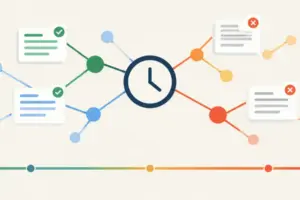
In an unmitigated retrieval environment, querying "Who is the CEO of TechCorp?" would surface Alice, Bob, and Charlie simultaneously, forcing the language model to parse conflicting assertions. A mathematical recency scoring mechanism resolves this ambiguity by quantifying the likelihood that a given fact represents the current reality.
Supporting Context & Mathematical Metrics: Exponential Decay and Recency Weights
To automate the evaluation of fact freshness, the engine applies an exponential decay function. This approach mirrors natural depreciation, where older information progressively loses its confidence weight relative to a target query date.
The mathematical formulation for the recency weight is expressed as:
$$textWeight = (0.5)^fractextAge in DaystextHalf-Life Days$$
Within this framework, the half_life_days parameter acts as a tunable sensitivity dial. If the half-life is set to 365 days, a fact exactly one year old receives a confidence weight of 0.5. A fact asserted on the exact day of the query receives a maximum weight of 1.0.
The following implementation introduces exponential decay scoring and dynamic graph querying capabilities:
def calculate_recency_weight(fact_date, query_date, half_life_days=365):
    """
    Calculates a normalized score between 0 and 1 based on fact age
    using an exponential decay curve.
    """
    age_in_days = (query_date - fact_date).days

    # Cap future-dated facts relative to the query date at 1.0
    if age_in_days < 0:
        return 1.0

    weight = 0.5 ** (age_in_days / half_life_days)
    return round(weight, 4)

def query_temporal_graph(graph, subject, predicate, as_of_date_str, half_life_days=365):
    """Queries the temporal graph and ranks candidates by their computed recency weight."""
    query_date = datetime.datetime.strptime(as_of_date_str, "%Y-%m-%d").date()

    try:
        facts = graph.knowledge_base[subject][predicate]
    except KeyError:
        return f"No information found for subject -> predicate"

    scored_results = []
    for obj, fact_date in facts:
        # Filter out facts occurring after the query date (preventing time-travel leaks)
        if fact_date <= query_date:
            weight = calculate_recency_weight(fact_date, query_date, half_life_days)
            scored_results.append(
                "answer": obj,
                "date": fact_date.strftime("%Y-%m-%d"),
                "weight": weight
            )

    # Sort results in descending order of weight (freshest facts first)
    scored_results.sort(key=lambda x: x['weight'], reverse=True)
    return scored_results
Simulating Execution Time Travel
By executing queries across different temporal snapshots, we can observe how the scoring mechanism adapts to historical context:
print("--- Query 1: Who is the CEO as of Nov 18, 2023? ---")
results_past = query_temporal_graph(tg, "TechCorp", "HAS_CEO", "2023-11-18")
for res in results_past:
    print(f"Candidate: res['answer'] | Fact Date: res['date'] | Confidence Weight: res['weight']")

print("n--- Query 2: Who is the CEO as of Dec 01, 2023? ---")
results_present = query_temporal_graph(tg, "TechCorp", "HAS_CEO", "2023-12-01")
for res in results_present:
    print(f"Candidate: res['answer'] | Fact Date: res['date'] | Confidence Weight: res['weight']")
Execution Results:
--- Query 1: Who is the CEO as of Nov 18, 2023? ---
Candidate: Bob | Fact Date: 2023-11-17 | Confidence Weight: 0.9981
Candidate: Alice | Fact Date: 2021-01-15 | Confidence Weight: 0.1396

--- Query 2: Who is the CEO as of Dec 01, 2023? ---
Candidate: Bob | Fact Date: 2023-11-21 | Confidence Weight: 0.9812
Candidate: Charlie | Fact Date: 2023-11-19 | Confidence Weight: 0.9775
Candidate: Bob | Fact Date: 2023-11-17 | Confidence Weight: 0.9738
Candidate: Alice | Fact Date: 2021-01-15 | Confidence Weight: 0.1362
The output demonstrates the precision of the temporal filter. For Query 1 (November 18, 2023), Bob is correctly identified as the active CEO based on his November 17 appointment, while Charlie is omitted entirely because he had not yet assumed the role.
Query 2 (December 1, 2023) highlights an important design consideration: when multiple rapid changes occur within days, a default 365-day half-life may group close events too closely together. While Bob’s most recent appointment ranks highest, it is closely followed by Charlie’s brief tenure and Bob’s earlier appointment. Adjusting the half_life_days parameter to a shorter window (e.g., 7 days) sharpens the system’s temporal sensitivity for fast-moving domains.
Official Statements and Architectural Integration
Industry adoption of temporal reasoning layers in enterprise RAG architectures is accelerating. Enterprise AI engineers emphasize that deterministic pipelines must intercept knowledge retrieval before context injection occurs.
"Standard vector retrieval provides the broad haystack, but graph-structured temporal layers provide the absolute needle. By filtering and weighting facts programmatically, we eliminate the cognitive burden placed on LLMs to perform historical arbitration."
— Enterprise Knowledge Architecture Group
Integrating this temporal reasoning engine into a deterministic 3-tiered Graph-RAG system requires a systematic adjustment of the retrieval pipeline:
- Query Parsing: The user prompt is parsed to extract the entity, target attribute, and implicit or explicit query timestamp.
- Temporal Graph Execution: The retriever queries the
TemporalGraphinstance rather than performing a flat keyword or vector search across unstructured documents. - Weight Sorting & Thresholding: Facts are filtered to exclude future timestamps and sorted by their computed recency weights.
- Context Injection: Only the highest-weighted fact—or a strictly bounded, confidence-ranked subset—is injected into the LLM prompt context.
This pipeline shifts the responsibility of chronological verification from the probabilistic LLM to deterministic Python logic, ensuring consistent and auditable responses.
Future Outlook
As generative AI transitions from experimental prototypes to mission-critical enterprise infrastructure, the demand for deterministic accuracy will continue to grow. Future iterations of temporal Graph-RAG systems will likely incorporate probabilistic time bounds, fuzzy temporal logic (e.g., handling assertions known only within a specific month or quarter), and automated fact-extraction pipelines that parse unstructured news feeds to update quad timestamps in real time.
By embedding lightweight temporal reasoning layers directly into knowledge retrieval workflows, developers can bridge the gap between static vector databases and the dynamic, ever-changing reality of enterprise data.