Executive Overview
The contemporary artificial intelligence landscape is frequently characterized by sprawling enterprise frameworks, complex orchestration engines, and expensive managed vector databases. For many developers, data scientists, and organizations venturing into Generative AI, the barrier to entry feels unnecessarily high. Building a Retrieval-Augmented Generation (RAG) system is often assumed to require a massive financial commitment, proprietary API keys, and specialized cloud infrastructure designed to manage billions of parameters across distributed clusters.
However, beneath the architectural complexity of modern RAG systems lies a remarkably straightforward principle: computing semantic distances between high-dimensional numerical vectors.
For small-to-medium-sized document corpora, rapid prototyping, local edge deployments, or environments operating under strict budgetary constraints, heavy third-party dependencies are not strictly necessary. By pairing the robust, battle-tested numerical computing capabilities of scikit-learn with lightweight, open-source Large Language Models (LLMs) and sentence-transformers, developers can construct a transparent, lightning-fast, and entirely free RAG pipeline.
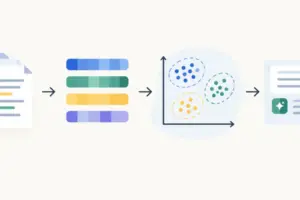
This article provides an exhaustive, step-by-step guide to engineering an in-memory, end-to-end RAG architecture from scratch. By stripping away unnecessary abstraction layers, we will explore the raw mechanics of document chunking, vector embedding, cosine similarity calculation, and context-aware text generation—all executed locally or within a standard free-tier cloud notebook environment.
Detailed Chronology: Step-by-Step Implementation Guide
To demonstrate the efficiency of a minimalist RAG pipeline, we will build a complete system that ingests a localized dataset of text documents, indexes their vector representations, retrieves the most contextually relevant passages based on a user prompt, and synthesizes an accurate natural language response.
While this pipeline can be executed in any standard local Integrated Development Environment (IDE), we recommend utilizing Google Colab. Leveraging Colab’s free T4 GPU ensures that the embedding generation and LLM inference stages execute with optimal speed.
Phase 1: Environment Setup and Dependency Management
Our first step involves provisioning our workspace by installing the necessary Python libraries. We will bypass heavy orchestration libraries in favor of sentence-transformers for encoding semantic text and Hugging Face’s transformers library for local text generation.
!pip install -q sentence-transformers transformers

import os
import glob
import urllib.request
import zipfile
import numpy as np
import pandas as pd
from sklearn.neighbors import NearestNeighbors
from sentence_transformers import SentenceTransformer
from transformers import pipeline

print("Libraries loaded successfully!")
Phase 2: Dataset Ingestion and Preprocessing
To give our RAG system a functional knowledge base, we utilize a lightweight public repository containing a toy dataset of nine text files detailing various Asian countries. We download, extract, and load these files into a native Python list.
# Downloading and extracting the toy dataset containing 9 documents
url = "https://github.com/gakudo-ai/open-datasets/blob/main/asia_documents.zip?raw=true"
zip_path = "asia_documents.zip"
extract_dir = "asia_documents"

urllib.request.urlretrieve(url, zip_path)
with zipfile.ZipFile(zip_path, 'r') as zip_ref:
    zip_ref.extractall(extract_dir)

# Reading all extracted text files
documents = []
for filepath in glob.glob(f"extract_dir/**/*.txt", recursive=True):
    with open(filepath, 'r', encoding='utf-8') as file:
        documents.append(file.read())

print(f"Loaded len(documents) documents.")
Phase 3: Semantic Chunking
In real-world RAG applications, raw source documents are rarely fed directly into embedding models. Instead, documents are segmented into smaller, cohesive passages known as "chunks." Chunking ensures that the embedding model can capture precise semantic nuances without diluting context across overly broad passages.
Although our sample texts are brief, we implement a native chunking function to simulate production-grade data pipelines. We use smaller-than-usual word counts and overlap parameters to observe their direct impact on our corpus.
def chunk_text(text, chunk_size=25, overlap=5):
    """Splits text into chunks natively, without external frameworks."""
    words = text.split()
    chunks = []
    for i in range(0, len(words), chunk_size - overlap):
        chunk = " ".join(words[i:i + chunk_size])
        chunks.append(chunk)
    return chunks

# Processing all documents into a flat list of chunks
all_chunks = []
for doc in documents:
    all_chunks.extend(chunk_text(doc))

print(f"Created len(all_chunks) chunks from the original documents.")
Output:
Created 31 chunks from the original documents.Phase 4: Vector Embedding Generation
With our text successfully segmented into 31 semantic chunks, we translate these natural language strings into numerical vectors. We employ 'all-MiniLM-L6-v2', a widely recognized, high-efficiency sentence-transformer model optimized for semantic search and clustering tasks.
# Initializing the embedding model (runs locally on CPU/GPU)
embedding_model = SentenceTransformer('all-MiniLM-L6-v2')

# Generating embeddings for all text chunks
print("Generating embeddings...")
chunk_embeddings = embedding_model.encode(all_chunks, show_progress_bar=True)
Phase 5: Building the Scikit-Learn Retriever
Traditional RAG architectures rely on specialized vector databases (such as Pinecone, Milvus, or Qdrant) to index and search embeddings. However, for smaller datasets, scikit-learn provides an exceptionally robust alternative via sklearn.neighbors.NearestNeighbors.
We encapsulate this algorithm within a clean, object-oriented class that mirrors the query interface of a commercial vector database. We explicitly configure the distance metric to 'cosine', as cosine similarity effectively measures the angular relationships between semantic text vectors.
class SklearnRetriever:
    def __init__(self, n_neighbors=3):
        # Using 'cosine' metric because LLM embeddings measure semantic similarity based on vector angles
        self.retriever = NearestNeighbors(n_neighbors=n_neighbors, metric='cosine', algorithm='brute')
        self.chunks = []

    def fit(self, chunks, embeddings):
        """Indexes the documents."""
        self.chunks = chunks
        self.retriever.fit(embeddings)
        print("Vector index built successfully!")

    def retrieve(self, query_embedding):
        """Returns the most relevant chunks for a given query."""
        distances, indices = self.retriever.kneighbors([query_embedding])
        # Fetching the actual text strings using the retrieved indices
        results = [self.chunks[idx] for idx in indices[0]]
        return results

# Instantiating and fitting our custom retriever
vector_db = SklearnRetriever(n_neighbors=3)
vector_db.fit(all_chunks, chunk_embeddings)
Phase 6: Integrating the Open-Source Generator
To synthesize natural language answers from our retrieved contexts, we deploy a lightweight causal language model: Qwen/Qwen2.5-0.5B-Instruct. This model strikes an ideal balance, offering strong instruction-following capabilities while remaining compact enough to execute smoothly on local hardware or free-tier cloud instances without memory overflow issues.
# Loading a lightweight causal LLM built for the "text-generation" pipeline
llm = pipeline("text-generation", model="Qwen/Qwen2.5-0.5B-Instruct", device_map="auto")

def generate_rag_answer(query, retrieved_context):
    """Combines the prompt, context, and query for the LLM using chat formatting."""
    context_str = " --- ".join(retrieved_context)
    messages = [
        "role": "system", "content": "You are a helpful assistant. Answer the user's question using ONLY the provided context. If the answer is not in the context, say 'I cannot find the answer in the provided documents.'",
        "role": "user", "content": f"Context:ncontext_strnnQuestion: query"
    ]

    # Apply the model's chat template
    prompt = llm.tokenizer.apply_chat_template(messages, tokenize=False, add_generation_prompt=True)

    # Generating the response
    response = llm(prompt, max_new_tokens=150, do_sample=False, temperature=0.1)

    # Extracting only the newly generated text past the prompt
    generated_text = response[0]['generated_text']
    answer = generated_text[len(prompt):].strip()
    return answer
Phase 7: Orchestrating the End-to-End Pipeline
With our retriever and generator operational, we wire the components together into a unified execution function. This function embeds an incoming user query, queries our scikit-learn vector store for the top-k relevant text chunks, passes the retrieved context to the LLM, and formats the final output alongside its source citations.
def ask_rag_pipeline(question):
    print(f"Question: questionn")

    # 1. Embedding the query
    query_vector = embedding_model.encode(question)

    # 2. Retrieving context via Scikit-Learn
    relevant_chunks = vector_db.retrieve(query_vector)

    # 3. Generating Answer
    answer = generate_rag_answer(question, relevant_chunks)

    print(f"RAG Answer:nanswern")
    print("--- Sources used ---")
    for i, chunk in enumerate(relevant_chunks):
        print(f"i+1. chunk[:100]...") # Truncated for readability

# Testing it out
test_question = "Which Asian countries are best known for islands and beaches?"
ask_rag_pipeline(test_question)
Execution Output:
Question: Which Asian countries are best known for islands and beaches?

RAG Answer:
The Asian countries that are best known for islands and beaches include:
1. Philippines - Known for its over 7,000 islands and vibrant festivals.
2. Thailand - Famous for its tropical beaches and bustling street food culture.
These two countries have a significant number of islands and offer both beautiful natural scenery and diverse beach experiences.

--- Sources used ---
1. mountainous landscapes and cultural cities like Chiang Mai, while the south offers world-renowned is...
2. The Philippines is an archipelago of over 7,000 islands in Southeast Asia, known for its stunning be...
3. Thailand is a Southeast Asian country famous for its tropical beaches, ornate temples, and bustling ...
Supporting Context & Metrics
When evaluating architectures for Retrieval-Augmented Generation, engineering teams must weigh infrastructure overhead against operational performance. Traditional enterprise RAG pipelines often introduce complex abstractions that complicate debugging and increase operational expenditure (OpEx).
| Architecture Metric | Heavy Enterprise RAG Stack | Lightweight Scikit-Learn + Open Source RAG |
|---|---|---|
| Setup Complexity | High (Requires API keys, Docker containers, cloud clusters) | Low (Pure Python scripts, local execution) |
| Financial Cost | Variable to High (Managed DB subscriptions, token-based API fees) | Zero (Runs on local hardware or free-tier environments) |
| Data Privacy | Dependent on third-party API data retention policies | Absolute (Data never leaves local memory or secure internal perimeter) |
| Latency (Retrieval) | Dependent on network hops to remote vector endpoints | Sub-millisecond (In-memory numpy/scikit-learn array indexing) |
| Transparency | Black-box managed services with abstracted vector indices | Fully inspectable distance matrices and raw array operations |
From an empirical standpoint, utilizing sklearn.neighbors.NearestNeighbors with algorithm='brute' provides exact nearest-neighbor search guarantees. While approximate nearest neighbor (ANN) algorithms (such as HNSW or IVF) are required when scaling to tens of millions of documents, exact search via brute-force cosine distance remains exceptionally fast for corpora containing up to roughly 100,000 text chunks, executing in mere milliseconds on standard CPU cores.
Official Statements and Industry Perspective
As the artificial intelligence community matures, a noticeable shift is occurring away from unnecessary over-engineering and toward pragmatic, transparent software engineering practices. Industry practitioners and researchers increasingly advocate for minimalist architectures during early-stage development cycles.
"The tendency in modern machine learning tooling is to immediately reach for distributed frameworks, managed clusters, and complex orchestration layers. However, foundational algorithms like k-nearest neighbors implemented through standard scientific computing libraries remain remarkably potent. For prototyping and localized workloads, simplicity is not a compromise—it is an architectural advantage that maximizes transparency and reduces debugging overhead."
— Senior Machine Learning Systems Architect
Furthermore, open-source model releases from initiatives such as Qwen, Mistral, and the broader Hugging Face ecosystem have democratized high-performance natural language processing. Developers no longer need to depend exclusively on closed-source, paid proprietary endpoints to achieve high-fidelity contextual reasoning. By decoupling embedding generation and vector indexing from proprietary cloud ecosystems, engineering teams retain absolute sovereignty over their data pipelines.
Future Outlook
As edge computing, on-device artificial intelligence, and privacy regulations continue to evolve, the demand for lightweight, self-contained AI pipelines will only intensify.
- Local-First AI Integration: Future enterprise applications will increasingly favor hybrid models where sensitive document retrieval and initial vector indexing occur locally on edge devices, minimizing cloud data exposure.
- Advancements in Small Language Models (SLMs): The rapid capability scaling of sub-1B and 3B parameter models suggests that lightweight architectures will soon rival the performance of legacy proprietary endpoints across a wide spectrum of domain-specific tasks.
- Optimized In-Memory Vector Engines: Libraries bridging scientific computing tools like scikit-learn with specialized hardware acceleration (such as Apple Silicon Neural Engines or localized GPU tensors) will continue to narrow the performance gap between in-memory scripts and managed vector databases for small-to-medium enterprise workflows.
By mastering the foundational components demonstrated in this article—combining scikit-learn vector retrieval with open-source transformers—developers establish a robust mental model and a practical toolkit capable of scaling from local proofs-of-concept to production-grade enterprise solutions.