Executive Overview
In the rapidly evolving landscape of artificial intelligence, foundational large language models (LLMs) operate fundamentally in an eternal present. By default, an LLM possesses no native retention mechanism between API calls; each invocation is a stateless event constrained entirely by the text provided within its immediate context window. While this stateless architecture proves exceptionally efficient for one-off Q&A interactions, it represents a critical bottleneck for modern AI agents.
Autonomous agents tasked with multi-step reasoning, long-running research operations, personalized user interactions, and complex multi-agent orchestration require persistent, structured, and dynamic recollection. Without a robust memory architecture, an agent is doomed to repeat past mistakes, lose critical user preferences across sessions, and succumb to contextual degradation.
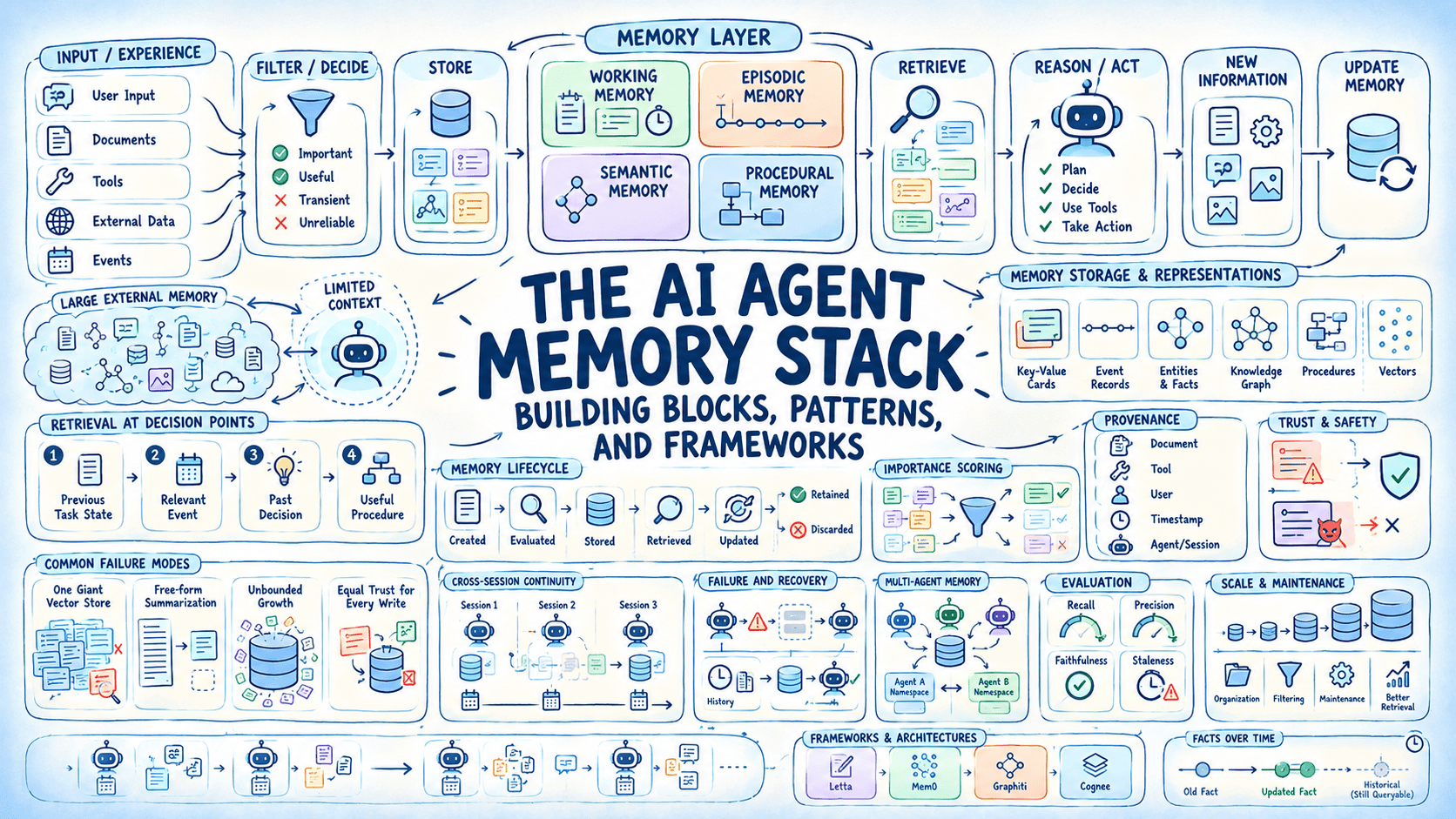
The engineering of agent memory transcends simple database integration. It is a multi-layered computational stack that governs storage, retrieval, relevance filtering, and lifecycle management. Recent advancements have redefined memory from a monolithic vector store into specialized cognitive tiers—mimicking human working, episodic, semantic, and procedural memories. This investigative report examines the mechanics of AI agent memory, the architectural strategies dictating success or failure at scale, and the cutting-edge frameworks (such as Letta, Mem0, Graphiti, and Cognee) shaping the future of autonomous systems.
Detailed Chronology: The Evolution of Agentic Retention
The journey toward persistent artificial memory mirrors the broader maturation of autonomous software agents. Understanding how we arrived at today’s sophisticated bi-temporal knowledge graphs and self-editing text blocks requires tracing the technical milestones that transformed stateless LLMs into persistent cognitive agents.
Phase 1: The Stateless Paradigm (Pre-2023)
In the early era of generative AI, language models functioned purely as reactive text transformers. Applications relying on models like early GPT iterations managed conversation history via brute-force context stuffing—appending the entire chat log to every new prompt. As token counts scaled, performance degraded, latency spiked, and financial costs multiplied. True architectural "memory" outside of temporary session buffers was virtually nonexistent.
Phase 2: The Emergence of Vector Retrieval (2023–2024)
As developers sought to build domain-specific assistants, Retrieval-Augmented Generation (RAG) emerged as the dominant paradigm. Developers began pairing LLMs with vector databases (such as Pinecone, Milvus, and Chroma). This allowed agents to perform similarity searches over static document stores.
While this gave agents access to vast external knowledge, it exposed severe limitations: vector stores treated all retrieved data with equal authority, struggled with evolving facts, and lacked temporal awareness. An agent could retrieve a semantic match, but it had no concept of whether that fact was superseded by newer developments.
Phase 3: Cognitive Tiering and Specialized Frameworks (2025)
Recognizing that human cognition relies on specialized memory stores, the AI engineering community pivoted toward modular cognitive architectures. Frameworks like LangChain, LlamaIndex, and specialized memory libraries introduced explicit taxonomies separating working memory (scratchpads), episodic memory (event logs), semantic memory (entity facts), and procedural memory (execution patterns).
During this period, developers realized that flat vector embeddings were insufficient for complex agentic workflows. This realization sparked the development of entity-aware and graph-based memory systems.
Phase 4: Autonomous Memory Management and Knowledge Graphs (2026 and Beyond)
Today, the frontier of agent memory focuses on autonomous maintenance, self-editing blocks, and graph-native architectures. Modern systems allow agents to actively rewrite their own memory profiles, invalidate obsolete relationships through bi-temporal tracking, and coordinate memory states across multi-agent swarms. Memory is no longer viewed as a static database where data is written once; it is treated as a living, breathing semantic substrate that evolves alongside the agent’s operational environment.
The Anatomy of the AI Agent Memory Stack
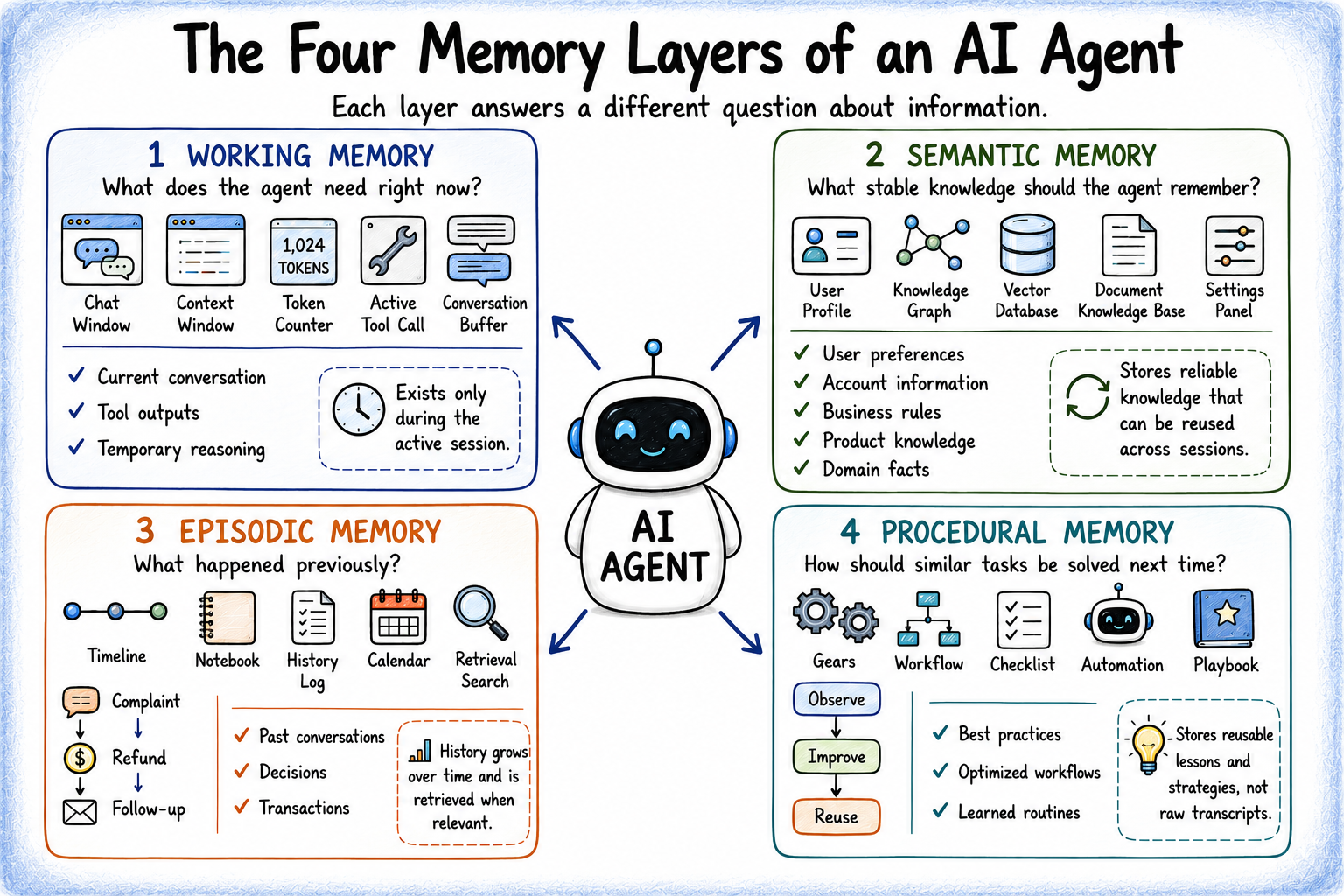
To design resilient autonomous systems, engineers must break down agent memory into its functional building blocks. Just as computer architecture separates CPU registers, RAM, cache, and hard disk storage, advanced AI agents utilize distinct memory tiers tailored to specific operational requirements.
+-------------------------------------------------------+
|                WORKING MEMORY (Context)               |
|    - Active task state, scratchpad, intermediate data |
+-------------------------------------------------------+
                           |
                           v
+-------------------------------------------------------+
|                EPISODIC MEMORY (Logs)                 |
|    - Past interactions, run histories, decision logs  |
+-------------------------------------------------------+
                           |
                           v
+-------------------------------------------------------+
|                SEMANTIC MEMORY (Facts)                |
|    - User preferences, immutable rules, entity data   |
+-------------------------------------------------------+
                           |
                           v
+-------------------------------------------------------+
|               PROCEDURAL MEMORY (Skills)              |
|    - Action patterns, workflow schemas, tool schemas  |
+-------------------------------------------------------+
1. Working Memory
- What It Holds: Active task states, intermediate calculation results, and scratchpad values.
- Storage Layer: In-memory caches or short-lived key-value stores (e.g., Redis).
- Retrieval Method: Direct, lightning-fast lookup by explicit keys.
- Operational Role: Working memory resides directly inside the LLM’s active context window. It handles the immediate execution steps of a task. Once a sub-task is completed, working memory is typically pruned or summarized to prevent context bloat.
2. Episodic Memory
- What It Holds: Chronological records of past interactions, task runs, and historical decisions made by the agent.
- Storage Layer: Time-ordered activity logs backed by vector search indices.
- Retrieval Method: Semantic similarity search paired with temporal filtering.
- Operational Role: Episodic memory allows an agent to answer questions like, "Have I encountered this error before?" or "What sources did I gather during last Tuesday’s research session?" It preserves the narrative arc of the agent’s operational history.
3. Semantic Memory
- What It Holds: Objective facts, user preferences, and enduring truths about entities and the environment. Unlike episodic data, semantic data is continuously updated rather than infinitely appended.
- Storage Layer: Entity-attribute-value (EAV) stores, relational databases, or specialized knowledge graphs.
- Retrieval Method: Exact attribute lookup combined with structured graph traversal.
- Operational Role: Semantic memory prevents the agent from forgetting foundational truths about its users or domain. If a user states, "I prefer Python over JavaScript," that preference is stored in semantic memory as a persistent fact associated with the user entity.
4. Procedural Memory
- What It Holds: Action patterns, successful workflow templates, tool-use strategies, and known failure modes.
- Storage Layer: Prompt templates, system instructions, or fine-tuned model weights.
- Retrieval Method: Pattern matching or direct dynamic injection into system prompts.
- Operational Role: Procedural memory represents the "muscle memory" of the agent. It dictates how the agent executes tasks based on historical optimization.
Supporting Context & Metrics: What Works and What Fails
Implementing a memory system introduces complex architectural trade-offs. Many developers fall into common traps by treating memory as a monolithic, undifferentiated bucket of data. Empirical evaluations of enterprise-grade agents highlight stark contrasts between successful memory engineering patterns and anti-patterns.
Common Memory Anti-Patterns
| Anti-Pattern Approach | Root Cause of Failure | Resulting System Degradation |
|---|---|---|
| Embedding Everything into One Vector Store | Treats all data as homogeneous text chunks without structural context. | Retrieves semantically similar but task-irrelevant information; fails to capture multi-entity relationships. |
| Free-Form Summarization as Compression | Relies on LLMs to continuously compress chat history into running summaries. | Destroys critical granular details, metrics, and numerical constraints; can hallucinate verified facts. |
| Unbounded Memory Growth (No Maintenance) | Appends every interaction to long-term storage without garbage collection. | Increases retrieval latency, bloats storage costs, and causes irrelevant entries to drown out useful insights. |
| Trusting Every Write Equally | Automatically commits all user inputs and tool outputs directly to long-term memory. | Opens the system to memory poisoning attacks, where malicious actors inject false persistent data. |
Proven Design Strategies for Scale
To ensure memory systems remain performant and reliable over millions of execution cycles, high-performing engineering teams adopt rigorous lifecycle management practices:
- Selective Persistence Filtering: Agents should not remember everything. Implementing a scoring mechanism—where intermediate observations are evaluated for future utility before being written to episodic stores—prevents unnecessary database bloat.
- Bi-Temporal Entity Tracking: Fact validation requires tracking when an event occurred and when the system became aware of it. This prevents historical contradictions from corrupting current reasoning.
- Explicit Trust Boundaries: Inputs originating from untrusted external sources (such as web scraping or unverified user prompts) must be sanitized and flagged before gaining long-term semantic persistence.
Official Industry Frameworks and Architectural Comparisons
As the agentic ecosystem matures, specialized memory frameworks have emerged to tackle the complexities of persistent storage, entity resolution, and relationship mapping.
Comparative Framework Analysis
| Framework | Core Memory Architecture | Handling Fact Mutations & Contradictions | Best Suited For |
|---|---|---|---|
| Letta | Self-editing text blocks directly modifiable by the agent. | The agent identifies a logical contradiction in its own memory block and rewrites it. | Long-running conversational agents requiring explicit self-awareness. |
| Mem0 | Vector-based memory augmented with entity-aware retrieval mechanisms. | New memory instances are injected and retrieved alongside historical context. | Personalized user-facing applications and recommendation engines. |
| Graphiti | Bi-temporal knowledge graph featuring typed relationships between discrete entities. | Invalidates older relationships dynamically while preserving historical queryability. | Complex enterprise intelligence and multi-hop reasoning tasks. |
| Cognee | Multi-layered extraction pipeline generating graph, vector, and relational layers. | Rebuilding memory representations with specialized temporal operational modes. | Enterprise-scale unstructured data assimilation and graph RAG. |
These frameworks highlight a fundamental industry bifurcation: some systems (like Letta) treat memory as an extension of the model’s internal prompt workspace via self-editing blocks, while others (like Graphiti and Cognee) abstract memory into external, highly structured graph and relational topologies.
Future Outlook: The Horizon of Autonomous Cognition
As we look toward the future of AI agent engineering, the boundaries between computation, storage, and reasoning will continue to blur. Several frontier developments are set to define the next generation of memory systems:
1. Zero-Shot Cross-Agent Memory Synchronization
In multi-agent architectures, agents frequently operate in parallel silos. Future memory frameworks will feature real-time, peer-to-peer memory synchronization across distributed agent swarms, allowing one agent to instantly inherit the episodic discoveries of another without redundant context ingestion.
2. Autonomous Memory Garbage Collection and Self-Pruning
Current memory systems rely heavily on hardcoded heuristic pruning rules or manual intervention. Next-generation architectures will leverage lightweight utility models dedicated solely to auditing the memory graph, identifying stale or contradictory facts, and executing background refactoring without human oversight.
3. Native Multimodal Memory Spaces
As agents expand beyond text into vision, audio, and spatial computing, memory stores must evolve beyond text chunks and structured graphs. Future memory stacks will natively index continuous video feeds, audio cadences, and 3D spatial coordinates within unified episodic vectors, enabling true experiential continuity for robotic and embodied AI agents.
Conclusion
Agent memory is no longer an optional peripheral feature; it is the core determinant of autonomy. By moving away from naive context stuffing and embracing specialized cognitive tiers, bi-temporal knowledge graphs, and rigorous lifecycle management, developers can build AI agents that transition from brittle, stateless query responders into truly persistent, adaptive digital entities.