Executive Overview
In the lifecycle of a modern Python codebase, feature pipelines and data ingestion modules often begin with pristine, elegant simplicity. A clean function loads embeddings from disk; another fetches a vocabulary from an internal microservice; a third applies a batch transformation. Yet, within a matter of weeks, the harsh realities of production engineering creep in.
Gradually, a third of each function becomes "boundary code"—defensive scaffolding that has little to do with the actual computational work. load_embeddings swells with path-existence checks and positive batch-size guards. fetch_vocab becomes entangled in explicit retry loops and latency counters. transform_batch sprouts high-resolution performance timers and local memoization dictionaries.
None of this boilerplate code is the primary responsibility of the function. Because it is manually pasted across dozens of modules, it inevitably drifts, resulting in inconsistent error handling, swallowed exceptions, and maintenance nightmares.
Python provides an elegant, idiomatic solution to this structural decay: the decorator. By taking a function, wrapping it in closure-based logic, and handing back a modified callable, developers can extract repeated boundary logic into a single, maintainable location.
However, a poorly written decorator is a liability. Homemade retry wrappers can silently swallow critical exceptions, while unmanaged caches can cause sluggish memory leaks. This comprehensive architectural guide explores how Python decorators work under the hood, how to preserve vital function metadata, and how to build production-grade decorators for timing, retries, caching, and input validation.
Detailed Chronology: The Anatomy and Mechanics of Decorator Execution
To wield decorators effectively in high-performance data and machine learning pipelines, developers must look past the syntactic sugar of the @ symbol and understand the underlying mechanics of function reassignment, closures, and wrapper execution.
From Function Reassignment to Syntactic Sugar
At its architectural core, a decorator is simply a higher-order function that takes a target callable as an argument and returns a new callable. Consider a basic announcement wrapper:
def announce(func):
    def wrapper():
        print("calling", func.__name__)
        return func()
    return wrapper

def greet():
    return "hello"

# Explicit function reassignment
greet = announce(greet)
In this explicit assignment, the original greet function is replaced by the wrapper function returned by announce. The Python language specification treats the @announce syntax above a function definition as direct syntactic sugar for this exact reassignment.
Crucially, decorator expressions are evaluated at definition time (import time), not at call time. Any initialization logic executed inside the decorator body outside the inner wrapper runs precisely once when the module is loaded. Furthermore, if a decorator fails to return a callable, the target function name is inadvertently bound to None, triggering an immediate TypeError upon the first invocation.
When multiple decorators are stacked, they execute in a specific nested order. Given the following arrangement:
@f1
@f2
def target_function():
    pass
Python evaluates this as target_function = f1(f2(target_function)). The bottom decorator (f2) wraps the original function first, and the top decorator (f1) subsequently wraps the resulting inner wrapper. Understanding this bottom-up execution order is vital when combining validation, caching, and execution metrics.
Closures and State Management
The true power of decorators stems from lexical closures. Python functions retain access to the variables of their enclosing lexical scope even after that scope has finished execution.
def announce(func):
    def wrapper(*args, **kwargs):
        print("calling", func.__name__)
        result = func(*args, **kwargs)
        print("returned", result)
        return result
    return wrapper
The outer function captures func, while the inner wrapper executes at call time, forwarding all positional (*args) and keyword (**kwargs) arguments via *args, **kwargs. It then captures and returns the original result.
Omitting argument forwarding or failing to return the computed result fundamentally violates the contract of the underlying function. Similarly, wrappers that maintain internal state (such as call counters) must explicitly declare variables using the nonlocal keyword to avoid shadowing local scopes. For complex state management, wrapping functions in dedicated classes implementing the __call__ method is often cleaner and easier to unit-test.
Preserving Function Identity via functools.wraps
One of the most common pitfalls in custom decorator design is the obliteration of function metadata. Without intervention, decorating a function strips away its original __name__, __doc__, module information, and parameter annotations, replacing them with the metadata of the generic wrapper.
This undermines stack traces, profilers, and documentation generators. The standard library resolves this via functools.wraps:
import functools

def announce(func):
    @functools.wraps(func)
    def wrapper(*args, **kwargs):
        print("calling", func.__name__)
        return func(*args, **kwargs)
    return wrapper
By applying @functools.wraps(func) to the inner wrapper, Python copies the original function’s metadata and establishes a __wrapped__ attribute pointing directly to the undecorated target. This attribute is invaluable for automated testing, allowing unit tests to invoke target_function.__wrapped__(*args) to bypass timing, retries, or caching layers entirely.
Supporting Context & Metrics: Four Production Boundary Patterns
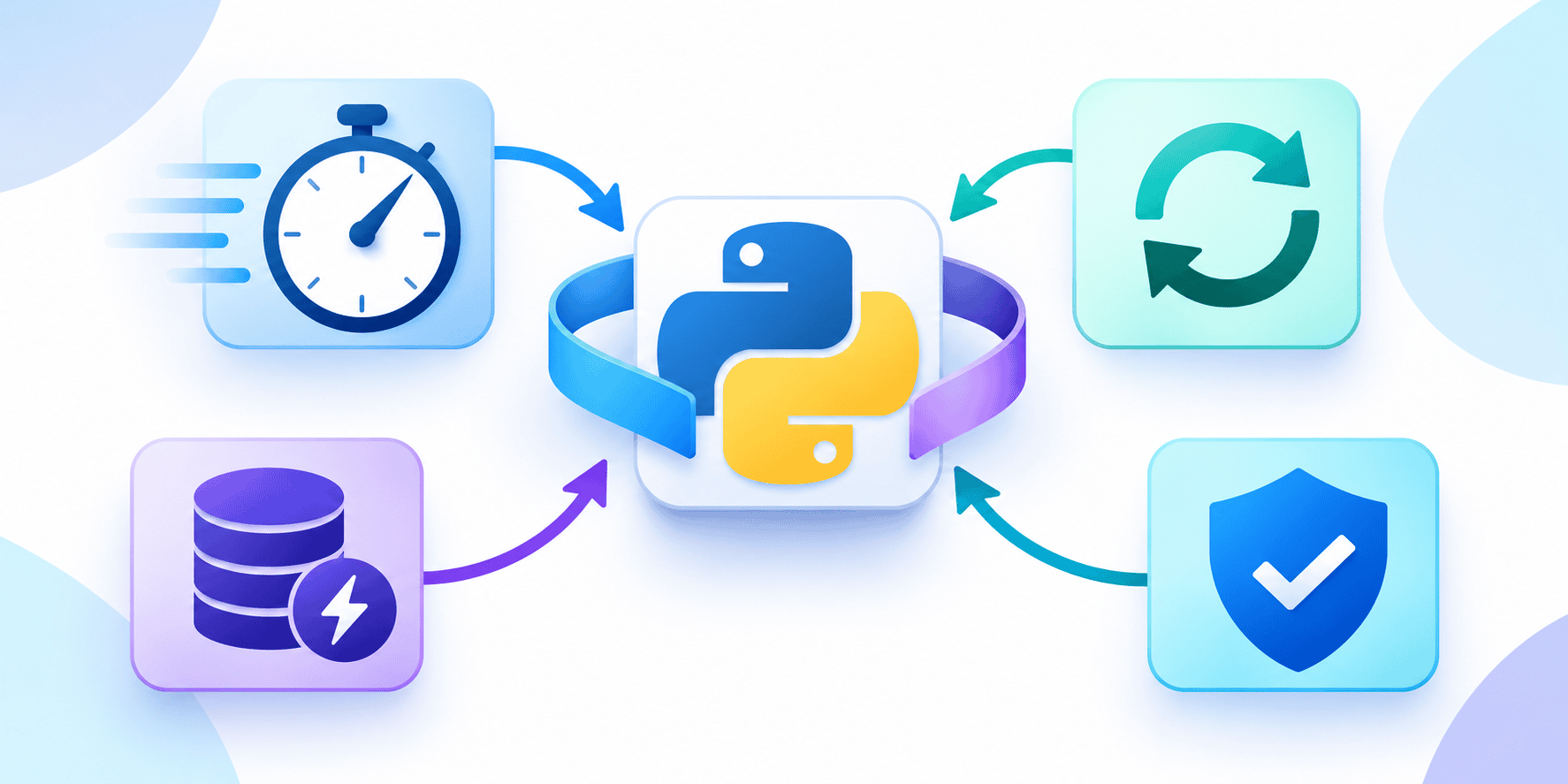
With the theoretical foundations established, we can examine the four primary boundary behaviors required in production software engineering: Timing, Retries, Caching, and Validation.
1. Non-Intrusive Execution Timing
Monitoring latency in data processing pipelines should never require cluttering core business logic with timestamp measurements. A robust timing decorator utilizes a try...finally block to ensure that execution duration is logged regardless of whether the function succeeds or fails:
import functools
import time

def timed(func):
    @functools.wraps(func)
    def wrapper(*args, **kwargs):
        start = time.perf_counter()
        status = "failed"
        try:
            result = func(*args, **kwargs)
            status = "ok"
            return result
        finally:
            elapsed = time.perf_counter() - start
            print(f"func.__name__: elapsed:.3fs (status)")
    return wrapper
When measuring short-duration code blocks, developers must utilize time.perf_counter() rather than wall-clock timestamps (time.time()). perf_counter() offers the highest available hardware resolution for elapsed-time measurement.
2. Resilient Retries via Decorator Factories
Network calls to microservices and databases are inherently prone to transient failures. Implementing a retry mechanism requires configurable parameters such as maximum attempts, delay intervals, and target exception tuples. This necessitates a decorator factory—a function that accepts configuration arguments and returns the actual decorator:
import functools
import time

def retry(max_attempts=3, delay=0.5, exceptions=(TimeoutError,)):
    def decorator(func):
        @functools.wraps(func)
        def wrapper(*args, **kwargs):
            for attempt in range(1, max_attempts + 1):
                try:
                    return func(*args, **kwargs)
                except exceptions as exc:
                    if attempt == max_attempts:
                        raise
                    print(f"func.__name__ attempt attempt failed: exc!r; retrying")
                    time.sleep(delay)
        return wrapper
    return decorator
This three-layer architecture (retry captures options, decorator captures the function, wrapper executes attempts) ensures maximum flexibility. Crucially, catching specific exceptions prevents bugs like KeyError from triggering endless, useless retry loops, while a terminal raise statement preserves the original exception traceback.
Production Caveat: Retries must be strictly restricted to idempotent operations (such as data reads). Applying a generic @retry decorator to financial transactions or non-idempotent writes risks catastrophic data corruption during network timeouts.
3. Intelligent Caching with functools.lru_cache
For computationally expensive or I/O-bound pure functions, memoization eliminates redundant calculations. While custom caching wrappers can be constructed, Python’s built-in functools.lru_cache provides a thread-safe, highly optimized implementation:
import functools

@functools.lru_cache(maxsize=256)
def token_count(text, model_name="base"):
    return len(_tokenizer(model_name).encode(text))
lru_cache exposes built-in introspection tools such as cache_info() (tracking hits, misses, and current size) and cache_clear(). Developers must ensure that all function arguments are hashable and avoid caching functions that return mutable objects (like lists or dictionaries), as shared state references can propagate unintended side-effects across callers.
4. Robust Input Validation Using inspect.signature
Input validation at the function boundary ensures that invalid arguments are rejected before expensive computational pipelines are invoked. Standard parameter checking can be complex when arguments are passed positionally, via keywords, or relied upon via default values.
Using Python’s inspect module, we can bind arguments explicitly to parameter names:
import functools
import inspect

def check(**rules):
    def decorator(func):
        sig = inspect.signature(func)
        @functools.wraps(func)
        def wrapper(*args, **kwargs):
            bound = sig.bind(*args, **kwargs)
            bound.apply_defaults()
            for name, rule in rules.items():
                value = bound.arguments[name]
                if not rule(value):
                    raise ValueError(f"func.__name__: name=value!r failed rule.__name__")
            return func(*args, **kwargs)
        return wrapper
    return decorator

def positive(v): return v > 0

@check(size=positive)
def transform_batch(batch, size=64):
    ...
By computing the function signature once at decoration time and binding arguments on each invocation, this decorator validates inputs cleanly without cluttering the underlying algorithm.
Official Statements and Architectural Comparison
To assist engineering teams in selecting appropriate boundary patterns, the following comparative matrix outlines optimal use cases, anti-patterns, and core technical caveats for each decorator pattern:
| Pattern | Optimal Use Case | Avoid When | Primary Technical Caveat |
|---|---|---|---|
Timing (@timed) |
Identifying bottlenecks in single-process pipeline stages. | Comparing absolute hardware performance (timeit required). |
Use perf_counter(); wrap execution in try...finally to log failures. |
Retry (@retry) |
Idempotent network or database queries prone to transient faults. | Non-idempotent writes, financial transactions, or state mutations. | Ensure terminal re-raising; time.sleep() blocks execution threads. |
Caching (@lru_cache) |
Pure, deterministic functions with hashable, frequently repeating inputs. | Functions with side effects or returning mutable data structures. | Watch for memory leaks (maxsize=None retains references indefinitely). |
Validation (@check) |
Enforcing 2–3 discrete parameter invariants at function boundaries. | Complex inter-field business models (use Dataclasses or Pydantic). | Runtime type annotations are ignored; explicit predicate checks required. |
Future Outlook: The Evolution of Python Meta-Programming
As Python continues to anchor itself as the preeminent language for artificial intelligence, machine learning engineering, and distributed data processing, the demand for clean, modular metaprogramming will only accelerate.
The future of decorator design lies in balancing zero-overhead abstraction with rigorous type safety. While traditional decorators have occasionally been criticized for obscuring code readability and confounding static analysis tools, modern typing extensions (such as ParamSpec and Concatenate introduced in PEP 612) allow developers to write fully type-hinted decorators that preserve complete IDE autocompletion and static type-checker integrity.
Engineering teams that master the art of writing small, focused, highly testable decorators will find their codebases remarkably resilient to change. By cleanly separating cross-cutting operational concerns—such as timing, retries, caching, and validation—from core business logic, developers ensure their applications remain maintainable, observable, and ready to scale under demanding production workloads.