Executive Overview
In the current artificial intelligence landscape, hype operates as the primary currency. Every week brings a fresh wave of product launches, glowing marketing splash pages, and rapidly updating leaderboards. AI providers routinely claim that their latest foundational models or autonomous agents have achieved "state-of-the-art" (SOTA) status, shattering previous performance records across a dizzying array of tests. For enterprise leaders, developers, and product managers rushing to integrate autonomous systems into production workflows, the core question is rarely about fractional percentage gains on a digital leaderboard. Instead, it is brutally pragmatic: Does this agent reliably do the job I hired it for?
To answer this question, the industry has shifted its focus away from traditional static evaluations toward complex AI agent benchmarks. Systems like SWE-bench, GAIA, WebArena, and OSWorld do not merely test whether a model can generate a coherent paragraph or write a basic function. They place language models into dynamic, interactive environments, requiring them to execute multi-step workflows, wield external tools, troubleshoot failures, and achieve complex, real-world goals.
However, these benchmarks are fundamentally misunderstood. While they are often treated as definitive scorecards of machine intelligence, they are, in reality, specialized stress tests. Each evaluation captures only a narrow slice of real-world functionality while remaining blind to crucial enterprise requirements such as operational cost, latency, error recovery, and security boundaries.
This guide cuts through the marketing noise surrounding modern AI evaluations. By examining what major benchmarks measure, where they break down, and how hidden variables distort leaderboards, technical decision-makers can learn to use these evaluations not as performance guarantees, but as directional signals for intelligent deployment.
Detailed Chronology: The Evolution from Static Models to Dynamic Agents
To understand why modern agent benchmarks are necessary, it is vital to trace how the evaluation of artificial intelligence has evolved alongside the technology itself.
Phase 1: The Era of Static Knowledge (Pre-2023)
In the early days of large language models, evaluation was dominated by static, single-turn benchmarks. Tests like MMLU (Massive Multitask Language Understanding) and HumanEval were designed to test broad factual recall and isolated code generation.
- The Mechanism: An evaluator presents a prompt to the model, the model generates a single response, and an automated script or human grader scores it.
- The Limitation: These tests functioned effectively as digital multiple-choice or coding exams. They measured a model’s semantic memory and reasoning capabilities in a vacuum, but offered zero insight into how a system would perform if given access to a live operating system, a browser, or a messy production codebase.
Phase 2: The Emergence of Interactive Environments (2023–2024)
As models grew more capable, researchers realized that raw reasoning did not automatically translate to practical utility. Users did not just want models that knew things; they wanted agents that could do things. This realization triggered the development of interactive agent benchmarks.
- SWE-bench (Late 2023): Developed to test software engineering capabilities, SWE-bench introduced a groundbreaking paradigm: dropping an LLM into a real GitHub repository to fix an actual bug.
- GAIA (Late 2023): Designed to bridge the gap between simple chat interfaces and general-purpose assistants, GAIA challenged models to synthesize information across disparate tools, file formats, and web modalities.
- WebArena (Late 2023 / Early 2024): Recognizing that web interactions are central to white-collar labor, researchers built sandboxed, simulated e-commerce and enterprise environments to test multi-step browser navigation.
Phase 3: Desktop-Scale Autonomy and Verification (2024–Present)
As agent frameworks matured, benchmarks expanded to match the scope of human white-collar work. OSWorld emerged to test full desktop operating system control, while curated subsets like SWE-bench Verified were introduced to clean up ambiguous tasks and faulty test suites in earlier evaluations. Today, the race is no longer about winning static exams, but about dominating dynamic, multi-application environments that mirror actual corporate workflows.
Supporting Context & Metrics: Dissecting the Major Benchmarks
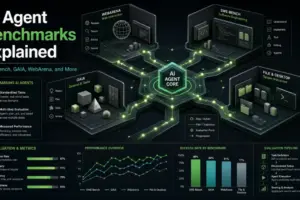
To use agent evaluations effectively, one must look past the aggregate scores and understand the architectural mechanics, strengths, and blind spots of the industry’s four leading benchmarks.
+-------------------------------------------------------------------------+
|                        THE AI AGENT BENCHMARK MATRIX                    |
+-------------------+---------------------------+-------------------------+
| Benchmark         | Primary Environment       | Core Metric             |
+-------------------+---------------------------+-------------------------+
| SWE-bench         | Python Codebases / GitHub | Unit Test Pass Rate     |
| GAIA              | Multi-Modal Documents/Web | Exact Match / Synthesis |
| WebArena          | Sandboxed Web Apps        | Task Completion Rate    |
| OSWorld           | Desktop OS / GUI Apps     | Workflow Success Rate   |
+-------------------+---------------------------+-------------------------+
1. SWE-bench and SWE-bench Verified
- What it Measures: Software engineering competence. An agent receives a real GitHub issue pulled from prominent open-source Python repositories (such as Django, scikit-learn, or SymPy). It must navigate the codebase, diagnose the bug, write a code patch, and pass the repository’s native unit test suite.
- The Nuance: The introduction of SWE-bench Verified—a human-vetted subset of the original benchmark—addressed a critical flaw where poorly specified issues or broken test suites artificially tanked model scores.
- The Blind Spot: Passing a unit test suite is not synonymous with writing production-grade code. An agent can generate a convoluted, fragile patch that satisfies automated assertions while introducing severe memory leaks, security vulnerabilities, or regressions elsewhere in the application. SWE-bench measures automated compliance, not architectural wisdom.
2. GAIA (General AI Assistants)
- What it Measures: Multi-tool reasoning and general digital assistant workflows. GAIA tasks require models to ingest mixed-media files (PDFs, audio, spreadsheets), cross-reference them with web searches, perform complex calculations, and synthesize a cohesive final output.
- The Nuance: GAIA questions are deliberately engineered to be trivial for a human with basic internet literacy, yet agonizingly difficult for unassisted AI systems due to the sheer number of sequential steps required.
- The Blind Spot: GAIA tasks are heavily constrained by rigid, deterministic grading criteria (often seeking a single correct string or number). Real-world enterprise workflows are rarely so binary; goals are often ambiguous, context shifts mid-stream, and the "correct" action depends on unstated organizational nuances.
3. WebArena and BrowserGym
- What it Measures: End-to-end web navigation and task execution within realistic, sandboxed digital environments (e.g., e-commerce backends, CRM systems, Reddit clones, and corporate travel portals).
- The Nuance: BrowserGym extends this category into a flexible evaluation framework, allowing researchers to plug in diverse web apps and standardize interaction protocols.
- The Blind Spot: Data contamination. Because many WebArena tasks have circulated in research repositories for years, newer foundational models frequently ingest these interaction patterns during pre-training. A soaring WebArena score may reflect memorized pattern-matching rather than genuine real-time zero-shot navigation.
4. OSWorld
- What it Measures: Full desktop operating system manipulation. OSWorld drops an agent into a sandboxed desktop environment, tasking it with coordinating across native GUI applications, manipulating local files, adjusting system settings, and handling multi-app workflows (e.g., extracting data from a spreadsheet, formatting it in a word processor, and emailing it via a desktop client).
- The Nuance: This is the most ambitious benchmark in existence, serving as the closest digital simulation of an administrative human assistant.
- The Blind Spot: High fragility. OSWorld scores are profoundly vulnerable to infrastructure noise. If a simulated desktop environment experiences a display rendering glitch, a minor UI layout update, or a lagging subprocess, the agent will fail—even if its underlying reasoning and step-by-step logic were entirely correct.
Official Statements: Industry Perspectives on Evaluation Limits
The limitations of modern benchmarks are not hidden secrets; they are openly acknowledged by top-tier AI researchers, infrastructure engineers, and benchmarking architects who build these systems.
"When we evaluate models on SWE-bench or OSWorld, we are measuring a very specific slice of competence under laboratory conditions. The danger is that the enterprise community treats a high benchmark score like a warranty. In production, your systems will face messy data, unpredictable API latencies, and human users who change instructions halfway through a task. Benchmarks cannot prepare you for the chaos of the wild."
— Senior Research Scientist, Enterprise AI Infrastructure Lab
Industry leaders also emphasize the growing divergence between academic evaluations and commercial viability:
"Leaderboards give you a directional compass, but they are terrible maps. An agent that optimizes its path to pass a benchmark by burning through 200 API calls and fifty dollars of compute per task is an academic success story and a commercial disaster. We need evaluations that factor in cost-efficiency and operational friction just as heavily as raw task completion."
— VP of Engineering, Autonomous Workflow Platform
Future Outlook: The Next Generation of AI Evaluations
As artificial intelligence transitions rapidly from experimental chat interfaces to autonomous corporate workforces, the evaluation ecosystem must undergo a radical transformation. Several key trends will define the future of AI agent benchmarks over the next three to five years:
1. Shift from Static Benchmarks to Dynamic, Interactive Red-Teaming
Static datasets like SWE-bench and GAIA will inevitably saturate as models memorize or overfit to evaluation distributions. The industry is moving toward dynamic benchmarks—environments where test parameters, user intents, and underlying system states mutate in real time during the evaluation run. This will prevent developers from gaming leaderboards through specialized data contamination strategies.
2. Integration of Multi-Dimensional Economic Scoring
Future evaluations will expand beyond binary success-or-failure metrics. Leading research labs are beginning to integrate comprehensive scoring matrices that weigh:
- Token Economics: Measuring the total computational cost required to reach a solution.
- Latency Budgets: Evaluating how long an agent takes to complete a multi-step workflow.
- Resource Thriftiness: Penalizing agents that execute redundant tool calls or fail to cache retrieved information.
3. Rigorous Safety and Boundary Testing
Current benchmarks largely ignore agent governance. Future enterprise evaluations will place heavy emphasis on testing failure boundaries: How does an agent handle unauthorized requests? Does it recognize when a task violates corporate compliance policies? Does it gracefully halt and request human sign-off when facing high-stakes ambiguity, or does it hallucinate a dangerous workaround?
4. Enterprise-Specific Custom Evaluation Pipelines
Ultimately, the future of agent evaluation belongs to the enterprise itself. While public leaderboards will remain useful for filtering out uncompetitive foundational models, forward-thinking organizations are building private, bespoke test harnesses. By scripting simulations that mirror their internal databases, proprietary software stacks, and unique compliance workflows, companies will abandon generic public leaderboards in favor of rigorous, customized validation pipelines.
Conclusion
AI agent benchmarks such as SWE-bench, GAIA, WebArena, and OSWorld represent monumental achievements in the science of machine evaluation. They provide vital empirical touchstones in a crowded marketplace, illuminating specific dimensions of autonomous reasoning, tool usage, and environment navigation.
However, treating these benchmarks as absolute guarantees of production success is a recipe for operational failure. Public leaderboards are directional signals—they can successfully filter out weak architectures and highlight promising foundational models. But they cannot account for the unpredictable friction, economic constraints, security boundaries, and custom workflows of the real world.
For technical leaders navigating this evolving landscape, the mandate is clear: use public leaderboards to start the conversation, but build your own rigorous, custom evaluations to finish it. In the era of autonomous agents, the only benchmark that ultimately matters is the one executed within your own operational environment.