Executive Overview
Every week, a new artificial intelligence provider claims to have built the definitive state-of-the-art agent. Marketing pages glow with hyper-optimized percentages, leaderboards update in real-time, and venture-backed startups boast triple-digit jumps in multi-step task performance. Yet, for engineers, product leads, and enterprise CTOs who have actually deployed autonomous AI workflows in production, a profound chasm exists between laboratory scores and operational reality. The central question for modern tech leadership is no longer whether an LLM can win a math competition or draft a sonnet, but whether it can reliably execute complex, multi-layered business logic without crashing enterprise applications, leaking secure data, or burning through millions of API tokens.
To navigate this noise, the artificial intelligence community relies on agent benchmarks—rigorous, standardized evaluations designed to measure autonomous capabilities. Unlike traditional model metrics that test single-turn text generation, modern agent evaluations drop systems into simulated operating systems, web browsers, and codebases.
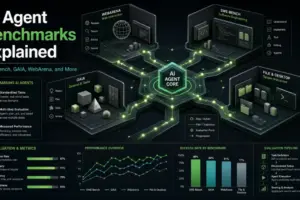
However, relying blindly on these leaderboards is a recipe for costly production failures. This comprehensive analysis cuts through the marketing hype. We explore the major AI agent benchmarks—including SWE-bench, GAIA, WebArena, and OSWorld—dissecting what they measure, exposing where their methodologies break down, and offering an authoritative guide on how engineering teams must utilize them as directional signals rather than performance guarantees.
Detailed Chronology and Evolution of AI Evaluation
To understand why modern agent benchmarks are structured the way they are, we must examine the historical trajectory of AI testing. The evolution of capability evaluations mirrors the rapid advancement of foundational models over the past decade.
Phase I: Static Knowledge and Single-Turn Tests (2018–2022)
In the early era of large language models, evaluation was remarkably straightforward. Traditional benchmarks like MMLU (Massive Multitask Language Understanding) and HumanEval were designed to test isolated competencies. MMLU quizzed models across humanities, STEM, and social sciences using multiple-choice formats, while HumanEval measured a model’s ability to generate functional Python snippets from docstrings in a single pass.
These tests operated on a simple paradigm: prompt-in, response-out, score-checked. While invaluable for establishing baseline language fluency and basic code generation, they were fundamentally static. They evaluated a model the way a written, multiple-choice exam evaluates a human student—measuring memory and isolated logic, but ignoring practical execution, adaptability, and environmental feedback.
Phase II: The Agentic Turn and Interactive Environments (2023–Present)
As foundational models scaled in parameter size and reasoning capabilities, the industry shifted from mere text generation to action. Models were no longer expected to simply answer questions; they were tasked with operating tools, browsing the internet, and executing multi-step workflows.
This paradigm shift necessitated a completely new class of evaluations. Researchers realized that an AI could score 95% on MMLU yet be completely incapable of opening a terminal, writing a bug fix, and verifying it against a repository’s test suite. Thus, agent benchmarks were born.
- Late 2023: Introduction of SWE-bench, bringing software engineering tasks from real-world GitHub repositories into the evaluation loop.
- Early 2024: Launch of GAIA (General AI Assistants) to test complex, multi-modal reasoning across documents, web searches, and file structures.
- Mid-2024: Deployment of WebArena and OSWorld, moving evaluation into sandboxed web environments and fully fledged desktop operating systems.
This evolution transformed AI testing from passive academic grading into high-fidelity, interactive work simulations.
Supporting Context & Metrics: Deconstructing the Major Agent Benchmarks
Each major benchmark targets a specific vector of agentic capability. Understanding their architecture, scope, and inherent limitations is vital for any engineering team attempting to correlate test scores with production readiness.
1. SWE-bench and SWE-bench Verified
- What it measures: Software engineering proficiency in real-world Python repositories (such as Django and scikit-learn).
- How it works: The agent receives a genuine GitHub issue description and a codebase. It must navigate the files, write a code patch, and pass the repository’s automated unit test suite.
- The Verified Variant: SWE-bench Verified introduces human curation to ensure that tasks are unambiguously solvable and that test suites do not pass on false positives.
The Production Blind Spot: Passing a unit test suite is not synonymous with writing clean, maintainable software. An agent can generate a convoluted patch that satisfies automated assertions while simultaneously introducing severe memory leaks, security vulnerabilities, or regression bugs in unmonitored modules. SWE-bench measures automated pass/fail criteria; it remains entirely blind to code quality, long-term technical debt, and architectural integrity.
2. GAIA (General AI Assistants)
- What it measures: Complex reasoning, multi-modal retrieval, and tool orchestration.
- How it works: GAIA poses intricate questions that require agents to cross-reference web searches, parse PDF documents, extract data from spreadsheets, and execute calculations in the correct sequence.
- Design Philosophy: Questions are designed to be effortless for a human with internet access, but exceptionally grueling for current AI architectures due to the necessity of sustained, multi-step attention and tool selection.
The Production Blind Spot: GAIA tasks possess rigid, single-correct-answer structures. Real-world business workflows, by contrast, are messy, ambiguous, and laden with shifting goals. An assistant operating in a live enterprise environment rarely encounters cleanly bounded problems with definitive answers.
3. WebArena and BrowserGym
- What it measures: End-to-end web navigation and GUI interaction.
- How it works: Using sandboxed replicas of enterprise applications (e-commerce portals, CMS platforms, ticketing systems), agents must click buttons, fill out complex forms, manage state, and navigate menus like a human user. BrowserGym extends this into a modular framework for custom environments.
The Production Blind Spot: The Contamination Crisis. Many WebArena tasks have circulated in academic and open-source spaces long enough to bleed into the training corpora of frontier models. High scores on web navigation benchmarks frequently reflect sophisticated pattern-matching against memorized task templates rather than generalizable GUI comprehension. Furthermore, minor UI updates in production web apps will routinely break agents that relied on static DOM structures during testing.
4. OSWorld
- What it measures: Full desktop operating system automation and cross-application workflows.
- How it works: Places an agent inside a sandboxed desktop environment, commanding it to manipulate files, toggle system settings, and coordinate workflows across disparate GUI applications (e.g., moving data from a spreadsheet to a local database via terminal commands).
The Production Blind Spot: OSWorld is exceptionally fragile. If a virtual machine rendering stutters, a window manager crashes, or a desktop application throws an unexpected pop-up, the agent fails—even if its underlying logical reasoning was flawless. Scores are frequently dictated by the stability of the testing infrastructure rather than the raw intelligence of the model.
Official Statements and Industry Consensus
As the gap between benchmarks and business outcomes widens, leading researchers and machine learning practitioners have begun speaking out about the limitations of public leaderboards.
Dr. Andrew Ng, a prominent voice in the AI community, has frequently emphasized that static evaluations fail to capture the iterative nature of agentic workflows. In various industry forums, Ng has noted that production success relies less on a model’s zero-shot benchmark score and more on the framing of the agentic loop—specifically, how systems handle reflection, tool use, and self-correction over multiple iterations.
Similarly, engineering leaders at top AI labs have acknowledged that "benchmark optimization" has become a pervasive phenomenon. When commercial viability is tied directly to leaderboard supremacy, there is an intense economic incentive to fine-tune models specifically for test distributions—a practice that yields impressive marketing graphics but fragile production systems.
In technical documentation released by major foundation model providers, researchers increasingly urge enterprise clients to treat public evaluations as a filtering mechanism rather than an assurance of capability. A low score on SWE-bench or GAIA is a definitive red flag indicating a model lacks the foundational reasoning required for complex automation; however, a high score is merely an entry ticket, not a deployment guarantee.
Future Outlook: Building Toward Production-Grade Evaluation
What does the future hold for AI agent evaluation? As the industry matures, the limitations of static leaderboards are forcing a paradigm shift toward dynamic, domain-specific, and cost-aware testing methodologies.
1. Shift Toward Private, Domain-Specific Evaluations
Forward-thinking enterprises are abandoning public leaderboards entirely in favor of private, synthetic evaluation suites tailored to their exact operational workflows. Rather than testing whether an agent can fix a Django bug, engineering teams are constructing private harnesses that test whether an internal agent can correctly audit an proprietary database schema, summarize internal legal contracts, or execute customer support ticketing workflows adhering strictly to company compliance guidelines.
2. Multi-Dimensional Performance Metrics
Future benchmarks will expand beyond binary success rates to incorporate critical production constraints:
- Cost and Token Efficiency: Measuring the dollar cost required to achieve a successful task outcome. An agent that solves 90% of tasks while burning $5.00 per run is commercially non-viable compared to one that solves 85% of tasks for $0.05.
- Latency and Execution Speed: Factoring in time-to-completion for time-sensitive enterprise workflows.
- Safety, Guardrails, and Boundary Enforcement: Rigorously testing whether an agent correctly identifies when not to act, refusing destructive file modifications or unauthorized data access requests.
- Error Recovery and Resilience: Evaluating how gracefully an agent pivots when confronted with broken APIs, missing data, or ambiguous user prompts.
Conclusion
AI agent benchmarks such as SWE-bench, GAIA, WebArena, and OSWorld represent monumental engineering achievements in the quantification of autonomous systems. They provide critical insight into specific vectors of machine intelligence—ranging from code synthesis and multi-modal retrieval to browser navigation and desktop automation.
Yet, treating these evaluations as guarantees of production success is a perilous miscalculation. Public leaderboards measure performance in sterile, idealized laboratory conditions, systematically ignoring the economic, structural, and operational friction of the real world.
To deploy AI agents with absolute confidence, engineering leadership must adopt a pragmatic, two-step philosophy: Use public leaderboards to filter out the noise and eliminate underperforming models, then build private, rigorous evaluation harnesses custom-tailored to your enterprise’s unique workflows to finish the job.