Executive Overview
The deployment of Large Language Models (LLMs) at scale faces a fundamental hardware and algorithmic wall: the tyranny of single-token autoregressive generation. Every time a user submits a prompt to an AI chatbot, coding assistant, or autonomous agent, the underlying neural network must compute, evaluate, and emit its response one token at a time.
For real-time applications where user experience dictates utility—such as sub-second conversational interfaces, real-time code completion, and rapid customer service interactions—this sequential bottleneck introduces intolerable latency. Historically, scaling compute infrastructure meant throwing more hardware at the problem, yet traditional server architectures routinely hit a wall. The core constraint is not raw arithmetic processing power, but the physics of memory bandwidth.
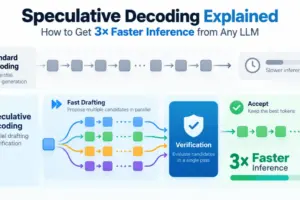
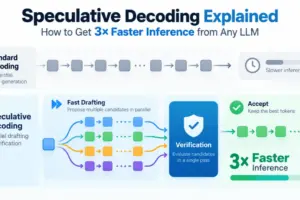
Enter Speculative Decoding: an ingenious inference-acceleration paradigm that achieves two- to three-fold speedups without retraining models, altering weights, or degrading output quality. By pairing a lightweight "draft" model with a massive "target" model, speculative decoding bypasses traditional memory-bandwidth constraints. This article examines the inner mechanics of speculative decoding, its hardware-level optimizations, modern evolutionary variations like Medusa and Eagle, and what deployment looks like for enterprise practitioners.
Detailed Chronology: The Evolution of Inference Optimization
To understand why speculative decoding represents a paradigm shift, it is essential to trace the historical progression of how engineers have attempted to solve the LLM latency crisis.
The Era of Traditional Autoregressive Generation
Since the rise of the Transformer architecture, text generation has operated on a strictly sequential basis. To predict token $t_n$, the model must ingest the prompt and all preceding tokens ($t1$ through $tn-1$), pass them through every single layer of its billions of parameters, and output a probability distribution for the next token.
During this foundational era, optimizations focused almost exclusively on quantization (e.g., reducing 16-bit floats to 8-bit or 4-bit integers) and kernel fusion. While these methods successfully shrunk model footprints and accelerated individual matrix multiplications, they left the core autoregressive loop untouched: every single token still required a discrete, isolated trip to the processor.
The Breakthrough of Speculative Sampling (Early 2023)
In late 2022 and early 2023, independent research teams—notably Leviathan et al. (Google) and Chen et al. (UC Berkeley / Stanford)—published seminal papers introducing speculative decoding (originally termed speculative sampling).
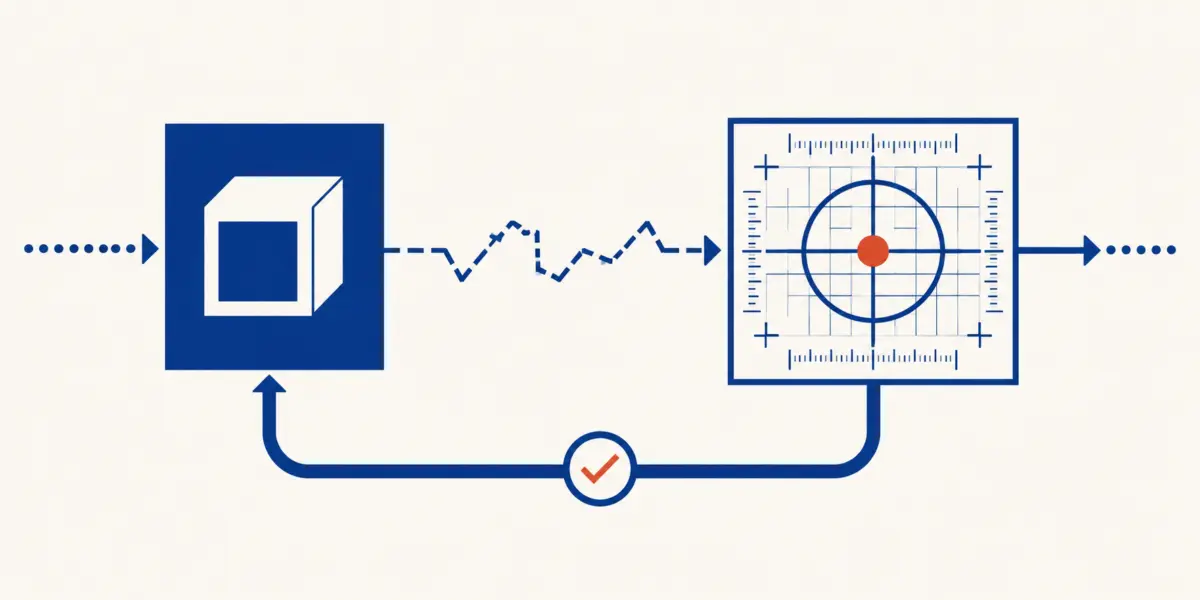
Instead of treating the model as a solitary engine generating tokens in a vacuum, researchers realized they could decouple the generation of candidate text from the verification of text. By utilizing a smaller, auxiliary model to aggressively guess upcoming tokens, and leveraging the massive parallelism of modern GPUs to verify those guesses in a single forward pass, they achieved dramatic speedups. Crucially, statistical algorithms ensured that the final generated sequence possessed an identical mathematical probability distribution to text generated purely by the target model.
The Rise of Draft-Free and Internal-Draft Architectures (2024–Present)
While the two-model paradigm proved revolutionary, maintaining a separate draft model introduced engineering overhead, memory fragmentation, and synchronization challenges. This realization sparked the next evolutionary wave:
- Self-Speculative Approaches (Medusa): Researchers began attaching multiple lightweight prediction heads directly onto the target model’s final transformer layer, allowing the model to draft its own future tokens.
- Hidden-State Extrapolation (Eagle): Advancing beyond surface-token predictions, algorithms like Eagle began leveraging the rich internal hidden states of the target model to project future tokens with vastly superior accuracy.
- Prompt Lookup Decoding: Eliminating auxiliary parameters entirely, zero-model techniques began parsing local context windows and prompt history to source speculative candidates directly.
Today, these methodologies are no longer confined to academic arXiv preprints; they are embedded natively into high-performance inference engines like vLLM, Hugging Face TGI, and llama.cpp.
Supporting Context & Metrics: The Memory-Bandwidth Crisis
To fully appreciate the mechanism of speculative decoding, one must understand why GPUs sit idle during standard LLM generation—a phenomenon known to systems engineers as being memory-bandwidth bound.
Compute vs. Memory: The Hardware Paradox
Modern AI accelerators, such as the NVIDIA H100 GPU, possess staggering computational capacity, measured in hundreds of teraflops or even petaflops of matrix math capability. However, the billions of parameters that constitute an LLM (e.g., a 70-billion parameter model) cannot fit inside the processor’s tiny on-chip SRAM cache. Instead, they reside in high-bandwidth memory (HBM).
During standard decoding:
- The GPU loads the entire weight matrix of the model from HBM into the compute units.
- The model performs calculations for just one single token.
- The resulting token is emitted, and the GPU must wipe its working memory and reload the entire weight matrix all over again for the next token.
Consequently, the GPU’s arithmetic logic units (ALUs) sit idle for the vast majority of the cycle, waiting for data to travel across the memory bus. Adding more raw compute power to the server yields zero performance improvement because the system is bottlenecked strictly by the speed of data transfer—not the speed of calculation.
The Speculative Solution Matrix
Speculative decoding completely alters this memory-to-compute ratio through batch verification.
| Metric / Dimension | Standard Autoregressive Decoding | Speculative Decoding (Two-Model Setup) |
|---|---|---|
| Memory Access Pattern | Full weight reload per token | Full weight reload per speculative batch |
| GPU Utilization | Low (Compute units waiting on HBM) | High (Parallel verification of 4–8 tokens) |
| Mathematical Integrity | Exact target model distribution | Provably identical target distribution |
| Primary Bottleneck | Memory Bandwidth | Draft Model Accuracy / Acceptance Rate |
| Typical Speedup Factor | 1.0x (Baseline) | 2.0x to 3.0x |
When a draft model generates a sequence of 5 to 8 candidate tokens, the target model loads its weights once and evaluates the entire batch in a single parallelized forward pass. Because GPUs are natively optimized for parallel matrix operations, processing a batch of tokens takes almost the exact same amount of time as processing a single token.
The Math Behind the Acceptance Rate
The efficiency of speculative decoding is dictated by the acceptance rate—the statistical frequency with which the draft model’s candidate tokens are validated by the target model.
Mathematically, if the target model assigns a higher probability to a draft token than the draft model did, it is accepted automatically. If the draft model was overly confident, the token is accepted stochastically based on a normalized ratio:
$$p(textaccept) = minleft(1, fracPtexttarget(x)Ptextdraft(x)right)$$
If a token fails validation, it is corrected using an adjusted residual distribution, ensuring zero mathematical drift from the target model’s true intended output. When well-matched models achieve an acceptance rate of 70% to 80%, real-world inference speeds regularly surge past 2.5x baseline performance.
Official Statements and Industry Perspectives
As speculative decoding transitions from academic theory to enterprise deployment, industry leaders and systems architects have increasingly emphasized its role in cost reduction and user-experience optimization.
Infrastructure Efficiency and Edge Deployment
AI hardware architects and systems researchers note that inference cost is the single largest operational expense for modern LLM-driven enterprises. By effectively doubling or tripling hardware throughput without requiring a hardware upgrade, speculative decoding alters the economics of cloud computing.
"Inference efficiency is no longer just about shrinking models via quantization; it is about maximizing the operational utility of every clock cycle. Speculative decoding allows us to bridge the gap between model capability and deployment latency, transforming what was once a memory-transfer bottleneck into a highly parallelized pipeline."
— Leading Systems Infrastructure Engineer (Synthesized Industry Consensus)
Open-Source Integration and Production Readiness
The inclusion of speculative decoding in frameworks like vLLM and Hugging Face’s Text Generation Inference (TGI) has democratized access to the technique. Software engineering leads emphasize that deployment requires careful tuning of the draft-to-target model ratio:
- Model Selection: The draft model must be structurally compatible (or trained specifically) to mimic the tokenization and linguistic patterns of the target model. Popular combinations pair a 1B or 7B parameter draft model with a 70B parameter target model.
- Batch-Size Trade-offs: Industry benchmarks highlight an important operational nuance: speculative decoding excels in single-request, low-concurrency environments (such as interactive coding assistants). In hyper-batched enterprise backend pipelines where thousands of requests are already parallelized across the GPU, speculative decoding can introduce memory overhead and actually degrade throughput. Practitioners are advised to deploy the technique selectively based on workload profiles.
Future Outlook: The Next Frontier of LLM Inference
As large language models continue to scale into the hundreds of billions—and eventually trillions—of parameters, sequential generation will remain fundamentally unsustainable for latency-critical applications. Speculative decoding is laying the groundwork for even more advanced acceleration frameworks.
1. Zero-Overhead Self-Drafting
The future of speculative decoding lies in eliminating external draft models entirely. Architectures inspired by Medusa and Eagle point toward native self-speculation, where models are pre-trained with built-in multi-token prediction heads from inception. This eliminates the memory overhead of maintaining a secondary model while retaining the speed advantages of parallel verification.
2. Hardware-Software Co-Design
Next-generation AI accelerators are beginning to feature specialized memory controllers and hardware-level instruction sets tailored specifically for parallel verification loops. As silicon manufacturers design chips optimized for speculative execution—borrowing architectural concepts long used in traditional CPU branch prediction—inference speeds will climb even higher.
3. Speculative Retrieval and Graph-Based Decoding
Beyond text prediction, emerging research is exploring speculative execution for multimodal models (vision-language models) and tool-use agents. By predicting the execution paths of tool calls or visual token sequences, speculative frameworks will soon accelerate not just text generation, but entire autonomous agent workflows.
Conclusion
Speculative decoding has permanently reshaped how the artificial intelligence community approaches the physics of model inference. By reframing the generation process from a rigid, single-token bottleneck into a dynamic dance between fast drafting and parallel verification, engineers have unlocked massive performance gains without sacrificing a single drop of output quality.
For developers, product managers, and enterprise architects, integrating speculative decoding is no longer an experimental edge case—it is rapidly becoming the default standard for deploying responsive, cost-effective, and lightning-fast AI applications at scale.