Executive Overview
In the lifecycle of software engineering, few events are as abrupt or humbling as the midnight MemoryError. A background analytics script, payment aggregator, or telemetry parser hums along smoothly for twelve months, processing gigabytes of routine traffic without incident. Then, an architectural adjustment—such as a shift in log rotation policies or a sudden surge in digital transactions—consolidates a week’s worth of logs into a single 9-gigabyte file. The nightly cron job executes, attempts to parse the payload, and collapses under its own weight before a single record is successfully summarized.
In most cases, the underlying parsing logic is completely sound. The actual culprit is not an algorithmic defect, but an insidious data structure: the unmitigated list. By defaulting to eager evaluation—slurping entire files into RAM via .readlines() or constructing massive intermediate lists via list comprehensions—developers inadvertently build time bombs into their ingestion pipelines.
Python has offered a native solution to this architectural flaw for over twenty years through iterators, generator functions, and generator expressions. By enforcing a pipeline model where records are pulled through processing stages one at a time and released before the next arrives, engineers can process datasets limited only by disk capacity rather than RAM.
This comprehensive analysis examines the mechanics of Python’s iterator protocol, explores how to construct pure-Python streaming pipelines for massive log and data dumps, and demonstrates how to measure and guarantee memory efficiency using native profiling tools like tracemalloc.
Detailed Chronology: The Evolution of the Out-of-Memory Bug
The Anatomy of an Eager Processing Failure
Consider a typical log-processing script designed to parse application transactions, filter error-level logs, and isolate slow execution times:
with open("app.log") as f:
    records = [parse(line) for line in f]      # Every record exists in RAM simultaneously
errors = [r for r in records if r["level"] == "ERROR"]
slow = [r for r in errors if int(r["latency_ms"]) > 1000]
During a code review, this snippet rarely raises eyebrows. It appears clean, declarative, and idiomatic. However, it violates a fundamental rule of large-scale data processing: it demands complete materialization at the very first step. The list comprehension [parse(line) for line in f] forces Python to load, parse, and retain every single record in the file before the first filter condition can even be evaluated. When log volumes ballooned from megabytes to gigabytes, this eager approach guaranteed an eventual MemoryError.
The Lazy Paradigm Shift
To resolve this issue, developers must abandon the instinctual habit of storing intermediate results in lists. Instead, the data pipeline must remain "lazy" from the file object at the ingest boundary to the batched sink at the output boundary.
If a processing workflow only requires one record at a time to perform its validation, transformation, or filtering, forcing every record to coexist in memory is an architectural misstep. The core trick is maintaining laziness across the entire execution path. Introducing a single eager step—such as an intermediate list or an unconstrained sort—shatters the pipeline, instantly reintroducing the memory bloat.
The Contract That Makes Streaming Work: Iterables vs. Iterators
Python’s for loop syntax conceals a simple yet powerful protocol that underpins the entire streaming ecosystem. Understanding the distinction between an iterable and an iterator is essential for building robust pipelines.
The Iterator Protocol
An iterable is any Python object capable of returning its members one at a time (e.g., lists, strings, dictionaries, open file handles). An iterator, by contrast, is a stateful object that maintains a cursor over a data stream, keeping track of where the execution currently resides.
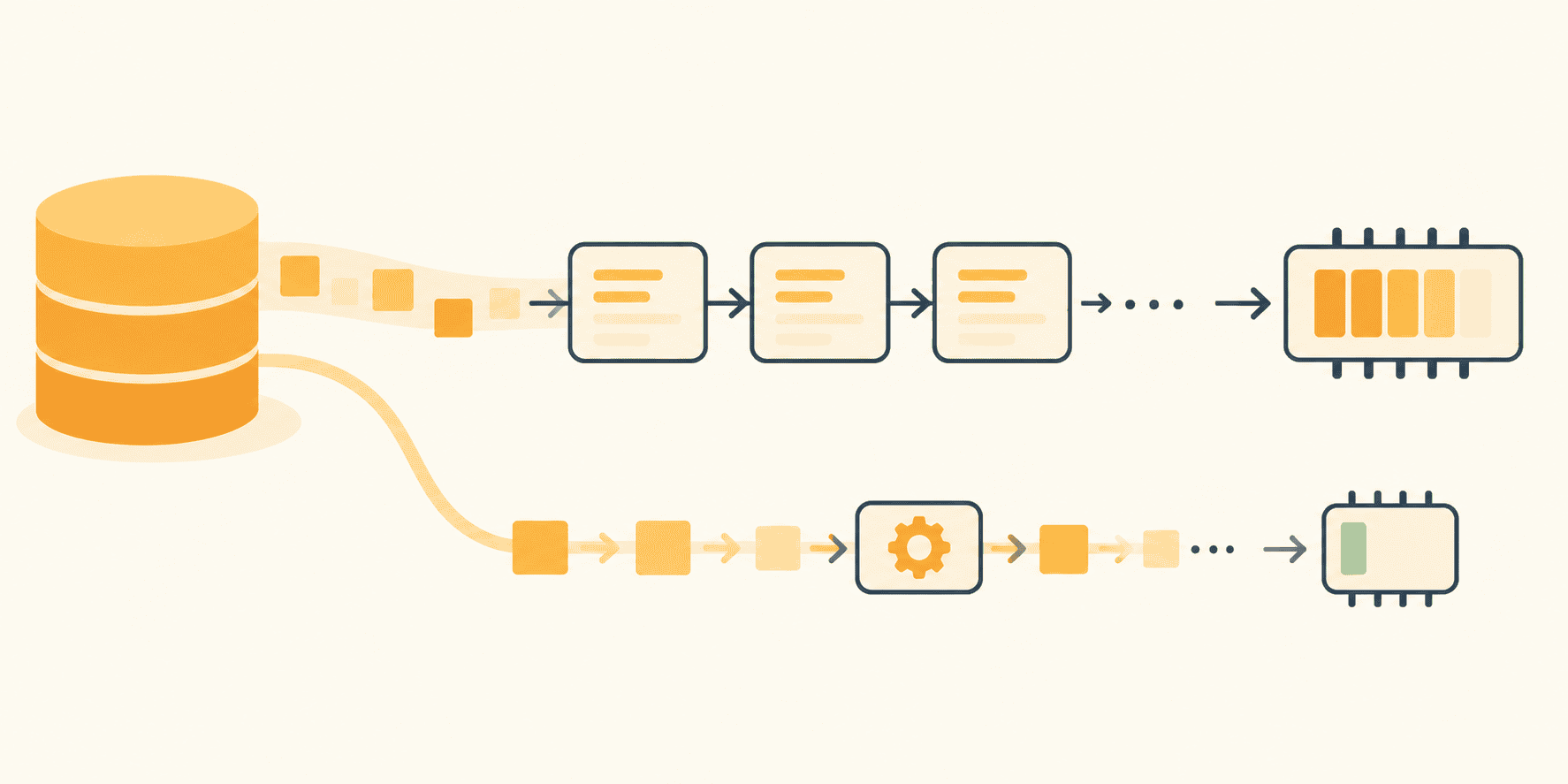
When a loop like for line in f executes, Python invokes iter(f) once to establish the iterator, followed by repeated calls to next() on that iterator until a StopIteration exception is raised. Far from being an error condition, StopIteration is simply the protocol’s standard mechanism for signaling the end of a stream.
The underlying rules governing this behavior are straightforward:
__iter__(): Returns the iterator object itself.__next__(): Returns the next item from the container. If no items remain, it raisesStopIteration.
numbers = iter([10, 20, 30])
print(next(numbers))  # 10
print(next(numbers))  # 20
print(next(numbers))  # 30
print(next(numbers))  # Raises StopIteration
Crucially, an iterator is not a detached copy of a dataset; it is a forward-only cursor. This single property enables efficient streaming: traversing a 9 GB file requires only a modest read buffer rather than 9 GB of allocated strings.
Avoiding the Exhausted Iterator Trap
The forward-only nature of iterators is a frequent source of subtle bugs. Once an iterator raises StopIteration, it remains exhausted; it cannot be rewound.
When a generator appears to return empty results on a subsequent loop, it is rarely broken—it was simply consumed during an earlier diagnostic check, such as a len() evaluation, a debug print(), or an accidental list() conversion. To fix this, developers must either consume the stream precisely once or re-instantiate the generator function that produced it.
Supporting Context & Metrics: Building the Pure-Python Streaming Pipeline
1. Leverage the File Object First
Before writing custom generator code, engineers should exploit the memory efficiencies already provided by Python’s standard library. An open file object is naturally its own memory-efficient iterator.
While f.read() loads an entire file into a monolithic string, and f.readlines() constructs a memory-heavy list of strings, iterating directly over the file handle (for line in f) reads data in buffered, incremental chunks:
# EAGER: The entire file is loaded into a list of strings first
with open("app.log") as f:
    lines = f.readlines()
for line in lines:
    handle(line)

# LAZY: Exactly one line resides in memory at any given moment
with open("app.log") as f:
    for line in f:
        handle(line)
2. Transforming Steps into Generator Functions
To maintain modularity without sacrificing memory efficiency, parsing and filtering logic can be encapsulated within generator functions utilizing the yield keyword. Any function containing yield becomes a generator object upon invocation; its internal body does not execute immediately, but rather advances one step at a time as the caller requests values.
import re

LINE = re.compile(r"^(?P<ts>S+) (?P<level>[A-Z]+) (?P<service>[w-]+)(?P<rest>.*)$")

def read_lines(paths):
    for path in paths:
        with open(path, encoding="utf-8") as f:
            yield from f

def parse_records(lines):
    for line in lines:
        match = LINE.match(line)
        if match is None:
            continue  # Skip, log, or metrics-increment; never crash the stream
        record = match.groupdict()
        record["fields"] = dict(
            item.split("=", 1) for item in record.pop("rest").split() if "=" in item
        )
        yield record

def only_level(records, level):
    for record in records:
        if record["level"] == level:
            yield record
By leveraging yield from, the read_lines function seamlessly chains multiple rotated log files into a unified stream while ensuring each individual file is safely closed before the next opens.
3. Composing the Pipeline
Wiring these discrete generators together establishes a reactive chain of assignments that executes zero computation until values are explicitly pulled from the terminal end:

from itertools import islice

lines = read_lines(["app.log.2", "app.log.1", "app.log"])
records = parse_records(lines)
errors = only_level(records, "ERROR")
slow = (r for r in errors if int(r["fields"].get("latency_ms", 0)) > 1000)
rows = ((r["ts"], r["service"], r["fields"].get("request_id", "-")) for r in slow)

for row in islice(rows, 5):
    print(row)
The parenthesized expressions represent generator expressions—the memory-conscious counterparts to list comprehensions. While a list comprehension inside square brackets materializes every element instantly, a generator expression evaluates a single element per request.
Official Statements and Architectural Benchmarks
Measuring Real-World Memory Footprints
A pipeline that looks lazy and a pipeline that is lazy can behave entirely differently under load. The only definitive method for verifying memory characteristics is empirical measurement using Python’s built-in tracemalloc module:
import tracemalloc

tracemalloc.start()

# Execute pipeline operations
write_batches(rows, "slow_errors.tsv")

current, peak = tracemalloc.get_traced_memory()
tracemalloc.stop()

print(f"Current memory: current / 1e6:.1f MB | Peak memory: peak / 1e6:.1f MB")
When evaluating performance across a synthetic 200,000-line log file (~17 MB on disk), the architectural contrast is stark:
- The Eager Script: Peaked at 198 MB of RAM as it loaded, duplicated, and filtered lists in memory.
- The Streaming Pipeline: Peaked at a negligible 0.4 MB of RAM, with peak consumption remaining virtually flat regardless of whether the source file grew to 20 GB.
Batching at the Boundary
Laziness should not prevent integration with external datastores, APIs, or filesystems. Most downstream systems require batched payloads rather than individual records. The golden rule of streaming architecture is to materialize data only at the boundary, in explicitly bounded batch sizes.
In Python 3.12 and newer, itertools.batched() natively handles this requirement:
from itertools import batched

def write_batches(rows, path, size=1000):
    with open(path, "w", encoding="utf-8") as out:
        for batch in batched(rows, size):
            out.writelines(f"tstservicetridn" for ts, service, rid in batch)
            out.flush()
For legacy Python environments (3.11 and earlier), an equivalent utility can be constructed cleanly using islice:
def batched_legacy(iterable, n):
    it = iter(iterable)
    while batch := tuple(islice(it, n)):
        yield batch
Future Outlook: The Limits and Horizons of Streaming Architecture
While generators and iterators solve the vast majority of memory-pressure challenges associated with line-oriented logs, exports, and JSONL datasets, developers must remain cognizant of algorithmic boundaries.
Certain computational tasks fundamentally cannot be streamed. Global sorting, exact deduplication across an entire unindexed file, or calculating precise statistical percentiles over unstructured latency metrics require access to the entire dataset simultaneously. For these workloads, engineers must rely on external disk-based sorting utilities or approximate streaming algorithms (such as HyperLogLog for cardinality estimation).
As modern machine learning pipelines scale to ingest multi-terabyte pre-training corpora, fine-tuning datasets, and real-time streaming telemetry, the principles of lazy evaluation remain indispensable. By treating data flow as a continuous, bounded stream rather than a static collection, Python developers can write resilient, scalable, and highly performant applications that shrug off dataset inflation with ease.