Executive Overview: A Season of Rapid Evolution
As the calendar turns toward autumn, the web development landscape is experiencing a period of accelerated growth, characterized by a fundamental rethinking of how we handle interaction, layout, and browser-level capabilities. Edition #18 of What’s !important highlights a significant transition: we are moving away from "hacks" and workarounds toward native, declarative CSS solutions that prioritize performance, accessibility, and developer experience.
From the introduction of the class-prefix selector to the sophisticated application of the Custom Highlight API, the last few weeks have been a masterclass in progressive enhancement. This report synthesizes the most impactful updates from the CSS ecosystem, exploring how modern browsers are beginning to bridge the gap between complex JavaScript-driven interactions and high-performance CSS.
Detailed Chronology: Key Developments in Web UI
Precision Interactions: Tooltips and Interest Invokers
The conversation surrounding UI micro-interactions was dominated by the technical challenge of tooltip behavior. Developers have long struggled with the "Goldilocks" problem: tooltips must appear quickly enough to be responsive but be delayed enough to avoid "jitter" during rapid mouse movement.
Abhishek Jakhar opened this discourse by advocating for a hybrid approach—a delay-then-instant strategy. By implementing a delay, developers prevent accidental triggers, while an immediate disappearance ensures the interface remains uncluttered when the user navigates away.
Chris Coyier furthered this by introducing the concept of Interest Invokers. This emerging standard provides two specific CSS properties: interest-delay-start and interest-delay-end. While currently limited to Chrome, these properties represent a shift toward browser-native handling of user intent, effectively removing the need for complex, performance-heavy JavaScript event listeners to manage state.
The Rise of <geolocation>
The Geolocation API has historically been a source of developer frustration, requiring intricate handling of hardware permissions and asynchronous state management. The introduction of the <geolocation> element attempts to simplify this lifecycle. However, as noted in recent analysis, the element introduces new "styling restrictions" that require developers to rethink their UI patterns.
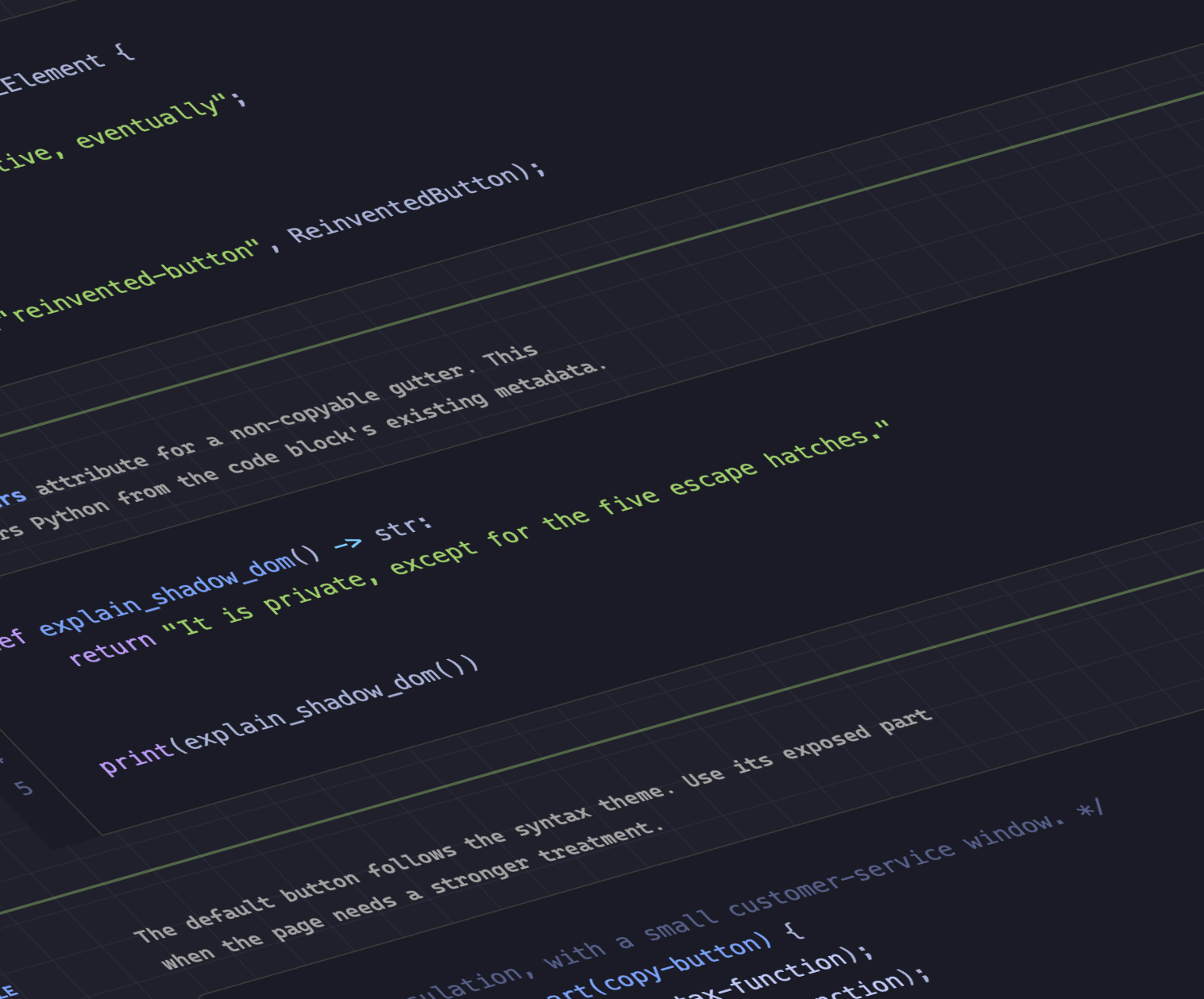
By utilizing the <geolocation> element alongside the legacy Geolocation API, developers can implement a robust, backwards-compatible strategy. This approach exemplifies the industry’s commitment to progressive enhancement: providing a modern, native experience for those on supported browsers while maintaining functional stability for the remainder of the user base.
Syntax Highlighting via ::highlight()
Dave Rupert’s MicroLighter project has brought the power of the CSS Custom Highlight API to the forefront of web performance. By moving syntax highlighting logic away from DOM-heavy span-nesting and into the browser’s internal highlight layer, MicroLighter significantly reduces memory consumption and layout thrashing. This development, supported by documentation from Geoff Graham and others, marks a pivotal moment for developers building code-heavy documentation sites and IDE-like web interfaces.
Supporting Context & Metrics: Structural Innovations
CSS Grid and Custom Properties
Temani Afif has pushed the boundaries of CSS Grid by demonstrating how to extract spatial information into CSS Custom Properties. By calculating the number of rows, columns, and individual cell coordinates, developers can now build highly responsive grid layouts that react to their own internal structure.
This is not merely a layout tool; it is a gateway to proximity-based design. As Afif demonstrated, these coordinates can be leveraged to detect hover proximity, allowing for sophisticated, physics-inspired UI behaviors that were previously only possible through complex coordinate geometry in JavaScript.
The Great Toggle Debate: Two-State vs. Tri-State
A spirited debate has emerged regarding the architecture of Dark Mode toggles. Lea Verou, a vocal proponent of the two-state model, argues for simplicity and standard user expectations. Conversely, Bramus has championed the tri-state approach, which allows for "Auto," "Light," and "Dark" modes, providing users with more granular control over their environment.
The industry currently seems to be settling on the "auto-until-overridden" approach. This middle ground respects the user’s system-level preference while providing an override that persists for the session, balancing user autonomy with a seamless "set it and forget it" experience.
Official Statements and Technical Proposals
The Future of CSS Selectors: class-prefix
Bramus’s introduction of the class-prefix selector (e.g., .something-*) has sent ripples through the CSS community. While not yet implemented, the industry consensus is that this feature is a "must-have" for design system architecture.
Comparative Performance Analysis:
- Current Attribute Selectors:
[class^="something-"]and[class*=" something-"]are expensive for the browser to compute, as they require string matching across the entire class attribute string. - Proposed
class-prefix: By providing a native token-based selector, the browser can optimize the matching process, leading to significant performance gains in large-scale applications with thousands of elements.
Feature Detection: named-feature()
In a move to improve the utility of @supports, the named-feature() function has been proposed and is currently undergoing testing in Chrome. This allows developers to query for specific browser capabilities—such as complex transform behaviors or specialized anchor positioning—that were previously invisible to CSS feature detection. This capability ensures that as the web platform expands, developers can safely adopt cutting-edge features without breaking legacy experiences.
Future Outlook: The Balancing Act
As we look toward the final quarter of the year, the focus is clearly shifting toward "balance" in layout. Ahmad Shadeed’s deep dive into flex-wrap: balance illustrates this trend perfectly. Much like the text-wrap: balance property that revolutionized typography, flex-wrap: balance allows the browser to intelligently distribute flex items across rows or columns, preventing "orphan" items that create visual imbalance.
Strategic Recommendations for Developers:
- Embrace Progressive Enhancement: Continue to build with modern standards like
::highlight()and interest invokers, but maintain robust fallbacks using standard JavaScript APIs. - Optimize for Performance: Shift visual logic (like syntax highlighting or hover states) from the DOM to native CSS properties to reduce main-thread activity.
- Prepare for New Selectors: Begin auditing current CSS architectures. As
class-prefixselectors gain traction, standardizing naming conventions (e.g.,component-variant) will facilitate a faster migration to these more performant selectors.
The web of late 2026 is becoming a platform where the browser does more of the heavy lifting. By offloading complex UI state, layout balancing, and feature detection to native CSS, developers are freeing up JavaScript to focus on core application logic. As we transition into the cooler months, the velocity of these updates suggests that the "browser-as-an-OS" paradigm is no longer a distant vision, but a daily reality.
Stay tuned to What’s !important as we continue to track these developments and provide the necessary context to keep your codebase at the cutting edge.