Executive Overview
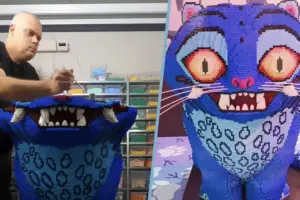
As anticipation builds globally for news regarding the cinematic sequel to the cultural phenomenon KPop Demon Hunters, fans and creators are finding inventive ways to channel their enthusiasm. For Belgian professional Lego builder Björn Ramant, that anticipation materialized into a staggering, monumental endeavor: a life-sized, 37,000-brick sculpture of Derpy, the beloved feline spirit-animal courier from the hit franchise.
Unveiled to the public at Lego World 2026 in Utrecht, the Netherlands, Ramant’s colossal creation has quickly become one of the convention’s standout attractions. Standing nearly half the height of its creator, the sculpture represents a masterclass in structural engineering using interlocking plastic bricks. It is a project that required meticulous digital sketching, relentless brick-sorting, and an internal scaffolding of heavy-duty metal poles to prevent the massive feline from collapsing under its own weight.
Ramant’s journey from a corporate software architect to a celebrated, independent Lego designer—operating under the studio name The Pieces Fit—underscores a broader trend of professionals channeling technical precision into tactile, artistic brickwork. This feature explores the meticulous creation of the colossal Derpy sculpture, charting the timeline of its construction, examining the commercial landscape of KPop Demon Hunters merchandise, detailing Ramant’s transition into professional brick-artistry, and assessing the future outlook for both the artist and the expanding franchise he celebrates.
Detailed Chronology: From Digital Concept to Utrecht Exhibition
The genesis of what would become a 37,000-brick masterpiece began long before the first block was clicked into place. For Ramant, the project required a carefully phased timeline spanning conceptualization, structural problem-solving, and physical assembly.
Phase One: Conceptualization and Digital Drafting (Late 2025)
Before committing a single physical brick to the build, Ramant engaged in weeks of intensive digital modeling and sketching. Capturing the distinct, animated personality and geometry of a spirit-animal courier from an animated universe using angular plastic blocks requires immense spatial visualization. Translating organic curves into a medium defined by ninety-degree right angles is the ultimate test of a Lego designer’s mettle. During this phase, Ramant mapped out the color palette, sourced rare tile configurations, and calculated weight distribution ratios to ensure the sculpture wouldn’t warp or buckle during construction.
Phase Two: The Build Begins (November – December 2025)
The physical assembly commenced in late autumn. Working out of his Belgian studio, Ramant spent roughly two and a half months executing the build. Observers of his process have frequently likened him to a human 3D printer, methodically layering rows of bricks with clinical precision. Because the sculpture stands at nearly half the height of an adult human, standard brick-to-brick friction alone was insufficient to maintain structural integrity. Ramant engineered a hidden internal framework utilizing four industrial metal poles as vertical scaffolds, threading the plastic bricks around this metallic spine to guarantee absolute stability.
Phase Three: Unveiling at Lego World 2026 (February 2026)
Following months of painstaking isolation in his studio, the completed Derpy sculpture made its public debut at Lego World 2026 in Utrecht, Netherlands. Placed on display among some of Europe’s most impressive fan-made architectural and character builds, the feline courier immediately drew crowds. A captivating timelapse video documenting the assembly process—showcasing Ramant’s methodical, rapid-fire building style—went viral across design and fandom forums, cementing the sculpture’s status as a major cross-over event between modern animation fandom and professional brick artistry.
Supporting Context & Metrics: The Anatomy of a Brick Masterpiece
To fully grasp the magnitude of Ramant’s achievement, one must examine the specific metrics and logistical challenges involved in constructing a sculpture of this scale.
By the Numbers: The Derpy Build
- Total Brick Count: Approximately 37,000 individual Lego elements.
- Construction Duration: 2.5 months (including digital design, component selection, and physical assembly).
- Internal Support: 4 heavy-duty metal poles functioning as vertical load-bearing scaffolds.
- Height: Approximately half the height of the creator.
- Current Exhibition: Lego World 2026, Utrecht, The Netherlands.
The Engineering Challenges of Large-Scale Lego Art
Amateur builders often underestimate the physics involved in large-scale sculpture. While small sets rely on the standard clutch power of ABS plastic blocks, structures weighing tens of kilograms suffer from internal shear stress. Without reinforcement, the lower tiers of a large sculpture will gradually compress, leading to bulging, cracking, and eventual structural failure.
Ramant’s background as a software architect heavily influenced his approach to this problem. Rather than treating the build purely as an artistic endeavor, he approached it as a structural engineering challenge. By integrating the four metal support poles into the core anatomy of the sculpture, he effectively decoupled the aesthetic outer shell from the load-bearing interior. This allowed him to focus on capturing the organic contours of Derpy’s fur, expression, and posture without compromising the safety of the exhibition piece.
Commercial Tie-Ins and Retail Landscape
While monumental gallery pieces like the 37,000-brick Derpy draw awe at conventions, mainstream fans can also participate in the brick-building trend at home. Concurrently with the exhibition buzz, official merchandise channels have highlighted smaller-scale building kits. For enthusiasts seeking a manageable desktop display, retail availability has expanded, with platforms like Amazon offering promotional price cuts on official sets, such as the Lego Derpy and Sussie companion pack, recently marked down by 20% to $56.
Furthermore, the broader ecosystem surrounding the KPop Demon Hunters franchise continues to thrive. Beyond brick-based interpretations, fans looking to immerse themselves further in the universe have turned to expanded media, including the recently launched official KPop Demon Hunters comic book series, which bridges narrative gaps between screen appearances.
Official Statements and Artist Profile: Meet Björn Ramant
The transition from the structured, digital world of corporate software architecture to the vibrant, tactile universe of professional Lego design is a narrative of calculated risk and unyielding passion.
From Software Architecture to The Pieces Fit
Based in Belgium, Björn Ramant spent years navigating the logical, systematic world of software development. However, his latent passion for physical creativity eventually overrode his corporate career. A major turning point arrived in 2020 when Ramant competed in the high-stakes televised building competition Lego Masters. The experience validated his advanced spatial and construction skills on a national stage.
Following his appearance on the show, Ramant took the leap into entrepreneurship, founding his own custom design business under the fitting moniker The Pieces Fit. Through this studio, he specializes in bringing complex, licensed, and original characters to life using standard and modified Lego elements.
The Creative Philosophy Behind the Feline Courier
In discussions regarding his work, Ramant has frequently emphasized the meditative yet intensely demanding nature of large-scale character builds. When asked about the challenges of rendering Derpy in Lego form, the artist noted that the hardest part is never the placement of the bricks, but rather capturing the "soul" of the character.
"When you are working with a medium that is fundamentally square, trying to convey the soft, fluid movement of an animal spirit is an exercise in optical illusion," Ramant observed during discussions about his design process. "You have to trust the geometry, but you also have to know when to break the rules of standard stacking to create an emotional expression that resonates with fans of the source material."
While the massive Derpy model currently stands as a crowning achievement of his recent exhibition work, Ramant has already acknowledged that his task is not yet finished. True to the dynamic duo dynamic of the KPop Demon Hunters lore, the monumental feline will soon need a companion piece. As Ramant noted with a mix of anticipation and exhaustion following the Utrecht unveiling: "Now I’ll have to add Sussie."
Future Outlook: What Lies Ahead for Brick Art and the Franchise
As the worlds of pop culture entertainment and high-end artisan brick construction continue to intersect, the horizon looks exceptionally bright for both independent creators and major intellectual properties.
The Evolution of Fan-Driven Art
The viral success of Ramant’s Derpy sculpture points to a broader evolution in how fandoms consume and celebrate media. In an era where digital content is infinite and easily streamable, physical, labor-intensive tributes hold a distinct psychological value. The months of sweat, blistered fingers, and structural troubleshooting poured into a 37,000-brick sculpture create a tangible anchor for fan communities. Exhibitions like Lego World 2026 serve as physical pilgrimage sites where digital fandom transforms into tangible, shared reality.
Franchise Expansion and Merchandise Trends
For KPop Demon Hunters, the ongoing engagement from elite builders like Ramant, combined with commercial expansions into comics, official building sets, and merchandising discounts, indicates a healthy, multi-channel franchise strategy. As producers prepare for future cinematic installments, the active grassroots participation of creators ensures that audience engagement remains high during inter-release windows.
Ramant’s Next Steps: Completing the Duo
Looking forward, the immediate horizon for The Pieces Fit studio involves expanding the current exhibition footprint. With Derpy successfully charming audiences in Utrecht, the logical next step—building Sussie—will likely dominate Ramant’s workshop schedule over the coming months. Whether the companion build will match the 37,000-brick scale of its feline counterpart remains to be seen, but one thing is certain: the global community of brick enthusiasts and animation fans will be watching closely as the next chapter of this physical art phenomenon unfolds.