Executive Overview: Bridging the Gap Between Human and Machine
The landscape of ecommerce is undergoing a seismic shift, moving away from static, human-centric web pages toward a dynamic, "agentic" future. On October 15, at Vercel’s Ship 26 conference in San Francisco, a landmark partnership between two ecommerce giants—Shopify and Vercel—was unveiled. Shopify CEO Tobi Lütke and Vercel CEO Guillermo Rauch took the stage to announce a new paradigm in web development: the creation of storefronts that are natively optimized for both human shoppers and AI autonomous agents.
This collaboration centers on the release of a rebuilt Hydrogen software development kit (SDK) from Shopify and an innovative, AI-enabled open-source storefront template from Vercel, aptly titled "Vercel Shop." By providing developers with the tools to build storefronts that are machine-readable, the duo is laying the infrastructure for an era where AI agents—acting as personal shopping assistants—can browse, compare, and manage carts on behalf of human consumers. This is not merely a technological incrementalism; it is a fundamental architectural change that treats AI as a first-class citizen of the digital marketplace.
Detailed Chronology: A Partnership Forged in Innovation
The October announcement serves as the culmination of a strategic trajectory that began in earnest earlier this year. The foundation was laid on June 30, when Vercel and Shopify announced a significant overhaul of the Hydrogen SDK. Hydrogen, which had previously been perceived as a rigid framework, was rebuilt to offer greater modularity, allowing developers to leverage Shopify’s backend power across a wider array of JavaScript frameworks and runtimes.
Following the June rebuild, the companies focused on the "last mile" of the user experience: the storefront interface. While the backend infrastructure was robust, the presentation layer remained tethered to traditional browser-based interaction. The development of Vercel Shop was the logical progression. By September, engineering teams from both organizations were stress-testing the template’s ability to communicate with large language models (LLMs) and external autonomous agents. The October 15 unveiling at Ship 26 signaled that these tools were finally ready for enterprise-level implementation, effectively democratizing the ability to build "agent-ready" storefronts.
Supporting Context: The Technical Anatomy of Agentic Ecommerce
To understand the significance of this move, one must consider the historical difficulty of building custom storefronts. Traditionally, developers have had to laboriously connect a frontend experience to backend systems for inventory, pricing, and cart management. This "plumbing" often breaks, leading to inconsistent user experiences.
The new Hydrogen SDK and Vercel Shop template address these complexities through three primary technical pillars:
- Unified Data Modeling: By organizing ecommerce functions into shared, reusable tools, developers no longer need to reinvent the wheel for standard tasks like product fetching or inventory verification.
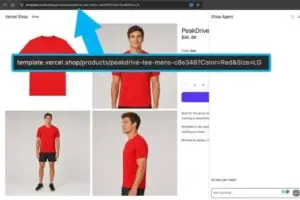
- Semantic URL Parameters: As evidenced by the Vercel Shop template, product data is now exposed through structured, machine-readable URL parameters. This allows an AI agent to "see" a product’s color, size, and availability without needing to parse the visual HTML of a page.
- The AI Gateway Integration: By leveraging Vercel’s AI Gateway, developers can provide a secure, standardized bridge for AI agents to interact with store data, ensuring that communication remains efficient and secure.
Shopify’s "Remixable" Philosophy
During the keynote, Shopify’s Tobi Lütke articulated the core philosophy driving this collaboration. "Checkouts are ridiculously hard to get right," Lütke noted, highlighting that the complexity of global payments, taxes, and shipping logic requires decades of refinement. By keeping the checkout layer consistent while allowing developers to "remix" the frontend using Hydrogen, Shopify is empowering brands to maintain their unique identity without sacrificing the security and reliability of the underlying commerce engine. This modularity is the cornerstone of the new era; it allows businesses to build bespoke experiences that are as unique as their brand, all while remaining tethered to a battle-tested commerce infrastructure.
The Dual-Experience Paradigm: Humans vs. Agents
Vercel Shop introduces a dual-track user experience. On one hand, it functions as a high-performance, visually stunning storefront for human users. On the other, it provides a "headless" interface for autonomous agents.
The Rise of the External Agent
An AI agent acting on a consumer’s behalf has different needs than a human shopper. A human requires high-resolution imagery and persuasive copy; an agent requires clean, semantic data. When an agent searches for a "black jacket, size Large," it does not need to render a CSS-heavy page. Instead, it interacts with the structured product information exposed by the template. This reduces latency, lowers bandwidth consumption, and increases the success rate of automated transactions.

The Store Assistant
Beyond external agents, Vercel Shop integrates an internal AI assistant—a conversational interface that serves as a personalized shopping concierge. Similar in utility to Amazon’s Alexa or Walmart’s Sparky, this assistant can:
- Answer questions about store policies or material compositions.
- Navigate complex product catalogs to provide tailored recommendations.
- Manage the shopping cart directly through chat commands.
Crucially, this assistant is fully synchronized with the visual storefront. If a human user adds a product to their cart via the visual interface, the assistant is immediately aware of that addition. If the shopper then asks the AI to "change the jacket to a medium," the state of the cart is updated globally. This creates a seamless, omnichannel experience that was previously impossible to orchestrate without expensive, proprietary middleware.
Official Statements and Strategic Alignment
The collaborative effort is rooted in a shared vision of the future of the web. Guillermo Rauch, CEO of Vercel, emphasized that the goal is to make the web "smarter" by default. By enabling the storefront to speak the language of AI, developers are essentially creating an API for human-like interaction.
Shopify, meanwhile, continues to position itself as the "operating system" for modern commerce. By providing the open-source infrastructure through Hydrogen, they are ensuring that their platform remains the default choice for the next generation of web developers who are increasingly looking to integrate AI into every facet of their digital presence. The message from both companies is clear: the future of ecommerce is not a choice between humans and AI, but an integrated ecosystem where both can thrive.
Future Outlook: The Road Ahead
As we look toward 2026 and beyond, the implications of this collaboration are profound. We are moving toward a world where shopping is an asynchronous activity. A consumer might tell their personal AI, "Find me a winter coat that fits my style and budget," and the AI will traverse various storefronts—all built on frameworks like Vercel Shop—to negotiate the best options, check availability, and prep the cart.
However, the technology is still in its infancy. Shopify has been careful to note that the AI assistant cannot process payments or finalize orders, ensuring that the critical "checkout" moment remains under human control for security and compliance reasons. This "human-in-the-loop" model will likely define the next few years of development.
Furthermore, as the Vercel Shop template continues to be refined, we can expect to see an explosion of "agent-first" design patterns. Developers will likely start prioritizing semantic markup and structured data over purely aesthetic design choices, as their stores will be judged not just by how they look, but by how easily they can be "read" by the next generation of shopping agents.
In conclusion, the Shopify-Vercel partnership marks the official end of the era where a website was merely a digital brochure. We are entering an era of "intelligent storefronts." For merchants, the challenge will be to adapt their content to be as intelligible to an AI as it is to a human; for developers, the challenge will be to master these new frameworks; and for consumers, the change promises a future where shopping is faster, smarter, and significantly more personalized. The infrastructure is now in place—the rest is up to the builders.