Executive Overview
For years, digital marketers, brand strategists, and paid-search professionals have scrambled to understand how generative artificial intelligence fits into the consumer purchase funnel. As platforms like ChatGPT transform from novel tech experiments into daily utilities, brands have naturally rushed to optimize their digital assets for conversational AI visibility. However, a groundbreaking new study released by audience research firm SparkToro suggests that businesses may be barking up the wrong tree.
Analyzing nearly 42,000 ChatGPT conversations generated by a demographic-weighted U.S. consumer panel, SparkToro revealed that explicit purchase intent appears in a mere 6.9% of all conversations. Furthermore, an overwhelming 87.9% of ChatGPT responses fail to mention a single brand, product, or business name.
These findings have prompted SparkToro co-founder and CEO Rand Fishkin to issue a sharp warning to marketers: investing heavily in ChatGPT-specific visibility optimization might be a misallocation of resources. Instead, Fishkin argues that the true battleground for AI search visibility is Google—specifically through features like AI Overviews and AI Mode. This in-depth report explores the methodology behind the SparkToro study, breaks down how Americans actually use generative AI in 2026, and analyzes the profound implications this data holds for digital advertising budgets, search engine optimization (SEO), and pay-per-click (PPC) strategies.
Detailed Chronology: How the SparkToro Study Came Together
To understand the weight of these findings, it is essential to examine how the data was gathered, filtered, and analyzed. The research project represents one of the most comprehensive independent look-ins at consumer-driven AI interaction patterns to date.
The Data Pipeline: Verso and the U.S. Panel
The foundational data for the analysis was provided by Verso, a platform that tracks users’ ChatGPT conversation histories when they willingly link their accounts via an opt-in tool. Verso stores these imported conversations and includes them—fully de-identified—in licensed datasets for business and academic researchers.
The initial dataset comprised 41,961 conversations generated by 12,321 individual users between January 1 and October 29, 2026. To ensure the findings could be generalized to the broader U.S. populace, researchers utilized a sub-sample of 9,675 panelists whose demographic profiles contained enough data to be statistically weighted against the 2024 United States Census. This weighting adjusted for skews toward younger demographics, female users, and lower-income brackets.
Filtering Out the Noise: Handling Power Users
Before running analytics on the dataset, SparkToro executed a vital data-cleaning step: they eliminated the 131 heaviest users in the panel. These power users averaged more than 33 prompts per active month. While they accounted for roughly 1% of the total panelists, they were responsible for an outsized 21% of all generated prompts.
Removing these outliers ensured that the resulting percentages reflected typical consumer behavior rather than the extreme edge-cases of AI power-users or automated scripts. For the remaining weighted group, the average user sent 9.9 prompts between January and October.
Coding Conversations via Claude
To categorize the massive volume of text, SparkToro deployed a written codebook to Anthropic’s advanced AI model, Claude. Each conversation was systematically coded based on its title, up to six user-generated prompts, the initial lines of ChatGPT’s responses, and any embedded product cards or bolded brand names.
To verify accuracy, an independent coder recoded a random sample of conversations. The validation metrics were exceptionally high: the two coders agreed on core functional categories 90% of the time and matched on brand tags between 97% and 99% of the time, establishing robust data integrity for the final report.
Supporting Context & Metrics: How Consumers Use ChatGPT
The core takeaway of the SparkToro report centers on a stark reality: consumers do not primarily view ChatGPT as a shopping mall or an e-commerce catalog. Instead, they use it as a creative suite, a personal assistant, and an informational engine.
The Breakdown of Consumer Intent
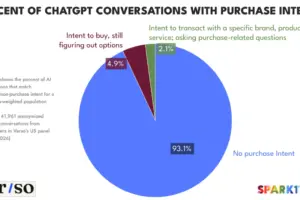
When examining purchase intent within the weighted U.S. panel, SparkToro’s graph categorized consumer interactions into three distinct tiers:
- No Purchase Intent (93.1%): The vast majority of conversations involve tasks completely detached from commerce, such as debugging code, brainstorming creative writing, summarizing articles, or asking general knowledge questions.
- Researching Options (4.9%): The user has a plan to purchase a product or service and is actively evaluating options, comparing features, or weighing alternatives.
- Specific Brand Inquiry (2.1%): The user is directly asking questions related to purchasing a specific brand, product, or service.
When combining the options-researching and brand-inquiry brackets, roughly 7% of ChatGPT usage touches upon the buyer journey—a figure that roughly aligns with the 12.1% of responses that ended up naming at least one brand, product, or company.

+-------------------------------------------------------+
|          ChatGPT Conversation Intent Breakdown        |
+-------------------------------------------------------+
| No Purchase Intent                         |   93.1%  |
| Researching Options                        |    4.9%  |
| Asking Questions About a Specific Brand    |    2.1%  |
+-------------------------------------------------------+
Primary Use Cases: What Are People Actually Doing?
Every conversation in the study was assigned a single category representing its primary goal, prioritizing output type over the underlying topic (for instance, asking ChatGPT to draft a refund email to PayPal was categorized under writing and communication rather than shopping).
The primary use cases shook out as follows:
- Images and Visual Design: 17.6% of conversations (the leading category).
- Information and Entertainment: 14.4% of conversations.
- Writing and Communication: 12.7% of conversations.
- Shopping, Brands, and Local Services: 5.3% of conversations.
Contrasting OpenAI’s Native Data
SparkToro compared its panel findings against OpenAI’s official Signals data published in September. While OpenAI’s dataset skewed more heavily toward software writing and technical support, the SparkToro consumer panel leaned more toward image generation and how-to inquiries.
Rand Fishkin noted that this discrepancy is entirely logical. OpenAI’s dataset reflects global messaging across Free, Go, Plus, and Pro accounts, explicitly excluding enterprise usage, Codex, and—most importantly—API calls. Conversely, the SparkToro panel captures everyday consumer interactions heavily mediated through mobile devices.
Official Statements and Industry Implications
The low frequency of commercial intent on ChatGPT has ignited widespread debate among digital marketers. To properly evaluate the data, industry experts are weighing the platform dynamics against traditional search engines.
Rand Fishkin on Advertising and Visibility
Reflecting on the low volume of commercial and transactional prompts, Rand Fishkin pulled no punches in his assessment:
"I suspect this is bad news for ChatGPT’s advertising opportunities."
Fishkin contrasted these metrics with historical search engine data. In a December 2024 SparkToro analysis of over 330 million Google searches spanning 21 months, commercial intent accounted for 14.5% of searches, while transactional searches sat at 0.69% (though definitions across studies vary, preventing a direct apples-to-apples percentage match). More importantly, traditional search engines have long served as primary gateways for high-intent purchase queries.
Because 87.9% of ChatGPT responses omit brand names entirely, brands fighting tooth and nail to optimize their presence within OpenAI’s ecosystem may find the return on investment difficult to justify. Fishkin summarized the strategic pivot clearly:
"The primary reason AI visibility matters is Google’s implementation of AI Overviews and AI Mode, rather than ChatGPT itself."
What This Means for PPC and SEO Teams
For pay-per-click (PPC) and search engine optimization (SEO) teams, the findings serve as both a reality check and a strategic directive.
- Re-evaluating AI Budgets: Brands rushing to allocate dedicated budgets for "ChatGPT optimization" or early conversational ads must realize that less than 7% of interactions involve active purchasing decisions.
- The Google Dominance: Because Google’s search ecosystem inherently captures far higher commercial intent, optimization efforts targeting Google’s AI Overviews will yield significantly higher commercial returns than equivalent efforts on standalone chat platforms.
- Mobile vs. Desktop Gaps: Because the panel data was predominantly recorded via mobile phones, desktop, work-account, and enterprise-level queries may be underrepresented. PPC teams must cross-reference these macro trends with their own proprietary first-party referral and conversion data before restructuring digital ad spends.
Future Outlook: Where Do Brands Go From Here?
As generative AI continues to evolve at a breakneck pace, consumer behavior will undoubtedly shift. However, the data from SparkToro and Verso provides a vital baseline for the current state of consumer tech habits in 2026.
Looking ahead, researchers hope to expand panel sizes to include robust desktop, enterprise, and API-driven tracking to capture the complete spectrum of AI interactions. Until then, prudent marketing executives should adopt a measured approach.
Key Takeaways for Brand Strategists:
- Don’t Abandon ChatGPT Entirely: While purchase intent is low, ChatGPT remains a powerhouse for brand discovery in niche creative, informational, and visual sectors. Being mentioned organically in a design or coding query still builds top-of-funnel brand equity.
- Double Down on Google AI Features: Prioritize optimization for Google Search Generative Experience (SGE), AI Overviews, and AI Mode, where consumer commercial intent is deeply entrenched.
- Rely on First-Party Analytics: Never rely solely on generalized panels. Pair insights from studies like SparkToro’s with your brand’s internal tracking metrics to see how AI platforms are actually driving referral traffic and conversions to your digital storefront.
Ultimately, while the generative AI revolution is transforming how information is consumed, the fundamental laws of consumer intent remain unchanged: people shop where they search with intent, and right now, that journey still flows primarily through traditional search engines and Google’s evolving AI integrations.