Executive Overview
The decision-making process in modern software engineering is frequently plagued by unverified dogmas, vendor pitches, and the uncritical adoption of architectural patterns. This phenomenon is particularly acute in the realm of artificial intelligence infrastructure, specifically regarding vector similarity search. A typical development team integrates pgvector into an existing PostgreSQL deployment on a Tuesday afternoon. Relational records and high-dimensional embeddings reside neatly within the same relational table, permitting a single SQL statement to execute complex metadata filters alongside nearest-neighbor lookups.
Six months later, an enterprise vendor pitch arrives in the team’s inbox, insisting with absolute conviction that the company must migrate immediately to a "real" vector database before encountering catastrophic scalability walls. Rarely does either claim come fortified with empirical benchmarks.
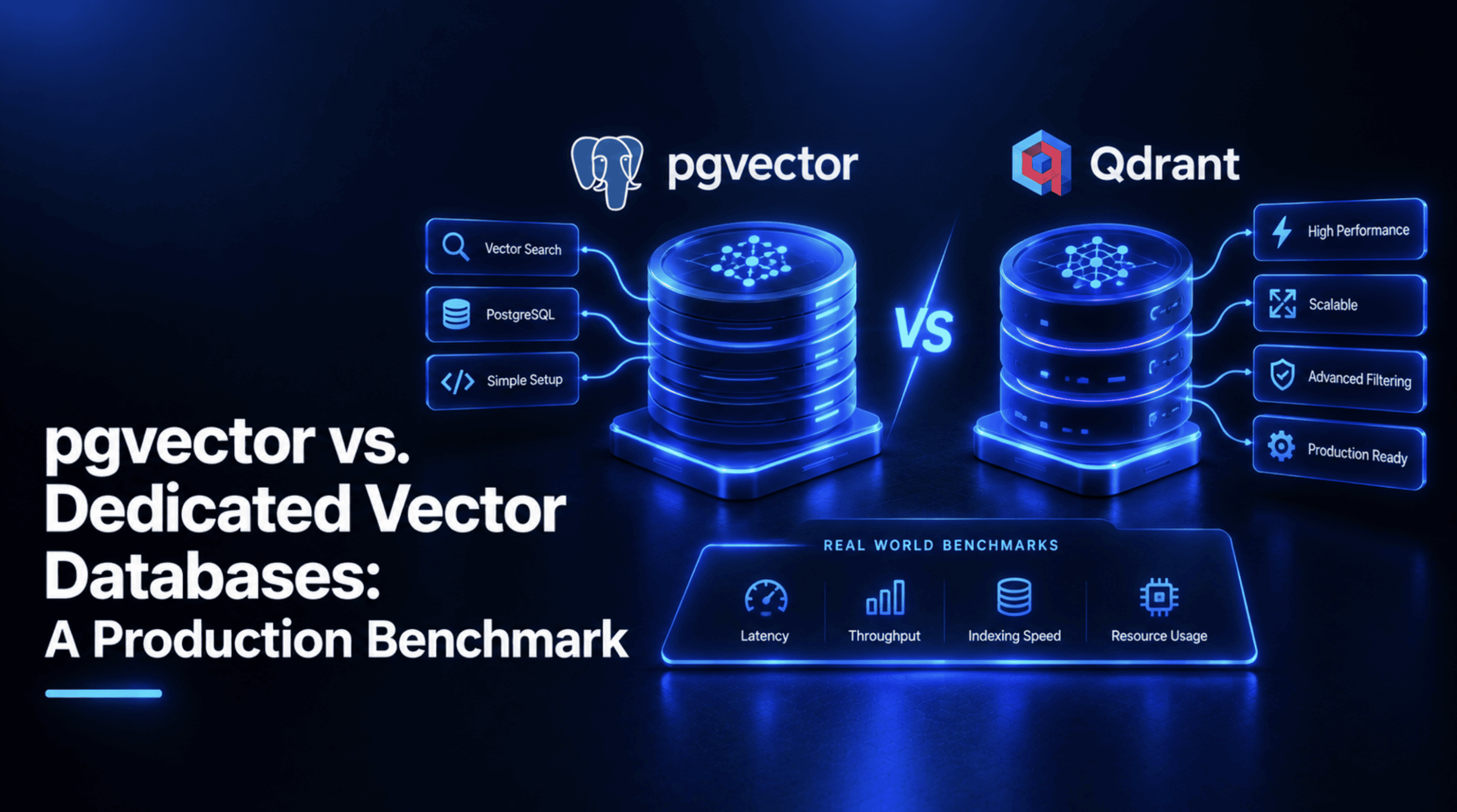
This article dismantles that information vacuum. By directly evaluating pgvector against dedicated vector database architectures—using both local rapid-prototyping exercises and transparent production-scale benchmarks—we analyze the performance realities of vector search. The objective is to replace confident marketing claims with reproducible numbers, examining throughput, tail latency, operational overhead, and data consistency to help engineering teams match their infrastructure choices to actual production workloads.
Detailed Chronology: The Evolution of Vector Storage
To understand the current architectural divergence between relational extensions and purpose-built vector engines, one must examine how the database industry arrived at this crossroads.
[Traditional RDBMS Era]
       │
       ▼ (2021-2023: Rise of LLMs & Embeddings)
[The Proliferation of Dedicated Vector Engines] (Pinecone, Qdrant, Weaviate, Milvus)
       │
       ▼ (2023-Present: Extension Renaissance)
[pgvector & Hybrid Extensions] (PostgreSQL native vector types, pgvectorscale)
The Rise of Dedicated Engines
When the generative AI wave accelerated following the widespread adoption of Large Language Models (LLMs) and transformer architectures, standard relational databases were ill-equipped to handle high-dimensional vector math at scale. Traditional B-Tree and Hash indexes failed to efficiently index vectors residing in spaces with hundreds or thousands of dimensions.
This capability gap catalyzed the rapid proliferation of dedicated vector databases. Startups and open-source projects designed new systems from the ground up:
- Pinecone pioneered fully managed, serverless vector architectures for zero-ops enterprise deployments.
- Qdrant utilized Rust to construct a memory-safe, highly performant search engine optimized for complex JSON payload filtering.
- Weaviate integrated vectorization models and hybrid BM25 search natively.
- Milvus focused on massive, distributed, GPU-accelerated architectures tailored for billion-scale industrial workloads.
The Counter-Revolution: Relational Extensions
Concurrently, database practitioners and database extension developers recognized a severe structural flaw in migrating to dedicated vector silos: data fragmentation. Storing vector embeddings in a dedicated vector engine while keeping transactional source-of-truth data in PostgreSQL, MySQL, or MongoDB necessitated complex dual-write pipelines, eventual consistency reconciliation, distributed transactions, and network overhead.
Enter pgvector. Developed as an open-source PostgreSQL extension, pgvector bridged the gap by introducing native vector types (vector) and exact/approximate nearest-neighbor search indices (IVFFlat and HNSW) directly into the world’s most popular relational database. By version 0.8.6, supporting PostgreSQL 13 through 17, pgvector challenged the absolute necessity of standalone vector infrastructure for mid-to-high-tier workloads.
Supporting Context & Metrics: Setting Up the Benchmark
To evaluate these architectural approaches objectively, we establish a controlled local benchmarking environment comparing pgvector (running on PostgreSQL 17) against Qdrant (running via its official Docker distribution).
Prerequisites and Local Initialization
The initial evaluation environment runs on standard hardware (Docker, Python 3.10+, and 8GB RAM).
For pgvector, we initialize a Docker Compose configuration:
services:
  postgres:
    image: pgvector/pgvector:pg17
    ports:
      - "5432:5432"
    environment:
      - POSTGRES_PASSWORD=benchmark
      - POSTGRES_DB=vectorbench
Executing docker compose up -d launches the container. We then establish a connection via Python, install the vector extension, and construct our schema with 1,536 dimensions—matching OpenAI’s text-embedding-3-small standard:
import psycopg2
from pgvector.psycopg2 import register_vector
from psycopg2.extras import execute_values

conn = psycopg2.connect(
    host="localhost", port=5432, dbname="vectorbench",
    user="postgres", password="benchmark"
)
conn.autocommit = True
cur = conn.cursor()

# Register the vector type extension
cur.execute("CREATE EXTENSION IF NOT EXISTS vector;")
cur.execute("""
    CREATE TABLE IF NOT EXISTS items (
        id bigserial PRIMARY KEY,
        embedding vector(1536)
    );
""")
register_vector(conn)
For Qdrant, we deploy the standalone container and initialize a matching collection via the official Python client:
docker run -d --name qdrant-bench -p 6333:6333 -p 6334:6334 qdrant/qdrantfrom qdrant_client import QdrantClient
from qdrant_client.models import Distance, VectorParams
qdrant = QdrantClient(url="http://localhost:6333")
qdrant.create_collection(
collection_name="items",
vectors_config=VectorParams(size=1536, distance=Distance.COSINE),
)Dataset Generation and Indexing
Using NumPy, we generate 100,000 synthetic vectors of 1,536 dimensions, normalized to a unit length of 1 to ensure an accurate cosine distance evaluation:
import numpy as np

NUM_VECTORS = 100_000
DIM = 1536
rng = np.random.default_rng(seed=42)

vectors = rng.normal(size=(NUM_VECTORS, DIM)).astype(np.float32)
vectors /= np.linalg.norm(vectors, axis=1, keepdims=True)
We load these vectors into pgvector using execute_values and batch-insert them into Qdrant using PointStruct objects in blocks of 1,000.
To ensure a fair performance comparison, we build identical Hierarchical Navigable Small World (HNSW) graph indices on both platforms using matching configuration parameters (m = 16, ef_construction = 64):
# pgvector HNSW Index Creation
cur.execute(
    "CREATE INDEX ON items USING hnsw (embedding vector_cosine_ops) "
    "WITH (m = 16, ef_construction = 64);"
)

# Qdrant HNSW Index Configuration
from qdrant_client.models import HnswConfigDiff
qdrant.update_collection(
    collection_name="items",
    hnsw_config=HnswConfigDiff(m=16, ef_construct=64),
)
Official Production Scale Data: Beyond the Laptop
While running 100,000 vectors on a local workstation validates syntax and connectivity, it is fundamentally insufficient for drawing production conclusions. Both systems easily process queries within low single-digit milliseconds at this diminutive scale.
To evaluate true industrial capabilities, we turn to transparent, industry-standard benchmark findings, such as those published by Tiger Data, which tested 50 million real-world Cohere embeddings (768 dimensions) on matched AWS r6id.4xlarge infrastructure (16 vCPUs, 128GB RAM).
Note on Architecture: The PostgreSQL configuration in this industrial test utilized pgvector combined with pgvectorscale—an advanced extension providing the StreamingDiskANN indexing structure.
| Performance Metric | pgvector + pgvectorscale |
Qdrant |
|---|---|---|
| p50 Latency @ 99% Recall | 31.07 ms | 30.75 ms |
| p95 Latency @ 99% Recall | 60.42 ms | 36.73 ms |
| p99 Latency @ 99% Recall | 74.60 ms | 38.71 ms |
| Throughput @ 99% Recall | 471.57 QPS | 41.47 QPS |
| p50 Latency @ 90% Recall | 9.54 ms | 4.74 ms |
| Throughput @ 90% Recall | 1,589.79 QPS | 360.81 QPS |
| Index Build Time (50M Vectors) | 11.1 hours | 3.3 hours |
Analyzing the Empirical Trade-offs
The production benchmark results dismantle polar narratives. Neither system achieves a total, uncontested victory across all operational dimensions:
- Throughput Mastery (
pgvector+pgvectorscale): At a strict 99% recall threshold, the PostgreSQL-based setup delivered more than 11 times the query throughput (471.57 QPS vs. 41.47 QPS) compared to Qdrant. - Tail Latency Stability (
Qdrant): Conversely, Qdrant exhibited superior tail latency control. Its p99 latency was nearly 48% faster (38.71 ms vs. 74.60 ms), ensuring that worst-case query execution times remained tightly bounded under high concurrent load. - Index Construction Velocity: Qdrant constructed the 50-million-vector index over three times faster than the PostgreSQL pipeline (3.3 hours versus 11.1 hours).
Crucially, both architectures successfully maintained average query latencies well below 100 milliseconds at 99% recall across 50 million high-dimensional records. This invalidates the common misconception that relational databases cannot maintain competitive speeds at scale.
Future Outlook: Choosing Your Production Architecture
As vector search becomes a standard component of enterprise application stacks, engineering teams must weigh architectural pros and cons based on concrete workload requirements rather than marketing narratives.
When pgvector is the Superior Choice
- Scale Below 10 Million Vectors: For standard enterprise applications operating within single-digit millions of embeddings, adding an extension to an existing database eliminates unnecessary infrastructure complexity.
- Strict Transactional Consistency (ACID): If your business logic requires updating relational metadata (e.g., user profiles, document permissions) and vector embeddings within a single atomic transaction without distributed locking or eventual consistency drift, PostgreSQL is unmatched.
- Operational Simplicity: Organizations with mature PostgreSQL database administration, monitoring, backup, and security pipelines can deploy vector search without onboarding entirely new database operational paradigms.
When to Select a Dedicated Vector Database
- Hyper-Scale Datasets (Hundreds of Millions to Billions): When vector inventories scale past tens of millions of records into the billion-vector territory, distributed, purpose-built storage engines provide superior horizontal scaling models.
- Strict Tail-Latency SLAs: If your product requirements dictate predictable, ultra-low p99 latencies under heavy concurrency where minor latency spikes impact user experience, dedicated engines like Qdrant offer structural advantages.
- Specialized Hardware Acceleration: Workloads requiring distributed GPU-accelerated index building and searching point directly toward architectures like Milvus.
- Zero-Operations Preference: Teams lacking dedicated database reliability engineers who require fully managed, serverless scaling will find platforms like Pinecone instrumental in reducing operational burden.
Ultimately, the choice between pgvector and a dedicated vector database is not a binary question of good versus bad. It is an engineering trade-off governed by dataset size, concurrency requirements, transactional boundaries, and team operational expertise.