Executive Overview
To the casual observer, the generative capabilities of frontier artificial intelligence systems—such as OpenAI’s GPT series, Meta’s Llama ecosystem, and Google’s Gemini—appear almost magical. When prompted, these architectures produce nuanced essays, write complex software code, and synthesize multi-disciplinary research in seconds. Yet, beneath the polished conversational interfaces and massive transformer blocks lies a rigid, highly mathematical foundation rooted not in computer science’s nascent decades, but in classical information theory formulated in the mid-20th century.
At the absolute core of how these massive models learn to generate human-like text is a deceptively intimidating metric: cross-entropy loss. Serving as the mathematical compass for optimization, cross-entropy loss guides gradient descent algorithms as they update billions or trillions of parameters during training. But why "entropy"? Where did this thermodynamic and information-theoretic concept originate, and how did it become the indispensable driving force behind the generative artificial intelligence boom?
This article bridges classical information theory with modern machine learning architectures. We will explore the historical roots of information entropy, unpack the mathematical framework of cross-entropy loss within the final output layers of Large Language Models (LLMs), and walk through a complete, reproducible Python-based visualization using NumPy and Plotly. By the end of this deep dive, you will understand precisely how mathematical "surprise" transforms raw data into fluent, context-aware machine intelligence.
Detailed Chronology: From Shannon’s Dice to Modern Transformers
1948: The Birth of Classical Information Theory
The intellectual lineage of modern AI’s loss functions traces back to a single, monumental paper published in 1948 by mathematician Claude Shannon at Bell Telephone Laboratories, titled "A Mathematical Theory of Communication." Shannon was primarily concerned with the engineering limits of signal transmission over noisy communication channels, such as telegraph wires or radio waves.
In solving these engineering problems, Shannon needed a mathematical way to quantify uncertainty, unpredictability, and information content. He introduced the concept of information entropy (often referred to simply as Shannon entropy), defining it as a mathematical measure of the "surprise" inherent in a probability distribution.
To visualize Shannon’s intuition, consider two hypothetical six-sided dice:
- Die A (The Fair Die): Every face has an equal $1/6$ probability of appearing. When you roll Die A, the outcome is entirely unpredictable. Uncertainty is at its absolute maximum.
- Die B (The Weighted Die): This die is heavily manipulated, engineered to land on the number 6 with a $95%$ probability, while the remaining five faces split the remaining $5%$. When you roll Die B, you are rarely surprised; you expect a 6 nearly every time. Uncertainty—and therefore information entropy—is exceptionally low.
Shannon codified this intuition into a formal mathematical equation for a discrete probability distribution $P$:
$$H(P) = – sum P(x) log_2 P(x)$$
This formula yields its maximum value when all possible outcomes share equal probabilities (a uniform distribution, like Die A). Conversely, the more a single outcome dominates the probability landscape, the lower the resulting entropy and uncertainty.
The Evolution Toward Neural Optimization
For decades, Shannon’s entropy remained a cornerstone of telecommunications, data compression, and statistical mechanics. However, as machine learning evolved from simple linear classifiers and logistic regression into deep neural networks, researchers required robust objective functions to measure how closely a model’s predictions matched reality.
In classification tasks—and eventually, in token-by-token sequence generation—researchers adopted cross-entropy loss. By measuring the divergence between a ground-truth probability distribution (the empirical reality) and a predicted probability distribution (the model’s output), engineers created a differentiable error signal. This signal could be backpropagated through deep networks, allowing optimization algorithms like Adam or SGD to systematically reduce model error over iterative training cycles.
Supporting Context & Metrics: LLMs as Uncertainty Engines
At their core, Large Language Models do not generate entire paragraphs, essays, or code blocks in a single, monolithic step. Instead, they operate iteratively as uncertainty engines, executing a continuous, high-speed game of "guessing the next token."
The Mechanics of Token-by-Token Prediction
Consider a partial sentence processed by an LLM:
$$text"The cat sat on the"$$
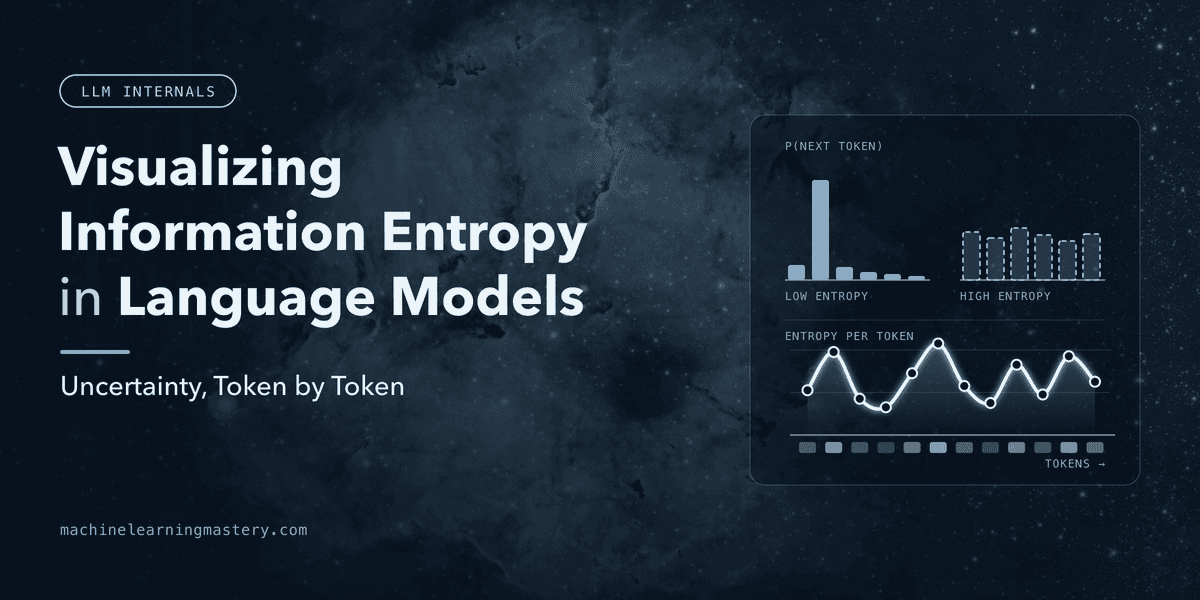
Before outputting the subsequent word, the model’s final projection layer evaluates its entire vocabulary—typically consisting of anywhere from $32,000$ to over $128,000$ distinct tokens—and assigns a probability score to every single one. At this precise junction, the model is confronting maximum lexical uncertainty.
The primary objective during pre-training is simple yet computationally monumental: minimize uncertainty regarding the correct next token, forcing the model to build an internal, statistically robust world model of grammar, facts, and semantics.
Defining Cross-Entropy Loss
Mathematically, cross-entropy measures the average number of bits needed to identify an event drawn from the true distribution $P$, when the coding scheme is optimized for a predicted distribution $Q$ instead of the true distribution $P$.
In the context of LLM training:
- The True Distribution ($P$): Represented as a "one-hot" vector for a given training example. If the true next token in our corpus is
"tatami", the ground-truth probability for"tatami"is $1.0$ ($100%$), while every other token in the vocabulary receives a probability of $0.0$ ($0%$). - The Predicted Distribution ($Q$): The output generated by the model’s softmax activation layer over the vocabulary.
Cross-entropy loss calculates the mathematical distance between $P$ and $Q$. When an LLM assigns a high probability to the correct ground-truth token, the resulting cross-entropy loss approaches zero. Conversely, if the model assigns high confidence to an incorrect word (or exhibits a flat, highly uncertain distribution across all vocabulary items), the cross-entropy loss spikes to unacceptably high values.
Technical Deep Dive: Visualizing Entropy and Loss in Python
To solidify these theoretical principles, let us examine a lightweight, self-contained Python script. While this script does not load a multi-billion parameter foundation model, it replicates the exact mathematical behavior occurring inside the final classification head of an LLM.
We establish a tiny vocabulary of five words and evaluate three distinct model prediction profiles against a known target token: "cat".
import numpy as np
import plotly.graph_objects as go
from plotly.subplots import make_subplots

# 1. Setup: A tiny vocabulary
vocab = ["apple", "banana", "cat", "dog", "elephant"]
target_word = "cat"

# TRUE distribution (Target token is "cat", index 2)
P = np.array([0.0, 0.0, 1.0, 0.0, 0.0])

# 2. Three Model Predictions: Computed by an LLM's final layer
models =
    "Confident & Correct": np.array([0.02, 0.03, 0.90, 0.03, 0.02]),
    "Confident & Wrong":   np.array([0.80, 0.05, 0.05, 0.05, 0.05]),
    "Uncertain (Flat)":    np.array([0.20, 0.20, 0.20, 0.20, 0.20]),


# 3. Math Functions for Entropy and Cross-Entropy Loss
def shannon_entropy(dist):
    """Measures internal uncertainty in bits."""
    return -np.sum(dist * np.log2(dist + 1e-9))

def cross_entropy(true_dist, pred_dist):
    """Measures loss against true target distribution."""
    return -np.sum(true_dist * np.log2(pred_dist + 1e-9))

# 4. Build Interactive Subplots using Plotly
subplot_titles = [
    f"<b>name</b><br>Entropy: shannon_entropy(q):.2f bits | Loss: cross_entropy(P, q):.2f"
    for name, q in models.items()
]

fig = make_subplots(
    rows=1, cols=3,
    subplot_titles=subplot_titles,
    shared_yaxes=True
)

for col_idx, (name, Q) in enumerate(models.items(), start=1):
    # Color target token green ('cat') and distractors blue
    colors = ['#2ca02c' if word == target_word else '#1f77b4' for word in vocab]

    hover_labels = [
        f"<b>Token:</b> word<br>"
        f"<b>Probability:</b> prob:.1%<br>"
        f"<b>Target Token:</b> 'Yes' if word == target_word else 'No'"
        for word, prob in zip(vocab, Q)
    ]

    fig.add_trace(
        go.Bar(
            x=vocab,
            y=Q,
            marker_color=colors,
            hoverinfo="text",
            hovertext=hover_labels,
            name=name,
            showlegend=False
        ),
        row=1, col=col_idx
    )

# 5. Styling Layout for Publication Quality
fig.update_layout(
    title_text="<b>Language Model Predictions: Entropy vs. Cross-Entropy Loss</b>",
    title_x=0.5,
    yaxis_title="Probability",
    yaxis=dict(range=[0, 1]),
    template="plotly_white",
    height=450,
    margin=dict(t=100, b=40, l=60, r=40)
)

fig.show()
Analyzing the Experimental Results
When evaluating the three model profiles through this script, distinct characteristics emerge:
- Model 1 (Confident & Correct): The model places $90%$ of its probability mass directly on
"cat". Internal Shannon entropy is low (indicating high internal determinism), and the cross-entropy loss against the true distribution is exceptionally low. This represents the ideal state of a trained LLM. - Model 2 (Confident & Wrong): Here, the model displays high confidence—assigning an $80%$ probability to
"apple"—yet it is completely incorrect. While its internal Shannon entropy is low (low uncertainty), its cross-entropy loss is unacceptably high because it guessed the wrong label with conviction. - Model 3 (Uncertain / Flat): The model distributes probabilities evenly across all five vocabulary items ($20%$ each). Here, Shannon entropy is at its absolute maximum (maximum internal uncertainty), and cross-entropy loss remains moderately high.
During backpropagation, gradient descent penalizes both Model 2 and Model 3. It forces the model weights to shift probability mass away from distractors and toward the true target token over millions of training iterations.
Official Statements and Industry Perspectives
Leading machine learning researchers and architecture designers emphasize that understanding information theory is non-negotiable for anyone building or fine-tuning foundation models.
Dr. Yann LeCun, Chief AI Scientist at Meta, has frequently noted that objective functions rooted in information theory provide the mathematical anchor required to prevent neural networks from collapsing into trivial, non-informative representations during self-supervised learning. Similarly, optimization literature from institutions like Stanford University and MIT highlights that cross-entropy remains the gold standard for classification tasks because its gradient properties naturally prevent saturation when models make confident, correct predictions.
Future Outlook: Beyond Standard Cross-Entropy
As the artificial intelligence landscape matures, researchers are actively investigating limitations and extensions of classical cross-entropy loss in massive transformer architectures:
- Beyond Next-Token Prediction: While auto-regressive next-token prediction trained via cross-entropy loss has driven unprecedented scaling laws, alternative paradigms—such as diffusion-based language generation and masked language modeling—experiment with alternative loss landscapes to enable non-sequential, parallel text generation.
- Alignment and Preference Optimization: Techniques such as Direct Preference Optimization (DPO) and Reinforcement Learning from Human Feedback (RLHF) build directly upon foundational loss frameworks, modifying cross-entropy objectives to reward models not just for factual next-token prediction, but for safety, helpfulness, and conversational nuance.
- Computational Efficiency: As vocabulary sizes expand to accommodate multilingual datasets and specialized code symbols exceeding $250,000$ tokens, computing the cross-entropy loss across the final Softmax layer becomes a severe memory bottleneck. Innovations in sampled softmax and hierarchical loss functions are becoming critical areas of hardware-software co-design.
By mastering the intersection of Claude Shannon’s 1948 information entropy and modern cross-entropy loss, engineers and researchers gain a profound appreciation for the mathematical elegance powering today’s most advanced artificial intelligence systems.