Executive Overview
Federal law enforcement agencies in the United States and Europe are aggressively untangling a sprawling cybercrime web following a landmark series of arrests targeting the prolific ShinyHunters hacking syndicate. Best known for a devastating September breach of the official FBI recruitment portal, fbijobs.gov, ShinyHunters has amassed an estimated $70 million in illicit extortion proceeds over the course of the year.
However, the ongoing federal probe has taken an extraordinary and deeply concerning turn. Investigators have identified executives at multiple prominent cyber extortion negotiation firms who allegedly maintained uncomfortably close relationships with the threat actors. According to sources close to the investigation, one U.S.-based executive is suspected of actively helping operate a specialized portal used to pressure victims into paying ransoms.
The investigation underscores a dark reality of the modern cybersecurity landscape: the existence of misaligned incentives, structural conflicts of interest, and alleged direct complicity within the multi-million-dollar ransomware negotiation ecosystem. As prosecutors tighten the net around transnational cybercriminals and their alleged white-collar enablers, the case offers a rare window into the murky intersection where corporate crisis management meets digital extortion.
Detailed Chronology: The Fall of Key Players and the Rise of "Rey"
To understand how federal investigators pierced the operational veil of ShinyHunters, one must trace a rapid series of international raids, high-profile arrests, and digital forensics breakthroughs that unfolded in late 2026.
The Reign and Arrest of Pepijn van der Stap
For years, the ShinyHunters brand evolved from a French-led collective into a decentralized enterprise responsible for dozens of high-profile data breaches. Control eventually coalesced around a teenage Jordanian hacker operating under the handle “Rey.” However, Rey’s rise to power was made possible only after Dutch authorities neutralized a vital senior member of the infrastructure.
On the evening of September 15, 2026, tactical police units in the Netherlands—utilizing flash-bang grenades to stun their target—apprehended Pepijn van der Stap, a convicted hacker and suspected senior ShinyHunters operator. Van der Stap was intercepted while actively logged into his accounts, specifically utilizing the encrypted messaging application Signal.

Law enforcement officers seized his active sessions, granting them immediate, real-time access to recent communications with frequent contacts. Among those contacts were ransomware negotiators based in Canada and the United States.
Furthermore, sources indicate that Van der Stap’s decrypted chats served as the cornerstone for unraveling an alleged international murder-for-hire plot. Reports from Dutch media outlet RTL revealed that two murders were allegedly ordered to be carried out abroad by Van der Stap, though there is no indication those lethal orders were ever executed.
The Capture of Edward Dubrovsky
The decrypted Signal communications formed a roadmap that led the FBI directly to the doorstep of Edward Dubrovsky, a 54-year-old Canadian cybersecurity executive. Dubrovsky, who had recently published a book on handling cyber extortion that advocated for consistently engaging with hackers, was arrested by the FBI on October 9.
According to federal court records in the United States, Dubrovsky was formally charged with threatening to disclose stolen data and interfering with interstate commerce through extortion. Federal prosecutors quickly moved to keep Dubrovsky in custody pending trial, sealing the associated court documents.
Investigators uncovered that Dubrovsky’s dialogue with Van der Stap went far beyond standard professional interaction. Sources close to the investigation noted that Dubrovsky frequently received details regarding fresh ShinyHunters victims before the victim organizations even realized they had been breached. Most explosively, federal investigators discovered that Dubrovsky was aware that ShinyHunters had exfiltrated highly sensitive data from FBI servers well before the hackers publicly taunted the bureau on social media. Despite this knowledge, Dubrovsky allegedly never alerted the bureau.
The Detainment of "Rey" in Jordan
The breach of fbijobs.gov in late September—which exposed Social Security numbers, home addresses, medical and psychological records, and employee specializations—prompted an unprecedented federal response. Moving with extraordinary speed, investigators tracked down individuals communicating with the syndicate’s leadership. On October 3, Reuters reported that "Rey" had been detained by authorities in Jordan and was actively cooperating with the FBI.

Supporting Context & Metrics: The "Shinywire" Portal and Ecosystem Conflicts
As federal scrutiny intensifies, investigators have turned their attention toward the structural mechanisms that facilitated ShinyHunters’ extortion campaigns. Central to this inquiry is a now-defunct website known as shinywire[.]com.
The Mechanics of "Shinywire"
Active from May 3, 2026, until its seizure or takedown on October 16, shinywire[.]com served as a centralized portal featuring nearly 100 organizations compromised by ShinyHunters. Each victim listing featured samples of stolen data, a ticking countdown clock, and direct warnings that the files would be published permanently if demands were ignored.
For example, American medical technology giant Intuitive Surgical—breached in March 2026 via a targeted phishing campaign that compromised employee credentials—was prominently featured on the platform. Organizations that failed to negotiate terms within a strict seven-day window saw their proprietary files dumped onto ShinyHunters’ dark web shaming blog hosted on the Tor anonymity network.
Federal investigators believe that at least one executive at a prestigious U.S.-based consulting firm—an entity boasting over 1,000 associates—played an active operational role in running the Shinywire portal. While the firm and the suspected executives have not yet been publicly named or criminally charged, the revelation points to deep corporate infiltration by cyber extortionists.
The "Ghostbyte" Connection and Corporate Feuds
The broader ecosystem is further complicated by bitter legal and professional feuds among industry elites. Prior to his arrest, Edward Dubrovsky filed a lawsuit in Ontario against Daniel Tobok, the former chief executive of Cypfer, a prominent cybersecurity firm with global operations. Dubrovsky alleged that he had been systematically pushed out of business decisions following a falling out with Tobok. Tobok denied the allegations, filing a counterclaim accusing Dubrovsky of misappropriating confidential information and competing unfairly through another entity, CyberSteward Inc.
Digging into historical cyber threat intelligence, former colleagues revealed that Tobok had long been associated by ransomware groups with the moniker "Ghostbyte." In a 2018 extortion incident involving the Russian-language Dharma ransomware affiliate program, a victim seeking negotiation guarantees was directed by the hackers to contact [email protected]. Threat intelligence platforms like Constella Intelligence subsequently linked email addresses historically used by Tobok to accounts utilizing the username "ghostbyte." Furthermore, blockchain analysis of the crypto wallet tied to the Dharma representative revealed dozens of transactions totaling roughly 43 bitcoin—valued at approximately $3.5 million today.

Cypfer issued a statement distancing itself from Dubrovsky’s legal troubles, emphasizing that the firm does not facilitate ransomware payments and had no prior knowledge of Dubrovsky’s arrest. The company noted it operates independently of CyberSteward and was recently acquired by the Apros Group, a holding company led by former FBI special agent Jason Hogg.
Official Statements and Industry Perspectives
The revelations surrounding negotiator complicity have ignited a fierce debate within the cybersecurity and cyber insurance industries regarding the ethics and legality of paying ransoms.
The Conflict of Interest in Ransom Payments
Paying hackers for decryption keys or guarantees of data deletion is not inherently illegal under U.S. law, provided the target group is not sanctioned by the U.S. Department of the Treasury (ShinyHunters currently holds no such designation). However, the financial structures underpinning incident response create profound ethical hazards.
Mark Camillo, Chief Executive of CyberAcuView—an industry group founded by major cyber insurers—pointed out that many negotiation firms operate on a contingency fee model, charging a percentage of the final ransom payout.
"This makes no sense if they are also the negotiator," Camillo stated. "There needs to be more transparency in the process as no one in the ecosystem should be profiting purely on the size of the ransomware transaction or payment itself."
When ransomware victims decide to pay, insurance providers frequently steer them toward compliant remediation firms. Conversely, firms that take a hardline stance against extortion—such as Coveware and Unit 221B—frequently advise clients against giving in to syndicates like ShinyHunters.

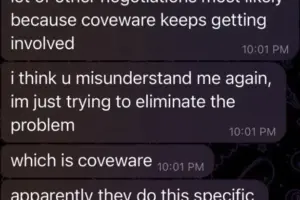
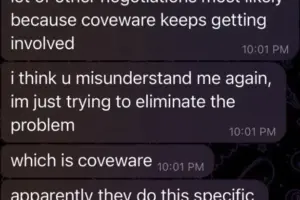
Private Telegram chats recovered by investigators revealed just how intensely ShinyHunters despised this pushback. In April and May 2026 logs, the syndicate’s leadership complained bitterly that Coveware was tanking their conversion rates. One message lamented: “Go on my website, majority of those companies would’ve paid if it weren’t for Coveware giving them misinformation… Someone (100% Coveware) is going out of their way to make sure i am not paid.” Another log explicitly noted that the group was attempting to "eliminate the problem."
A Crackdown on Fraudulent Negotiators
Federal prosecutors are increasingly treating rogue negotiators as co-conspirators rather than legitimate intermediaries.
- October 2026: The Department of Justice charged MonsterCloud CEO Zohar Pinhasi with wire fraud and conspiracy after he allegedly charged clients $19 million for remediation while secretly paying hackers only $8 million behind his clients’ backs.
- July 2026: Ransomware negotiator Angelo Martino was sentenced to 70 months in prison for conspiring with the BlackCat/ALPHV syndicate, passing confidential negotiation strategies to attackers to maximize extortion payouts.
Future Outlook: A Turning Point for Incident Response
The unfolding ShinyHunters prosecution marks a watershed moment for the global cybersecurity community. For years, the shadow economy of ransomware negotiation operated with minimal regulatory oversight, shielded by corporate confidentiality agreements and non-disclosure protocols.
The convergence of real-time messaging seizures (such as Pepijn van der Stap’s Signal logs), international law enforcement cooperation, and aggressive DOJ prosecutions signals a zero-tolerance approach toward white-collar enablers. Moving forward, the industry faces an inevitable reckoning:
- Stricter Regulatory Oversight: Cyber insurance providers and regulatory bodies are expected to mandate rigorous transparency regarding how incident response firms structure their fees, eliminating percentage-based ransom incentives.
- Erosion of Corporate Safe Harbors: Consulting firms that maintain overly cozy, unverified channels with threat actors will face intense federal scrutiny, shifting the paradigm from quiet negotiation to transparent law enforcement engagement.
- Heightened Risks for Extortionists: With key administrators like "Rey" detained and cooperating, and senior infrastructure facilitators behind bars, the resilience of decentralized syndicates like ShinyHunters is facing an existential stress test.
Ultimately, the message from federal investigators is clear: the wall separating cybercriminals from the corporate executives who negotiate with them has officially crumbled.