Executive Overview
As artificial intelligence rapidly transitions from stateless conversational interfaces to autonomous, long-running agentic systems, software engineers face a fundamental systems architecture challenge: how to manage information flow under the strict constraints of finite context windows. Every large language model (LLM) possesses a strict token ceiling. When conversations span multiple sessions, tool outputs compound, or massive document repositories are pulled into the processing loop, the system invariably hits a wall. Unmanaged, the context overflows, forcing agents to drop critical data, re-ask questions they have already answered, contradict prior decisions, or completely lose track of essential documentation.
To prevent these failures, modern agentic architectures rely on two distinct cognitive pillars: Retrieval and Memory.
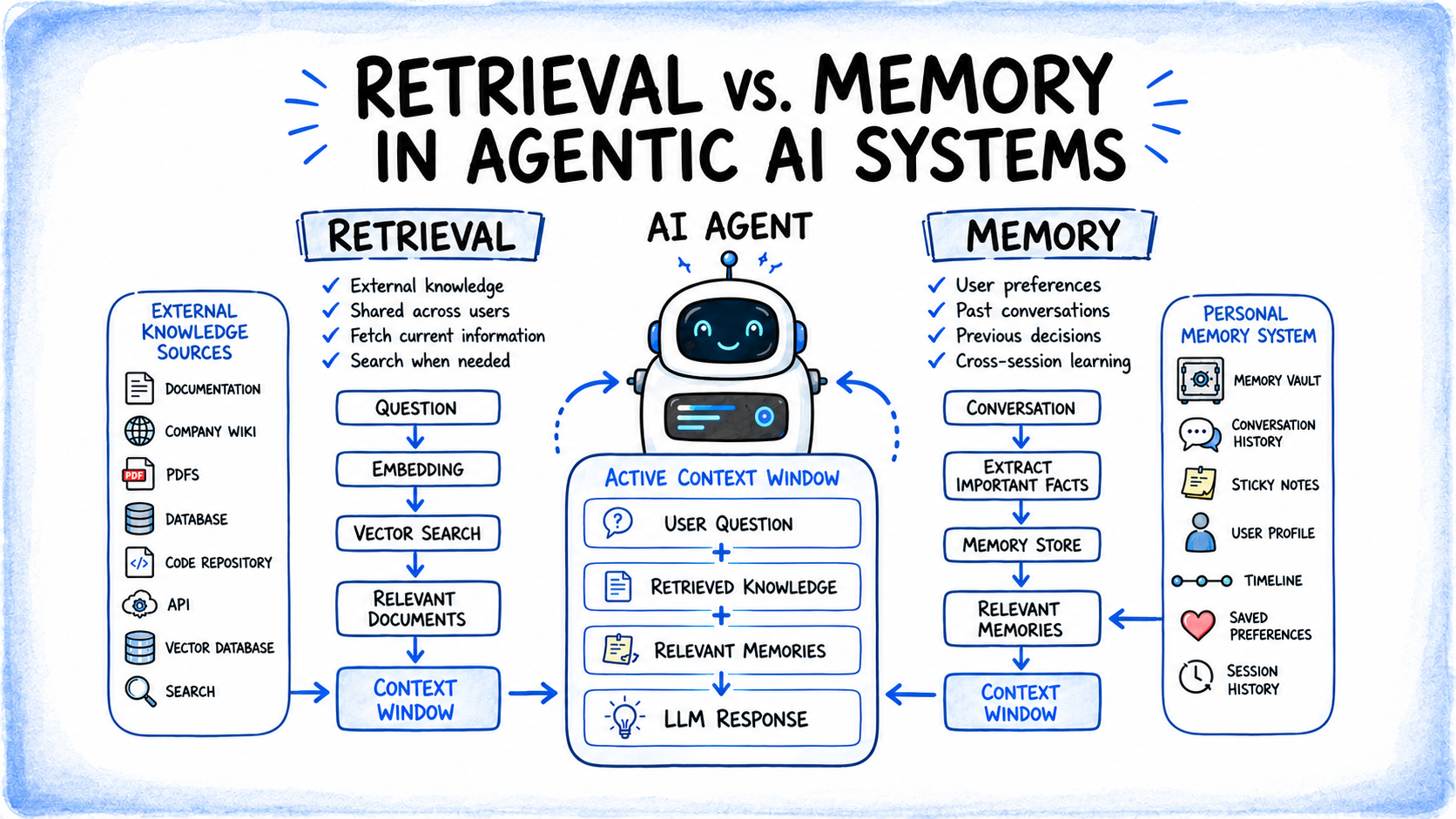
While these concepts are frequently conflated—and often implemented using identical underlying technologies like vector embeddings and similarity search—they serve fundamentally different architectural purposes. Retrieval acts as the agent’s window to the outside world, querying external, shared corpora (such as enterprise documentation, codebases, and databases) that fall outside the model’s training weights. Memory, by contrast, serves as the agent’s internal ledger, persisting what the agent has learned, deduced, or experienced across interactions to prevent it from resetting to zero with every new session.
Confusing these mechanisms, or relying exclusively on one while ignoring the other, is the primary reason enterprise agent systems fail in production. This article provides an authoritative breakdown of the conceptual and practical differences between retrieval and memory, examines why context windows necessitate this split, compares their operational profiles, and outlines actionable frameworks for combining them into robust, production-ready AI agents.
Detailed Chronology: The Evolution of Agentic State Management
To fully understand why retrieval and memory have diverged into specialized architectural sub-systems, it is helpful to trace the evolution of how LLMs handle state over time.
Phase 1: The Stateless Era (2020–2022)
In the early days of modern generative AI, models were fundamentally stateless request-response engines. Applications manually concatenated the entire conversation history into every API call. As chats lengthened, API payloads grew exponentially, driving up latency and cost. Developers quickly realized that stuffing everything into a single linear text stream was unsustainable, giving rise to the earliest makeshift pruning and summarization scripts.
Phase 2: The Rise of RAG and Vector Databases (2022–2024)
As models gained wider adoption for enterprise knowledge work, Retrieval-Augmented Generation (RAG) emerged as the industry standard for bridging the gap between static model weights and dynamic enterprise data. Developers decoupled external documents from the prompt, storing them in vector databases and executing semantic searches at runtime. While RAG solved the problem of external knowledge access, it treated every user query as isolated, ignoring the temporal dimension of ongoing user interactions.
Phase 3: The Agentic Turn and Context Engineering (2024–Present)
As autonomous agents began executing multi-step workflows—invoking tools, writing code, and orchestrating complex tasks over hours or days—RAG alone proved insufficient. Agents needed to retain insights about user preferences, intermediate task states, and past failures. This realization triggered the maturation of Context Engineering as a formal discipline. Developers began architecting dual-layer systems where external retrieval (RAG) and internal agent memory operate in tandem, regulated by sophisticated orchestration and pruning layers.
Understanding Why Context Forces a Split
The root constraint governing all LLM applications is the context window. The context window represents the total aggregate token allowance a model can evaluate during a single forward pass, encompassing the system prompt, conversation history, retrieved passages, tool definitions, and intermediate scratchpads.
Despite hardware advancements pushing context lengths into the millions of tokens, simply expanding the window does not solve the underlying systems problem. Attention mechanisms scale with computational and latency costs, and stuffing excessive data into an uncurated prompt leads to "lost-in-the-middle" phenomena, where models overlook critical details buried deep within large contexts.
Context engineering treats the token window not as a bottomless storage bin, but as a high-performance, volatile working memory—akin to RAM in traditional computing. Because working memory is scarce, agents must offload long-term data storage to specialized backing stores:
- External Knowledge: Information the model has never seen, should not be baked into its static weights, and is broadly applicable to multiple users.
- Internal State: Information generated dynamically by the agent or user during specific interactions that must persist over time.
While both types of information are frequently indexed using vector embeddings and retrieved via similarity metrics, their provenance, scope, and lifecycle are entirely distinct.
Defining Retrieval in Agentic Systems
Retrieval answers the fundamental question: “What does the world know about this subject that is absent from my training weights and current execution state?”
The canonical implementation of retrieval in agentic workflows is Retrieval-Augmented Generation (RAG). A robust retrieval pipeline typically involves:
- Ingestion and Chunking: External documents (PDFs, code repositories, database tables) are ingested, cleaned, and split into manageable semantic chunks.
- Embedding Generation: Each chunk is passed through an embedding model to generate high-dimensional vector representations.
- Indexing: Vectors are stored in a specialized database optimized for Approximate Nearest Neighbor (ANN) search.
- Query Execution: At runtime, the agent translates its current reasoning state or user query into a vector, queries the index, and injects the most relevant retrieved passages directly into its working context.
Characteristics of Retrieval
- Source: An external, authoritative corpus that the agent did not generate.
- Scope: Universal and shared. Every user querying the same enterprise policy manual interacts with the exact same underlying retrieval index.
- Freshness: Managed via scheduled or event-driven re-indexing pipelines, operating completely independently of individual user sessions.
- Cost Profile: Read-heavy. Lookups are executed dynamically per query, with writes occurring during batch ingestion cycles.
Defining Memory in Agentic Systems
Memory answers a completely different question: “What have I already learned, decided, or experienced in past interactions that I must carry forward?”
Agent memory is generally bifurcated into two distinct operational layers:
- Short-Term / Working Memory: Retains the immediate conversational turn-taking and transient tool outputs required to execute the current task.
- Long-Term Episodic and Semantic Memory: Persists user preferences, historical decisions, corrections, and resolved errors across multi-day or multi-week engagements.
Advanced agent frameworks utilize background extraction routines that analyze completed conversations, distill high-value facts, and write them to persistent storage (such as structured SQL tables or user-specific vector stores). When a new session initializes, the agent queries this dedicated memory store, pulling tailored context that applies strictly to the user or task at hand.
Characteristics of Memory
- Source: The agent’s own internal runtime reasoning, tool executions, and direct user dialogue.
- Scope: Highly localized and contextual. Memory is segmented by user ID, session ID, or specific project scopes.
- Freshness: Managed through consolidation, factual updates, and expiration policies designed to prune stale or contradictory information.
- Cost Profile: Read and write intensive. Background workers continuously extract, deduplicate, and update memory records following user interactions.
Practical Architectural Breakdown: A Customer Support Scenario
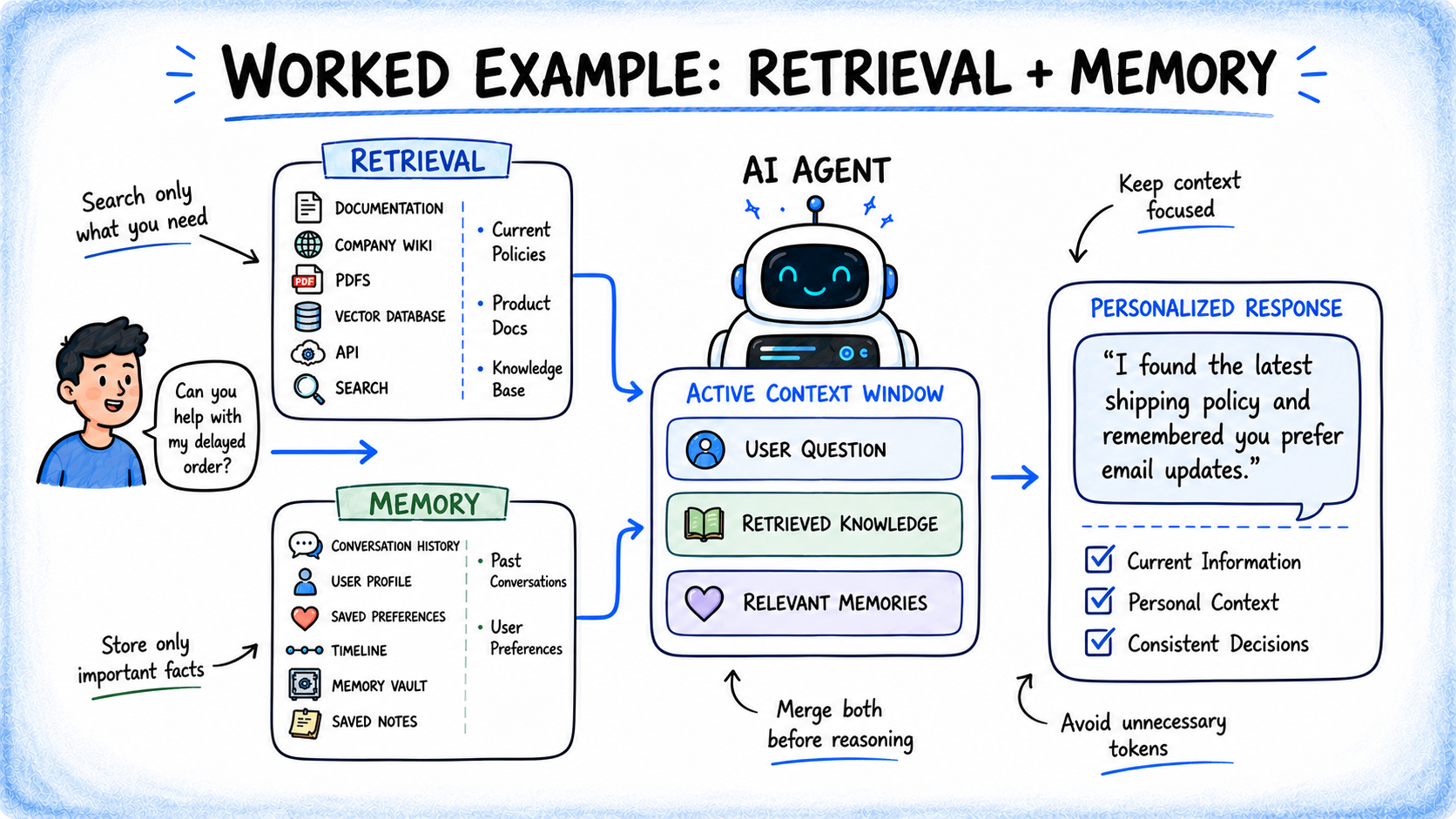
To crystallize the operational differences between retrieval and memory, consider a production enterprise scenario: a customer contacts an automated support agent regarding a delayed delivery.
[User Inquiry] ──> [Agent Orchestrator]
                         │
         ┌───────────────┴───────────────┐
         ▼                               ▼
  [Agent Memory]                [Retrieval Engine]
  (User History & Prefs)        (Current Shipping Policy)
         │                               │
         └───────────────┬───────────────┘
                         ▼
             [Synthesized Prompt Context]
                         │
                         ▼
[LLM Core] ──> [Personalized Response]- The Memory Lookup: Before addressing the shipment delay, the agent queries its persistent memory store for the customer’s profile. It discovers a logged preference from three weeks ago: the customer prefers email follow-ups over chat, and a previous shipping discrepancy was successfully resolved via a partial refund. This is memory, as it originates directly from the agent’s past interactions with this specific individual.
- The Retrieval Lookup: The agent recognizes that company shipping policies were updated late last month. It issues a semantic query against the corporate knowledge base to fetch the exact, current text governing delayed international freight. This is retrieval, as it pulls from an external, shared document repository applicable to all customers.
Both outputs are injected into the agent’s prompt context, but they fulfill entirely different functional roles: memory personalizes the interaction based on past history, while retrieval grounds the response in factual, up-to-date reality.
Comparative Matrix: Retrieval vs. Memory
| Dimension | Retrieval (RAG) | Agent Memory |
|---|---|---|
| Source of Truth | External corpora, documents, codebases, or databases created independently of the agent. | The agent’s own historical interactions, tool outputs, reasoning traces, and user dialogues. |
| Operational Scope | Global and shared across all users, tenants, and sessions. | Localized and private, scoped to specific users, tasks, or long-running sessions. |
| Primary Question | "What does the external world know about this domain?" | "What have I personally learned, decided, or observed previously?" |
| Freshness & Maintenance | Maintained via batch re-indexing, document versioning, and scheduled ETL pipelines. | Managed through dynamic fact consolidation, conflict resolution, and automatic expiration. |
| Primary Failure Modes | Stale documents, missing index entries, poor chunking strategies, or semantic search drift. | Contradictory user facts, hallucinated preferences, or memory bloat from unpruned history. |
| Compute & Cost Pattern | Read-heavy; single-lookup execution per relevant user query. | Read-write intensive; background extraction and summarization run asynchronously. |
Supporting Context & Metrics: Engineering Trade-offs
Building production-grade agentic systems requires careful balancing of latency, token expenditure, and storage overhead. Empirical benchmarks from enterprise deployments highlight several critical design considerations:
- Latency Overhead: Executing concurrent memory lookups and external retrieval calls adds network and database latency (typically 50ms to 300ms per retrieval step). Architectures must utilize asynchronous parallel fetching to prevent compounding bottlenecks.
- Token Inflation: Injecting unrefined retrieval chunks alongside verbose memory histories can easily consume 40% to 60% of an 128k context window before the core task prompt is even evaluated. Implementing aggressive semantic reranking and token budgeting is mandatory.
- Drift and Contradiction: Memory stores are uniquely vulnerable to drift. If a user changes their preference (e.g., switching preferred programming languages from Python to Rust), naive memory appending will result in contradictory facts residing in the store simultaneously. Production systems require explicit update-and-pruning logic to invalidate outdated memory entries.
Future Outlook: The Convergence of State Management
As agentic AI matures beyond simple chat assistants toward multi-agent swarms and fully autonomous corporate workers, the lines separating retrieval and memory will continue to evolve.
We are already witnessing the emergence of unified state layers—architectures that treat all system information (whether ingested from an enterprise wiki or generated via an internal agent thought loop) as unified, graph-structured knowledge nodes. In these advanced paradigms, graph databases map relationships between external static documents (Retrieval) and dynamic agent experiential nodes (Memory), allowing agents to traverse enterprise knowledge and historical personal state seamlessly.
Furthermore, advances in model-native caching and stateful inference endpoints will shift how frequently systems must write to external vector databases, reducing operational overhead. However, the foundational design principle will remain unchanged: engineers must intentionally separate the acquisition of external universal facts from the retention of internal operational history.
Conclusion
Retrieval and memory are the dual engines that power modern agentic AI systems. Retrieval bridges the gap between static model weights and dynamic external knowledge, while memory provides the temporal continuity required for agents to learn, personalize, and execute multi-step workflows over extended periods.
By understanding their distinct scopes, operational profiles, and failure modes, developers can avoid the common pitfalls of naive context stuffing. The most resilient, high-performing agent architectures do not choose between retrieval and memory—they harmonize both, ensuring the agent receives precisely the right context at precisely the right moment, unburdened by noise.