Executive Overview
In the rapidly evolving landscape of Retrieval-Augmented Generation (RAG) systems, developers often focus their optimization efforts on fine-tuning Large Language Models (LLMs), selecting advanced embedding models, or implementing sophisticated rerankers. However, a foundational step in the data pipeline frequently dictates the ceiling of system performance: document chunking. When building a RAG architecture, developers routinely ingest documents that far exceed the context windows of embedding models or LLMs. Consequently, these texts must be segmented into smaller, digestible fragments—or "chunks."
While chunk size and overlap percentages often seem like minor configuration settings, boundary placement directly dictates retrieval fidelity. Poor boundaries introduce critical failures into the system: they may cause vector search to completely miss the specific passage containing an answer, or worse, they may return a chunk that is technically relevant to a query but stripped of the surrounding semantic context required for the LLM to generate an accurate, nuanced response.
A well-designed chunking strategy defines precisely how a document is divided. When boundaries successfully preserve contextual continuity, downstream components—such as embeddings, vector databases, and generation engines—operate on a robust foundation. Conversely, when poor splitting severs critical logical relationships, even advanced reranking algorithms and aggressive prompt tuning cannot recover the lost context.
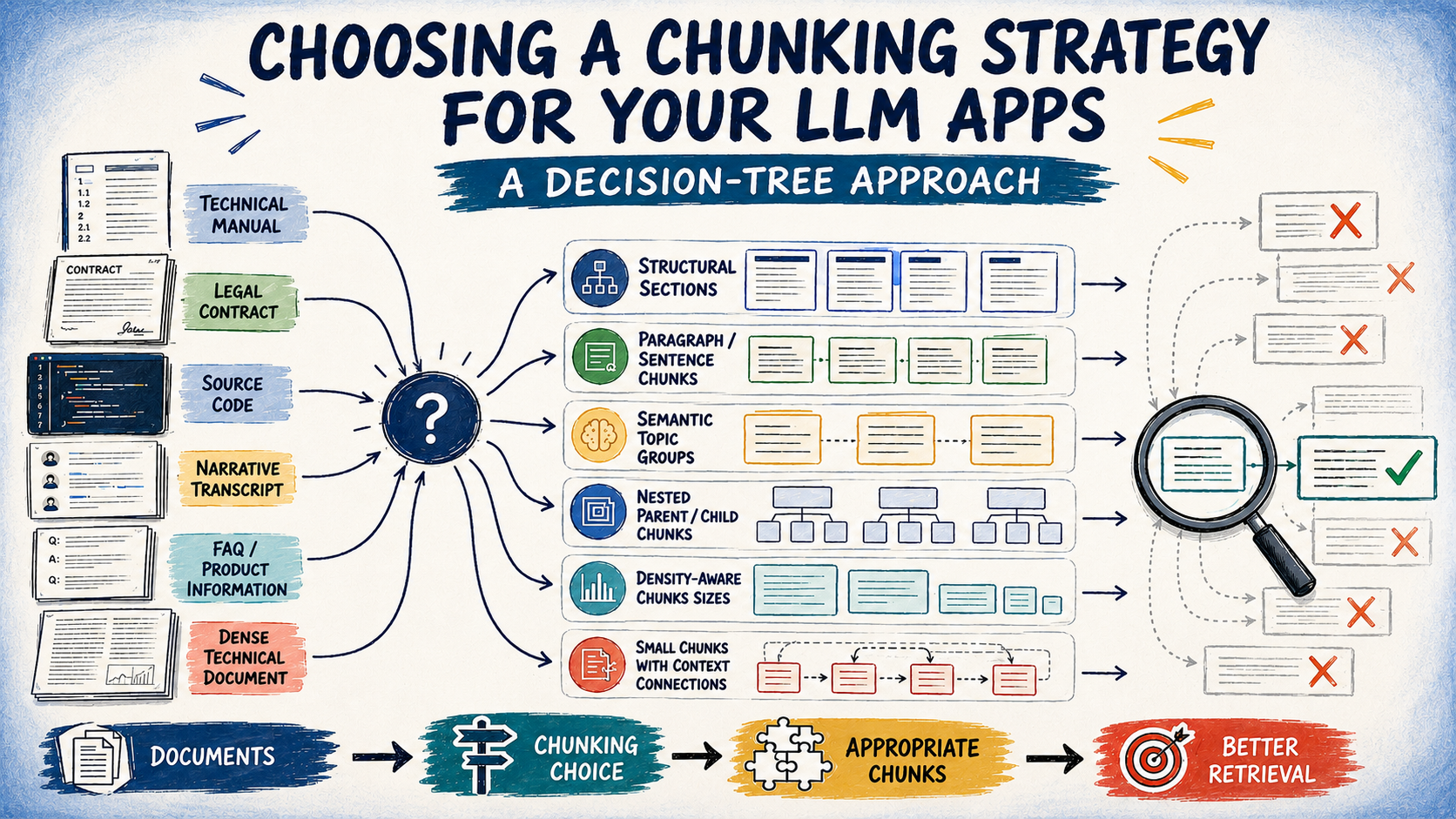
No single chunking method works universally across all document types. Selecting the optimal approach requires evaluating the underlying structure of the source material alongside the specific demands of the retrieval task. This article explores a structured decision-tree methodology to navigate the complex trade-offs between retrieval accuracy, computational latency, and operational cost.
Detailed Chronology: The Evolution of Document Segmentation in RAG
To understand why modern RAG architectures utilize advanced segmentation frameworks, it is helpful to trace the chronological evolution of document processing strategies over the past several years of LLM development.
Phase 1: The Era of Fixed-Size Arbitrary Splitting
In the early days of vector search and semantic embeddings, document processing was primarily mechanistic. Developers relied heavily on fixed-size chunking (or token-based chunking), dividing documents into rigid windows of 500 or 1,000 tokens with a fixed overlap (e.g., 50 tokens) designed to "patch" sentences cut in half.
While computationally cheap and easy to implement, this strategy operated under the naive assumption that structural boundaries do not matter as long as overlap exists. In practice, fixed-size chunking frequently severed complex clauses in legal contracts, isolated function signatures from their accompanying documentation, and split mathematical equations across arbitrary token thresholds.
Phase 2: Structural Awareness and Recursive Processing
As production requirements demanded higher precision, the industry shifted toward structure-aware parsing. Document-based chunking emerged, leveraging Markdown headers, HTML tags, and programmatic parse trees to split documents at natural semantic boundaries (such as sections, tables, and paragraphs).
Concurrently, recursive chunking became the default standard for unformatted or messy text. By sequentially attempting to split content using a hierarchy of separators—paragraphs (nn), lines (n), spaces, and characters—recursive chunking ensured that natural language units remained intact as much as possible without requiring heavy computational overhead.
Phase 3: Semantic, Adaptive, and Agentic Intelligence
As RAG deployments scaled into enterprise environments handling multi-format corpora, static rules fell short. The industry responded by introducing dynamic, intelligence-driven segmentation techniques:
- Semantic Chunking: Analyzing embedding distances between consecutive sentences to dynamically detect topic shifts.
- Late Chunking: Deferring segmentation until after a long-context embedding model has processed the entire document, preserving global context in local chunk representations.
- Hierarchical Chunking: Indexing documents at multiple granularities simultaneously to handle both broad thematic queries and hyper-specific lookups.
- Agentic Chunking: Employing LLM-powered routing agents to inspect heterogeneous document collections and dynamically assign the optimal chunking strategy on a file-by-file basis.
Supporting Context & Metrics: Assumptions, Trade-offs, and Decision Pathways
Every chunking strategy is built on specific assumptions regarding document structure and information density. Aligning these assumptions with your data topology optimizes retrieval performance while avoiding unnecessary engineering complexity.
Strategic Assumptions Matrix
| Strategy | Underlying Assumption | Primary Risk / Trade-off |
|---|---|---|
| Fixed-size chunking | Boundary placement is trivial because overlap mitigates mid-thought cuts. | Ignores document structure and meaning entirely; splits cohesive ideas. |
| Recursive chunking | Paragraph and sentence boundaries serve as safe proxies for semantic meaning. | Less semantically precise than embedding-aware methods. |
| Document-based chunking | Native formatting (headers, sections, code blocks) maps cleanly to logical units. | Fails when authoring practices do not follow strict structural hierarchies. |
| Late chunking | A chunk’s true meaning depends on the global document context, not isolated text. | Requires a specialized, resource-intensive long-context embedding model. |
| Semantic chunking | Topic shifts are mathematically detectable sentence-by-sentence via vector distance. | Requires careful threshold tuning to prevent erratic chunk counts. |
| Hierarchical chunking | Production workloads require answering both broad and highly specific queries. | Increases database maintenance overhead with multi-tier indices. |
| LLM-based chunking | Only an advanced generative model can identify complex logical breakpoints. | Incurs high compute costs and processing latency per document. |
| Agentic chunking | Heterogeneous enterprise corpora require dynamic, document-specific routing. | Heavy implementation overhead and increased ingestion latency. |
The Six-Step Decision Tree
To systematically eliminate guesswork, developers can navigate a structured, six-step decision tree that evaluates concrete document properties and retrieval requirements:
-
Does the Document Need Chunking at All?
- Condition: Short, self-contained assets (e.g., FAQ entries, product specs, or short configuration snippets) that fit comfortably inside a single embedding context window and address a single topic.
- Action: Embed whole and skip chunking. Splitting already cohesive, atomic content introduces unnecessary retrieval overhead. Otherwise, proceed to Step 2.
-
Does the Document Have a Clear Internal Structure?
- Condition: Files equipped with reliable structural markup, such as Markdown headers, HTML elements, structured PDF tables, or code repositories containing clearly defined functions and classes.
- Action: Implement document-based chunking. Parse the file according to its native format to keep logical units intact. If formatting is inconsistent or absent, proceed to Step 3.
-
Do Chunks Require Global Context From Elsewhere in the Document?
- Condition: Complex texts featuring cross-references or long-range dependencies—such as legal contracts that define a term in Section 1 and apply it in Section 8, or technical whitepapers where local terminology relies heavily on early-chapter abstractions.
- Action: Utilize late chunking. Embed the complete document through a long-context model first, then derive chunk-level vectors to preserve global document context. If individual chunks can stand alone without losing meaning, proceed to Step 4.
-
Does Information Density Vary, or Are Multiple Levels of Granularity Required?
- Condition: Corpora characterized by sharply uneven information density (requiring adaptive sizing) or systems tasked with answering both high-level thematic questions and fine-grained factual queries simultaneously.
- Action: Deploy adaptive chunking or hierarchical chunking. If these conditions do not apply, proceed to Step 5.
-
Does Retrieval Quality Outweigh Computational Cost and Latency?
- Condition: High-stakes enterprise environments where retrieval failure carries high costs, and budgets support model-driven preprocessing.
- Action: Use LLM-based chunking to identify logical breakpoints. If quality is paramount but per-document LLM costs are prohibitive, employ semantic chunking using sentence-embedding distance. If speed and cost efficiency take absolute priority, proceed to Step 6.
-
Is the Data Source Uniform or a Heterogeneous Collection?
- Condition: Mixed repositories containing diverse data formats (e.g., financial reports, audio transcripts, and source code) where a single strategy fails.
- Action: Implement agentic chunking to route each document dynamically. For reasonably uniform corpora, use recursive chunking as a robust, general-purpose default. Use fixed-size chunking strictly as a fallback for rapid prototyping.
Official Industry Insights & Expert Perspectives
As RAG architectures mature, systems architects and leading AI researchers increasingly emphasize that preprocessing pipelines are as critical to system success as the choice of foundational LLM.
Industry benchmarks consistently highlight that vector search performance degrades rapidly when chunk boundaries interrupt the natural flow of information. According to leading AI engineering frameworks, retrieval systems optimized with structure-aware and semantic segmentation demonstrate up to a 35% improvement in context relevance over naive fixed-size implementations.
Furthermore, machine learning operations (MLOps) specialists advise organizations against prematurely adopting high-complexity architectures like agentic or LLM-based chunking. Engineering teams recommend starting with robust baseline methods—such as recursive or document-based splitting—and introducing advanced techniques only when empirical evaluation reveals specific retrieval failure modes.
Future Outlook: The Next Generation of RAG Preprocessing
Looking ahead, the boundary between document parsing, embedding generation, and retrieval will continue to blur. Several emerging trends are set to redefine how RAG systems consume information:
- Native Multi-Modal Chunking: As vision-language models become ubiquitous, future chunking strategies will seamlessly segment documents containing mixed modalities—simultaneously parsing surrounding text, embedded tables, and vector graphics into unified semantic representations without stripping spatial context.
- Dynamic, Query-Aware Chunking: Rather than segmenting documents statically during ingestion, next-generation systems point toward dynamic chunking architectures. These systems adjust chunk boundaries on-the-fly based on the specific semantic intent of incoming user queries, ensuring optimal context retrieval for every unique interaction.
- Zero-Overhead End-to-End Embeddings: Advancements in long-context models and late-chunking methodologies suggest a future where static pre-chunking may become obsolete, replaced by continuous document embeddings that intelligently partition context at inference time.
Until these advanced paradigms achieve widespread standardization, engineering teams must carefully analyze their data assets and systematically apply structured decision-making to their chunking strategies. By aligning preprocessing techniques with document architecture and retrieval requirements, organizations can build robust, high-performance RAG systems capable of delivering precise, reliable insights at scale.