Executive Overview
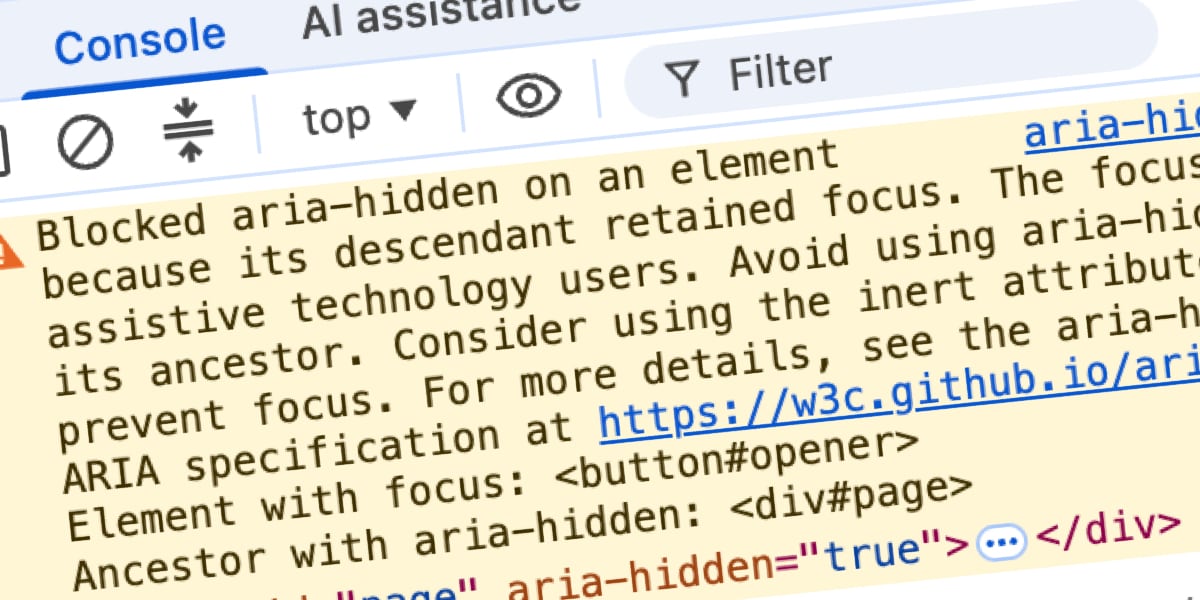
It begins with a familiar sting. You close a dialog box in your application, and the developer console flashes that particular, unmistakable shade of angry mustard. You highlight the message, drop it into a search engine, and find yourself accompanied by half the front-end internet. Whether you are building with Angular, Bootstrap, Ionic, or managing databases via phpMyAdmin, this exact string turns up identically.
Here is the crucial reality that the top-ranking search results routinely bury: the browser’s warning is entirely correct.
On the other side of that warning sits a real person—someone relying on a screen reader whose focus is about to drop into a black hole on your web page. The quick fixes that routinely rank at the top of search results all do the same thing under different names: the blur() one-liner, the setTimeout wrapper around the close handler, or the hack where developers frantically yank the aria-hidden attribute off the DOM.
Each of these solutions quiets the console while quietly injuring the exact user the browser was trying to protect. If you have already shipped one of these workarounds, you are in massive, prestigious company. You were failed by search engine optimization and incomplete documentation, not your own carelessness.
However, ignoring the architectural mismatch is no longer an option. This investigative feature explores how a simple console warning exposed a systemic conflict between browser rendering engines, component libraries, and web accessibility standards—and how engineers can fix their teardown contracts once and for all.
Detailed Chronology: How "Ghost Focus" Invaded the Modern Web
To understand why the web development ecosystem is suddenly drowning in accessibility warnings, we have to look at the timeline of how browser engines handle the paradox of aria-hidden.
Historically, the attribute was designed to pull content entirely out of the accessibility tree, making it invisible to screen readers. Crucially, however, it was never designed to pull content out of the keyboard focus order. Two entirely separate systems—focus management and accessibility trees—existed side-by-side with virtually nothing keeping them synchronized.
The Evolution of Chromium’s Enforcement
For years, developers could apply aria-hidden="true" to a background wrapper or even the entire <body> element when a modal opened. If a focused element remained trapped inside that hidden subtree, it created what engineers now call ghost focus: a state where the screen reader fires a focus event for a node it has been explicitly told does not exist. The user presses Tab, a control lights up on the screen, but their screen reader goes dead silent.
Chromium has been quietly patching this underlying flaw for years. As recorded in W3C ARIA working group logs as far back as 2020, engineers recognized that complete silence left users stranded in an unmapped room. But the enforcement mechanisms transformed dramatically across 2024:
- The Open-Time Variant (Summer 2024): Around Chrome 127, issues began clustering across major UI libraries like Material-UI (MUI #43106), Ant Design (#50170), and Flowbite (#943). Developers were greeted with warnings scolding them about elements that "just received focus" inside a newly hidden region.
- The Close-Time Variant (Late 2024): Arriving with Chrome 131 in late 2024, the "retained focus" warning began triggering globally. Issues like Bootstrap #41005 and Angular #30187 illuminated the exact same core defect: modals fading out while focus remained stubbornly parked on a close button inside the hidden wrapper.
Unlike Firefox and Safari—which historically process these conflicts silently without surfacing console warnings—Chrome decided to make developers feel the architectural tension. While the tone of the warning is jarring, the browser’s stance is definitive: a silent fix allows broken code to ship indefinitely, whereas a loud warning forces developers to confront a hidden user-experience failure.
Supporting Context & Metrics: The Anatomy of Popular, Dangerous "Fixes"
When confronted with a wall of yellow console text during a high-pressure release cycle, developers naturally reach for the path of least resistance. Unfortunately, the most popular "fixes" found online consistently degrade the user experience.
1. The blur() One-Liner
element.addEventListener('hide.bs.modal', () =>
  document.activeElement.blur();
);
This is the internet’s favorite quick fix. By calling blur() with nowhere else to go, focus falls back to the <body> element. The console warning vanishes because there is no longer a focused element inside the hidden subtree.
For a mouse user, this is invisible. For a screen reader user, it is catastrophic. Their reader falls silent or reads the page title, and the very next Tab press forces them to start navigating from the absolute top of a long, complex document—a severe violation of WCAG 2.4.3 (Focus Order).
2. The setTimeout Timing Hack
Many developers attempt to wrap focus restoration in a setTimeout or requestAnimationFrame:
requestAnimationFrame(() => triggerButton.focus());This relies on a dangerous race condition, betting that the render engine will finish painting before the focus call executes. On a high-end development machine, it usually works. Under heavy CPU throttling, on budget mobile devices, or within React’s concurrent rendering scheduler, it fails unpredictably. When it fails, you ship an intermittent, non-reproducible accessibility bug.
3. Stripping aria-hidden or Disabling Modals (modal=false)
Some codebases deploy MutationObservers to ruthlessly strip aria-hidden attributes the moment a UI library applies them. Others toggle libraries like Radix or Shadcn to modal=false. While this clears the console, it fundamentally breaks the modal contract: users can suddenly tab out of active dialogs and interact with background content that is supposed to be blocked off.
Official Standards & The Correct Teardown Contract
The only durable solution to this crisis is abandoning temporary hacks and adopting a strict teardown contract. The golden rule of modal architecture is deceptively simple: focus must leave a closing region before that region becomes hidden or inert.
Furthermore, because the HTML inert attribute explicitly blocks focus, you cannot successfully focus a trigger element if its container is still marked inert.
The Four-Step Vanilla JavaScript Teardown Contract
  #trigger = null;
  #background = null;

  open(dialog)
    // 1. Capture the return target BEFORE moving focus in
    this.#trigger = document.activeElement;
    this.#background.setAttribute('inert', '');
    dialog.hidden = false;
    dialog.querySelector('[autofocus], button, [href], input')?.focus();


  close(dialog)
    // STEP 1: Un-inert the background FIRST so the trigger can receive focus
    this.#background.removeAttribute('inert');

    // STEP 2: Move focus OUT synchronously before any hide-state lands
    this.#trigger?.focus();

    // STEP 3: Apply inert (NOT aria-hidden) to the closing shell for its transition
    dialog.setAttribute('inert', '');
    dialog.style.pointerEvents = 'none';
    dialog.classList.add('is-closing');

    // STEP 4: Unmount cleanly after transition completion
    const done = () =>
      dialog.hidden = true;
      dialog.classList.remove('is-closing');
      dialog.removeAttribute('inert');
      dialog.style.pointerEvents = '';
    ;

    const finish = (e) =>
      if (e && e.target !== dialog) return; // Guard against bubbled events
      dialog.removeEventListener('transitionend', finish);
      dialog.removeEventListener('transitioncancel', finish);
      done();
    ;

    const style = getComputedStyle(dialog);
    const dur = parseFloat(style.transitionDuration)
}
Framework-Level Implementations
Major ecosystem players are steadily adjusting to this reality:
- Native
<dialog>: The industry-wide migration toward native HTML dialogs using.showModal()represents the ultimate destination for modern applications. By leveraging the browser’s native "top layer" and implicit inertness, the entire class of ghost-focus bugs evaporates. - React & State Batching: In component frameworks like React, asynchronous state batching often causes background
inerttoggles and focus execution to cross paths. Utilizing synchronous state flushing (flushSync) or managing inertness via direct imperative DOM manipulation ensures that focus returns home before rendering commits hide-states.
Future Outlook: Standardization and the Death of "Ghost Focus"
Looking forward, the tensions surrounding accessibility warnings and DOM composition are reaching an institutional turning point. W3C working group discussions (such as ARIA WG issue #2422) have intensely debated standardizing heuristic handling for mismatched accessibility attributes. The industry consensus is hardening around a singular principle: automated browser checks are not bureaucratic nuisances; they are automated structural audits.
As component libraries progressively deprecate legacy patterns—exemplified by Bootstrap 6 abandoning manual inert wrappers in favor of native dialog primitives—the need for fragile, custom focus-trap libraries will steadily decline.
Final Reflection
When you first encountered that angry mustard console warning, your instinct was to silence it and move on with your deployment. But the warning was never an arbitrary style-guide critique. It was a vital distress signal from the browser, speaking on behalf of a user who was left stranded in silence by a broken interaction loop.
A clean console was never the true metric of software quality. By aligning your application’s lifecycle operations with a strict, accessible teardown contract, you ensure that your web applications remain welcoming, navigable, and genuinely inclusive for every human being on the other side of the screen.