Executive Overview
In the contemporary landscape of digital marketing, Google’s transition toward AI-centric advertising—led by Performance Max (PMax) and AI-powered Search campaigns—has fundamentally shifted the advertiser’s role. We have moved from an era of granular manual control to one of sophisticated stewardship. While Google’s algorithms are remarkably adept at identifying high-intent audiences, they lack the nuanced business context that defines a brand’s unique value proposition.
For modern marketers, success no longer hinges solely on what we tell Google to target, but rather on the strategic boundaries we establish to prevent the machine from overstepping. This investigative look explores the critical necessity of "AI guardrails"—the protocols, exclusions, and settings that ensure automated campaigns align with brand integrity and profitability. As we navigate this transition, the ability to instruct AI on who to avoid is becoming just as valuable as the ability to target high-value customers.
Detailed Chronology: From Negative Keywords to Behavioral Guardrails
The evolution of Google Ads has been defined by a constant tension between machine learning efficiency and human oversight.
The Era of Static Exclusions
Historically, the advertiser’s primary defense against irrelevant traffic was the negative keyword list. By proactively excluding terms like "cheap," "free," or "DIY," advertisers could effectively filter out low-intent searchers. This binary approach worked well when the search engine functioned as a simple matching mechanism. However, as intent-driven search evolved, the limitations of this method became glaring. A consumer searching for "premium laptop cases" might not include the word "cheap" in their query, but their behavior—perhaps browsing comparison sites—might signal a bargain-hunter mindset that doesn’t align with a luxury brand’s target demographic.
The Shift to Intent-Driven Intelligence
Today, Google’s AI doesn’t just look for words; it interprets user intent. This creates a "blind spot" for traditional marketers. If an advertiser relies solely on keyword exclusions, they are essentially fighting a ghost; the AI might identify a segment of users that fit the conversion profile but operate under a price-sensitivity that leads to low lifetime value (LTV).
We have entered a period where the strategy must pivot from lexical filtering (excluding words) to behavioral and contextual alignment (excluding audiences and messaging). Modern campaign management now requires a proactive instruction set that guides the AI’s learning curve, ensuring it prioritizes "high-value" over "high-volume."
Supporting Context & Metrics: Managing the Machine
To effectively manage AI-driven campaigns, advertisers must master the specific tools Google provides to constrain its automated tendencies.
Text Guidelines and Asset Optimization
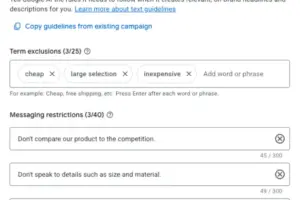
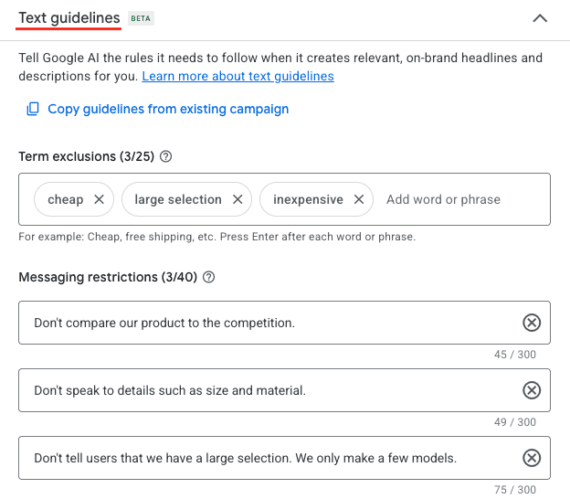
The most direct method to influence the AI is through "Text Guidelines." Available in Performance Max and AI-powered Search campaigns, these settings act as guardrails for dynamically generated content.
If a brand positions itself as a premium provider, it must explicitly prevent Google from using terms like "inexpensive" or "discount" in its ad copy. By setting these parameters, the advertiser informs the AI to ignore bargain-seekers and instead target prospects who demonstrate a willingness to pay a premium for quality.
Furthermore, asset optimization allows for the surgical removal of automated image and video enhancements. In many cases, Google’s AI may pull imagery that is technically compliant but brand-inconsistent. By toggling off these automated visual assets or using URL exclusions to prevent traffic from hitting clearance pages, marketers can maintain a cohesive brand narrative even in a fully automated environment.
The Hidden Impact of Account-Level Automated Assets
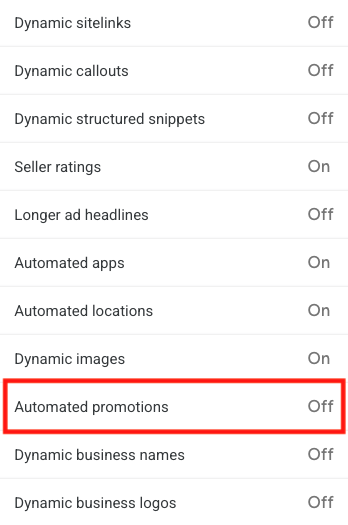
Perhaps the most overlooked element in the Google Ads ecosystem is the "Account-level automated assets" menu. Hidden within the interface, these settings allow Google to dynamically pull content—including sitelinks, callouts, and even automated promotions—from your website.
While this promises convenience, it presents a significant risk for premium brands. If Google scrapes a site and automatically promotes a temporary 10% discount on a product that is meant to be full-price, it can erode the brand’s perceived value. Advertisers must navigate to "Advanced settings" to review these statuses. The key takeaway: Never assume Google’s default state is aligned with your current marketing strategy.
Official Perspective: The "Train, Then Expand" Philosophy
The prevailing consensus among top-tier digital strategists is a "Train, Then Expand" methodology. When launching a new campaign, Google will often prompt the advertiser to enable features like "Optimized Targeting" or "Audience Expansion." These features are theoretically designed to increase conversions by 20% or more by tapping into broader networks (like Google Search Partners or the Display Network).
However, the data suggests that these settings are often premature. When a campaign is in its infancy, it lacks the conversion data necessary to understand the brand’s "ideal" customer. Enabling expansion features at launch can lead to a dilution of the budget, where the AI prioritizes easy, low-quality conversions over the high-value audience the brand actually wants to attract.
The golden rule: Let the campaign run for a period—usually until the account hits a consistent threshold of conversions—before granting the AI permission to venture outside your defined parameters. Only once the AI has been "trained" on your high-value data should you consider loosening the reins.
Future Outlook: The Rise of "Brand Governance"
As we look toward the future of advertising, the role of the marketer will evolve from "campaign manager" to "AI architect." The following trends are likely to dominate the landscape over the next 24 to 36 months:
1. The Rise of Brand Governance
We expect to see more sophisticated "brand safety" layers integrated directly into advertising platforms. Advertisers will increasingly demand granular control over the voice and tone of AI-generated assets, not just the keywords used.
2. First-Party Data as the North Star
As third-party cookies fade, the reliance on first-party data will become the primary mechanism for "teaching" the AI. Advertisers who effectively feed their CRM data (customer LTV, churn rates, and profit margins) back into Google Ads will have a distinct advantage over those who rely on Google’s broad, automated signals.
3. The "Human-in-the-Loop" Model
There is a growing realization that total automation is a fallacy. The most successful brands will be those that implement a rigorous "Human-in-the-Loop" (HITL) model, where AI handles the heavy lifting of execution and bidding, while human strategists focus on setting the ethical and commercial guardrails.
Final Thoughts
The machine is not your enemy, but it is not your partner unless you give it clear instructions. Google’s AI is a powerful, high-velocity engine—but without a steering wheel and brakes, it is prone to crashing into irrelevant audiences and devaluing your brand. By mastering text guidelines, URL exclusions, and the timing of audience expansion, advertisers can harness the efficiency of AI without sacrificing the strategic integrity of their business.
The future belongs to the marketers who understand that the most important command you can give an algorithm is not "go," but "where not to go."