Executive Overview
The landscape of generative and agentic artificial intelligence has undergone a seismic shift. What began in 2023 as experimental, fragile scaffolding consisting of loosely coupled Python scripts and raw API calls has matured into a robust, highly competitive ecosystem of serious orchestration frameworks. As development teams push deeper into 2026, they are no longer dealing with speculative proof-of-concept prototypes or weekend hackathon projects. Instead, architects are designing foundational orchestration layers intended to govern production systems for years to come.
Yet, a dangerous disconnect persists in how engineering organizations evaluate these technologies. Standard metrics—such as GitHub repository stars, high benchmark scores on public datasets, or overly simplistic “time-to-hello-world” rankings—offer virtually no insight into how a framework will behave when a critical workflow hits an unexpected edge case at 2:00 AM on a Sunday. A framework engineered for open-ended, autonomous collaborative research will inevitably fracture and collapse within a tightly regulated financial compliance pipeline. Conversely, a system built around strict, deterministic state-machine branching can introduce suffocating bureaucratic overhead and latency into a lightweight, real-time conversational assistant.
Choosing the right agentic AI framework requires moving past vanity metrics. This comprehensive guide implements a rigorous, decision-tree-based architectural approach. By evaluating workloads against actual operational requirements—ranging from state durability and type safety to ecosystem lock-in—engineering leaders can select the ideal framework for their production environments while avoiding costly architectural debt.
Detailed Chronology: The Evolution of Agentic Orchestration
To understand the current state of production frameworks, it is essential to examine the rapid evolutionary trajectory that brought the industry to its current juncture.
Phase 1: The Wild West and Raw API Scaffolding (2022–2023)
In the immediate wake of the public release of foundational large language models, agentic workflows were largely custom-built. Developers relied on raw loops, basic prompt engineering, and brittle string parsing to force models to call tools. Frameworks were nascent; communities were forced to invent patterns for memory management, tool execution, and error handling on the fly. Systems frequently suffered from infinite loops, unpredictable hallucinations, and catastrophic failures when confronted with ambiguous tool outputs.
Phase 2: The Proliferation of Metaphor-Driven Frameworks (2023–2024)
As the limitations of raw API loops became apparent, the first wave of dedicated orchestration libraries emerged. Projects introduced intuitive mental models borrowed from human organizations—treating agents as colleagues, researchers, or writers working in teams. While these frameworks dramatically lowered the barrier to entry and allowed teams to spin up multi-agent prototypes in hours, they struggled with deterministic control. Debugging these systems often felt like diagnosing a communication breakdown in a chaotic human office rather than inspecting a predictable software stack.
Phase 3: The Enterprise Turn Toward Determinism and Durability (2025–2026)
By 2025 and into 2026, the enterprise reality set in. Production systems handling financial transactions, legal discovery, and healthcare records could no longer tolerate black-box agent behavior. The industry experienced a sharp bifurcation: while rapid prototyping tools remained popular for creative and generative tasks, mission-critical systems demanded explicit state machines, type safety, human-in-the-loop checkpoints, and robust audit trails. Today, the modern framework ecosystem reflects this maturity, offering specialized tools tailored to distinct architectural philosophies.
Supporting Context & Metrics: When Do You Actually Need Multi-Agent Architecture?
Before an engineering team commits to evaluating complex orchestration frameworks, they must answer a foundational question: Does your task actually require a multi-agent architecture?
The single most prevalent architectural anti-pattern in modern AI engineering is reaching for orchestration complexity prematurely. A solitary agent, configured with well-defined system prompts and robust tool definitions, can handle a surprisingly vast array of tasks. Single-agent systems are dramatically easier to debug, monitor, unit-test, and reason about than their multi-agent counterparts.
Organizations should only introduce a multi-agent framework when a single agent hits unmistakable operational walls. The primary architectural triggers include:
- Cognitive Overload and Context Window Saturation: The scope of instructions, system prompts, and tool definitions exceeds the reliable attention span and context window of a single model instance.
- Specialized Persona Separation: The workflow requires distinct, conflicting perspectives—such as an aggressive security auditor paired with a defensive code generator—that cannot be faithfully simulated within a single system prompt without role degradation.
- Parallel Execution and Throughput: Sub-tasks can be executed concurrently across different domains, requiring independent worker agents that feed data back to a central coordinator.
If none of these triggers apply, engineering best practices dictate building a single-agent system first, reserving orchestration layers for when concrete operational limitations demand them.
The Decision Tree: Three Nodes That Narrow the Field
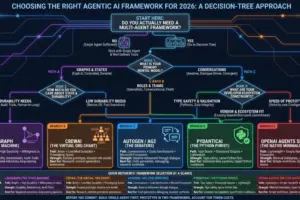
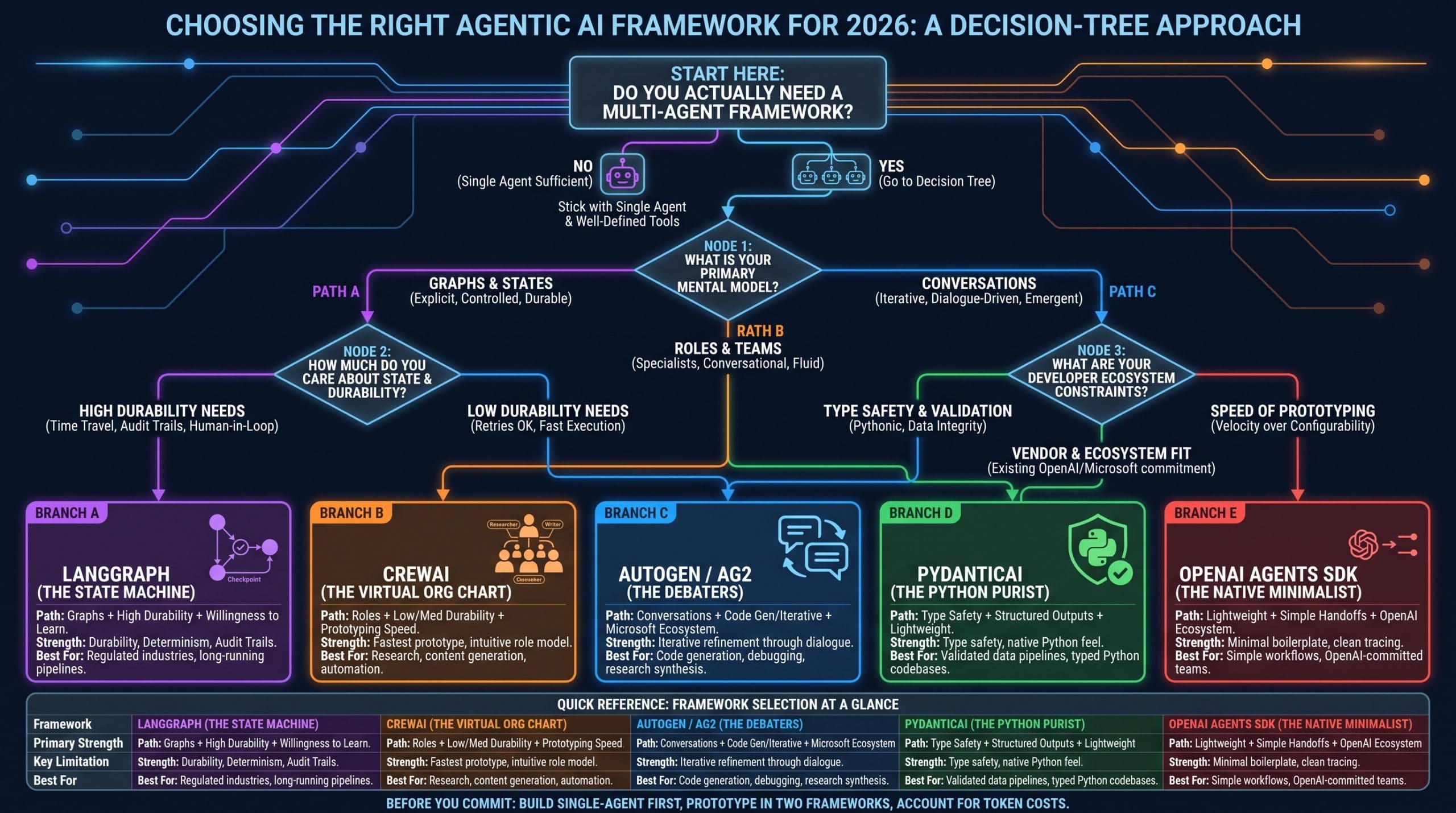
For systems that genuinely require multi-agent orchestration, navigating the crowded market requires evaluating workloads through a structured three-node decision tree.
                  [ Do you need Multi-Agent? ]
                              │ Yes
                              ▼
                 Node 1: Mental Model?
                 ├── Graphs & States ────► LangGraph
                 ├── Roles & Teams ──────► CrewAI
                 └── Conversations ──────► AutoGen / AG2
                              │
                              ▼
             Node 2: Durability & State Needs?
                 ├── High (Audits/Pause) ──► LangGraph
                 └── Low (Quick retry) ────► CrewAI / SDKs
                              │
                              ▼
           Node 3: Ecosystem & Type Constraints?
                 ├── Strict Python Types ──► PydanticAI
                 └── OpenAI Native ────────► OpenAI Agents SDK
Node 1: What Is Your Primary Mental Model?
The initial question is architectural, focusing on how developers naturally conceptualize the system’s execution flow:
- Option A (Graphs and States): The workflow consists of defined sequential steps, explicit conditional transitions, and critical failure-handling paths. State transitions are visualized like flowcharts with strict rules for retries and human approvals.
- Option B (Roles and Teams): The workflow maps directly to a virtual organizational chart. Specialist entities—such as a data researcher, a senior writer, and a quality assurance reviewer—hand tasks back and forth through conversational or goal-oriented handoffs.
- Option C (Conversations): The workflow is iterative and emergent. Two or more agents engage in back-and-forth dialogue, critiquing and refining outputs until an objective quality threshold is satisfied.
Node 2: How Much Do You Care About State and Durability?
The second node evaluates the lifecycle of execution and persistence:
- High Durability Needs: Workflows execute over minutes, hours, or days. The system must support pausing mid-execution, inspecting state parameters, rolling back after a failure, and integrating human-in-the-loop validation gates. This is mandatory for workflows touching financial transactions, legal documents, or medical records.
- Low Durability Needs: Workflows complete within seconds or a few minutes. Failures can be handled by simply restarting the job from scratch without the need to audit intermediate checkpoints.
Node 3: What Are Your Developer Ecosystem Constraints?
The final node addresses pragmatic software engineering requirements:
- Type Safety and Validation: The engineering team relies heavily on Python’s strict type hints. Data integrity across function boundaries is non-negotiable, and the agent framework must integrate seamlessly with existing validation layers.
- Vendor and Ecosystem Fit: The organization is deeply embedded in a specific provider’s ecosystem—such as Microsoft Azure or OpenAI—making native integrations and streamlined tracing higher priorities than framework-agnostic flexibility.
The Five Framework Branches
Mapping the decision tree leads directly to five distinct production framework branches, each with unique strengths and trade-offs.
Branch A: LangGraph (The State Machine)
- Ideal Path: Graph-based mental model + High durability needs + Willingness to invest in a steep learning curve.
- Architecture: Developed as a core part of the LangChain ecosystem, LangGraph models workflows as explicit directed graphs. Nodes represent functional units, edges define transitions, and state is maintained via a typed dictionary that flows through the system.
- Key Advantage: Because state is explicitly serialized, LangGraph supports advanced capabilities like “time travel”—allowing developers to pause a running workflow, inspect the state at any node, modify parameters, and resume execution. Human-in-the-loop workflows and audit trails are natively supported.
- Production Fit: Regulated industries, financial compliance pipelines, legal contract review engines, and long-running medical processing systems.
- Trade-off: High verbosity and a steep learning curve. Setting up schemas, nodes, edges, and checkporters requires writing significant boilerplate code.
Branch B: CrewAI (The Virtual Org Chart)
- Ideal Path: Role-based mental model + Low-to-medium durability needs + Prioritizing rapid prototyping speed.
- Architecture: CrewAI structures multi-agent systems around human workplace metaphors. Agents are defined with distinct roles, goals, and backstories, grouped into crews assigned to specific collaborative tasks.
- Key Advantage: Extremely intuitive mental model. Developers can go from concept to a working multi-agent prototype in under two hours.
- Production Fit: Market research pipelines, automated content generation workflows, and business process automation where moderate unpredictability is acceptable.
- Trade-off: Limited control when agents go off-script. Because coordination relies on role definitions rather than hard-coded state transitions, misbehaving or looping agents are harder to constrain.
Branch C: AutoGen / AG2 (The Debaters)
- Ideal Path: Conversational mental model + Code generation/iterative refinement + Microsoft ecosystem alignment.
- Architecture: Formally governed under AG2, this framework is built on multi-agent conversational loops where specialized agents communicate in natural language until a task is successfully resolved (e.g., code generation followed by automated execution and error reporting).
- Key Advantage: Exceptional performance in iterative coding, software debugging, and data synthesis tasks due to dynamic multi-turn dialogues.
- Production Fit: Software engineering co-pilots, automated data science pipelines, and enterprise environments deeply integrated with Azure OpenAI.
- Trade-off: Conversational drift. Unrestricted agent dialogues can wander or enter circular patterns, requiring meticulous system prompt engineering and termination controls.
Branch D: PydanticAI (The Python Purist)
- Ideal Path: Lightweight tool execution + Strict type safety + Structured data outputs.
- Architecture: PydanticAI eschews heavy orchestration abstractions in favor of a minimalist, FastAPI-inspired developer experience. Agents are defined with typed inputs/outputs and tools mapped directly to Pydantic models.
- Key Advantage: Native feel for Python developers accustomed to strict data validation. Eliminates complex graph abstractions while guaranteeing strict boundary data integrity.
- Production Fit: Data extraction pipelines, validated JSON/structured output generators, and backend microservices where data integrity is paramount.
- Trade-off: It is strictly an agent library, not a full orchestration framework. Teams requiring complex checkpointing and durable multi-agent handoffs must build those layers independently.
Branch E: OpenAI Agents SDK (The Native Minimalist)
- Ideal Path: Lightweight tool execution + Simple linear handoffs + Total commitment to the OpenAI ecosystem.
- Architecture: Released by OpenAI, this SDK provides a streamlined, low-boilerplate approach to defining agents, tools, and handoffs, complete with built-in tracing.
- Key Advantage: Unmatched velocity for simple, 1-to-2 agent architectures running entirely on OpenAI infrastructure.
- Production Fit: Internal automation tools, rapid prototyping, and production environments entirely standardized on OpenAI models.
- Trade-off: High vendor lock-in. Switching to open-source or multi-provider model strategies requires significant refactoring. It is not designed for complex parallel execution or distributed state management.
Quick Reference: Framework Selection Matrix
| Framework | Primary Strength | Key Limitation | Best Production Fit |
|---|---|---|---|
| LangGraph | Durability, determinism, robust audit trails | Steep learning curve, verbose boilerplate | Regulated industries, long-running enterprise workflows |
| CrewAI | Rapid prototyping, intuitive organizational metaphor | Difficult to constrain misbehaving or looping agents | Research, content generation, marketing automation |
| AutoGen / AG2 | Powerful iterative refinement via dialogue | Conversational drift, unpredictable in strict pipelines | Software engineering, code generation, Azure ecosystems |
| PydanticAI | Type safety, data validation, native Python feel | Not a full orchestration framework | Validated data pipelines, typed backend codebases |
| OpenAI Agents SDK | Minimal boilerplate, seamless native tracing | Vendor lock-in, limited orchestration complexity | Simple workflows, OpenAI-committed engineering teams |
Future Outlook: The Next Horizon in Agentic Infrastructure
As the agentic AI market continues its relentless evolution, several overarching trends are poised to shape the next generation of production infrastructure:
- Standardized Interoperability Protocols: Just as OpenAPI revolutionized REST API documentation, the industry is moving toward universal messaging and state schemas, allowing agents built in different frameworks to communicate seamlessly across organizational boundaries.
- Native Asynchronous Distributed Execution: Frameworks are increasingly shedding monolithic runtime models in favor of distributed, event-driven architectures capable of scaling horizontally across Kubernetes clusters to handle thousands of concurrent worker agents.
- Automated Verification and Safety Guardrails: Future orchestration layers will bake deterministic guardrails, automated hallucination detection, and real-time cost-control policies directly into the framework core rather than treating them as external middleware.
Ultimately, the most successful engineering organizations recognize that the optimal framework is not the one with the most vocal online community or the flashiest feature list. It is the tool that makes their specific operational failure modes easiest to anticipate, prevent, and remediate. By establishing clear architectural constraints first, engineering leaders can navigate the orchestration maze and build resilient, future-proof agentic systems.