Executive Overview
In a decisive move aimed at crippling the financial lifelines supporting the Kremlin’s military apparatus, the United Kingdom has levied sweeping economic sanctions against Cryptomus, a notorious cryptocurrency platform. Long recognized by blockchain intelligence firms and cybersecurity experts as a chameleon-like digital hub, Cryptomus has operated as a critical pipeline for high-risk financial flows. The platform has routinely funneled payments for global ransomware attacks, illicit narcotics trafficking, darknet market operations, fraud syndicates, and cybercrime services designed to help Russia successfully circumvent international financial restrictions.
Announced on October 8, the U.K. Treasury’s sanctions freeze all domestic assets tied to Cryptomus—historically known under corporate monikers such as Certa Payments and Xeltox Enterprises—and strictly bar British corporate entities and citizens from engaging in any commercial or virtual transactions with the platform. Alongside Cryptomus, the U.K. government targeted a cluster of interconnected virtual payment gateways, including VexPay, TokenSpot, and the Tsunami Payments service.
These coordinated measures represent a paradigm shift in how Western allies handle illicit cryptocurrency platforms. While previous penalties—such as a record-shattering Canadian administrative fine—failed to halt the platform’s day-to-day operations, the U.K.’s economic sanctions are designed to deliver a fatal blow. By cutting off access to institutional banking networks and criminalizing interaction with the platform, international regulators are increasingly signaling that shadow financial infrastructure will no longer be tolerated under the guise of corporate anonymity.
Detailed Chronology: From Certa Payments to Heleket
The operational history of Cryptomus is a masterclass in corporate evasion, rebranding, and jurisdictional arbitrage. Emerging on the digital landscape in 2022, the platform initially established its footprint under the name Certa Payments, operating out of Canada while maintaining nebulous structural ties to shell companies and offshore regulatory frameworks.
The Rise and Transformation of a Payment Hub
From its inception, Cryptomus positioned itself as an eager, compliance-averse payment processor catering to online merchants, high-risk enterprises, and a vast ecosystem of Russian cryptocurrency exchanges. As detailed in deep-dive investigative reporting by KrebsOnSecurity, the platform rapidly became the go-to financial engine for websites peddling underground cybercrime tools, illicit digital services, and ransomware laundering solutions.
However, as public scrutiny mounted and blockchain analytics firms mapped its transaction pathways, Cryptomus began shedding its skin. Faced with mounting regulatory pressure, the platform executed a series of strategic rebrandings.
The turning point came when Canadian regulatory authorities stepped in, levying a staggering CAD $176 million fine against Cryptomus for sweeping, systemic anti-money laundering (AML) violations. Rather than folding or paying the multi-million-dollar penalty, the platform’s operators took a page out of the cybercriminal playbook: they appealed the fine, launched a parallel "no-KYC" (Know Your Customer) service branded as Heleket, and continued processing massive volumes of suspicious transactions without missing a beat.
The Canadian Fine vs. U.K. Sanctions
According to veteran blockchain investigator and analyst Richard Sanders, who spent months mapping Cryptomus’s intricate operational infrastructure, the Canadian financial penalty—while historically significant—ultimately proved toothless in halting the platform’s processing capabilities.
"A fine doesn’t stop a cryptocurrency payment processor from processing payments," Sanders noted in a public assessment. "Sanctions kill the operation. The distinction matters."
Sanders also highlighted the historic geopolitical nature of the U.K. action. The October 2026 sanctions mark the first known instance of a "Five Eyes" nation (comprising Australia, Canada, New Zealand, the United Kingdom, and the United States) directly sanctioning a cryptocurrency operation that was originally incorporated within another Five Eyes jurisdiction. This cross-border enforcement breakthrough underscores the escalating frustration shared by Western intelligence agencies regarding corporate forum-shopping and regulatory loopholes.

Supporting Context & Metrics: The Scale of Illicit Processing
The sheer volume of capital moving through Cryptomus and its spin-off entities highlights why Western regulators were forced to escalate their response from monetary fines to total economic isolation. Independent blockchain analytics firms have spent years quantifying the vast sums of illicit value coursing through the platform’s digital veins.
Billions in Processed Funds
In April 2026, leading blockchain forensics firm TRM Labs published an exhaustive intelligence profile revealing that Cryptomus had processed more than $7 billion in transactions since launching in 2022. TRM’s analysis uncovered that this multi-billion-dollar ledger was not merely composed of gray-market e-commerce transactions; it directly intersected with some of the darkest corners of the digital underworld, including:
- Vendors distributing child sexual abuse material (CSAM).
- International terrorist financing cells and networks.
- Transnational human trafficking operations.
- Extortion payments tied to high-profile ransomware syndicates.
TRM Labs noted an interesting dynamic: while Cryptomus briefly instituted superficial KYC verification rules that caused its primary transaction volumes to crater, its operators seamlessly pivoted by deploying Heleket. This parallel platform absorbed the displaced, non-compliant traffic, allowing bad actors to continue laundering funds completely unchecked.
Chainalysis Findings: Powering the Russian Wartime Economy
In a blog post accompanying the U.K. sanctions announcement, blockchain data-crunching giant Chainalysis emphasized that Cryptomus and Heleket had evolved far beyond standard high-risk payment gateways, becoming foundational pillars of Russia’s wartime economy.
"Cryptomus and Heleket have emerged as major payment hubs for illicit activity," Chainalysis wrote. "Together, these services received more illicit funds across tracked categories than the mixers in our dataset, and the number of illicit counterparties surged to more than 900 in a single month in late 2025."
The integration of these platforms into Russian financial channels has provided Moscow with a vital escape hatch, allowing sanctioned entities, state-sponsored cyberespionage groups, and illicit procurement networks to convert cryptocurrencies into usable fiat currency or clean digital assets, completely bypassing traditional SWIFT banking rails.
Official Statements and Industry Reactions
The international response to the U.K.’s actions has been swift, with cybersecurity experts, compliance professionals, and blockchain intelligence organizations rallying around the enforcement decision as a necessary step toward cleansing the global financial ecosystem.
The Death Throes of Cryptomus-Linked Bots
The immediate operational impact of the U.K. sanctions was visible almost in real time. On October 8, users and investigators interacting with the official Cryptomus and Heleket support channels on Telegram encountered abrupt service disruptions. When questioned by users regarding sudden transaction freezes and processing failures, support agents fell back on defensive postures. In one notable instance captured by investigators, a Heleket support agent brazenly claimed—despite overwhelming technical and corporate evidence to the contrary—that the service bore no operational affiliation with Cryptomus.
[User Inquiry on Telegram - Oct 8, 2026]
User: "Why are transactions failing? Is this related to the U.K. sanctions on Cryptomus?"
Heleket Support Agent: "We are experiencing technical updates. Heleket is an independent platform and has no affiliation with Cryptomus."
[System Log: Transactions remain offline; platform infrastructure targeted by asset freezes.]
The End of Impunity
Industry analysts agree that asset freezes and sanctions designations strip away the corporate veil that crypto-evasion platforms rely on. By targeting the underlying infrastructure—including associated payment gateways like VexPay, TokenSpot, and Tsunami Payments—governments are warning global liquidity providers, decentralized finance (DeFi) protocols, and centralized exchanges that servicing these addresses now carries severe legal liabilities.
Richard Sanders emphasized that the collaborative intelligence sharing between private-sector blockchain forensics firms and public-sector law enforcement agencies has reached a maturity level where corporate shell games can no longer hide bad actors indefinitely.

Future Outlook: Unmasking the Phony Regulators of Western Sahara
Perhaps the most bizarre and illuminating chapter of the Cryptomus saga involves the ingenious, albeit fraudulent, regulatory architecture that gave the platform its initial veneer of legitimacy. Understanding how Cryptomus and Certa Payments acquired their supposed authority to operate international financial services exposes profound vulnerabilities in global corporate registration standards.
The Western Sahara Shell Game
An investigative deep dive into the corporate paperwork of Certa Payments revealed that its sole shareholder was a 25-year-old Ukrainian woman. Beyond Cryptomus, she also held executive control over several other enterprises, most notably the WS Management and Advisory Corporation.
WS Management and Advisory Corporation aggressively marketed itself as an official, exclusive regulatory body responsible for issuing licenses to cryptocurrency exchanges, foreign exchange brokers, and online gaming businesses incorporated within the Western Sahara—a disputed region in northwest Africa that lacks widespread international recognition as a sovereign nation.
The Phony Regulatory Web
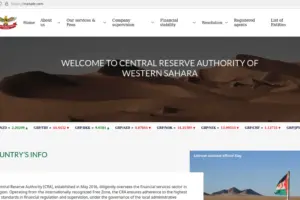
The pseudo-regulator operated out of a polished web portal (crasadr.com), which billed itself as the official site of the Central Reserve Authority of the Western Sahara (CRASAD). This fake authority claimed to oversee compliance, bank setup, and corporate formation for high-risk financial entities operating globally.
Digital footprint analysis revealed undeniable links connecting the scam to Cryptomus’s core infrastructure. For instance, one of Certa Payments’ former web domains (certa.website) shared the exact same physical server hosting 12 other domains, including rasd-state.ws—the digital home of the fabricated Central Reserve Authority.
By fabricating a regulatory body in a lawless or disputed territory, the operators of Cryptomus engineered a regulatory "grey zone" where they could issue their own compliance certificates, duating banks and business partners into believing they were a legitimate, supervised financial institution.
The Road Ahead
The U.K. sanctions against Cryptomus, combined with ongoing international scrutiny, signal the beginning of the end for sovereign-laundering schemes backed by fake regulatory authorities. As regulatory nooses tighten across Five Eyes jurisdictions, platforms that rely on phantom oversight, shell corporations, and rapid-fire rebranding will find fewer safe havens.
For the global cybersecurity and financial intelligence communities, the downfall of Cryptomus serves as both a blueprint for tracking advanced criminal payment processors and a stark warning to other illicit operators: while code may be immutable, the legal and financial infrastructure required to turn digital tokens into tangible cash is increasingly vulnerable to coordinated state power.