Executive Overview
In a decisive maneuver targeting the financial arteries of Russia’s wartime economy, the United Kingdom has levied sweeping economic sanctions against Cryptomus, a notoriously adaptable cryptocurrency payment platform. For years, financial crime investigators and blockchain intelligence firms have identified Cryptomus as a critical infrastructure hub for global cybercrime. The platform has allegedly facilitated billions of dollars in illicit transactions, acting as a primary conduit for ransomware syndicates, international drug cartels, darknet market operators, fraud networks, and state-backed entities working to bypass international financial sanctions against Russia.
Announced on October 8, the U.K. Treasury’s sanctions freeze any assets held by Cryptomus within British financial institutions and legally prohibit U.K. companies and citizens from engaging in commercial or virtual asset transactions with the platform. Alongside Cryptomus, the U.K. government targeted several associated virtual payment frameworks, including VexPay, TokenSpot, and the Tsunami Payments service.
The crackdown represents a watershed moment in international cryptocurrency regulation. According to blockchain analytics experts, this marks the first known instance of a "Five Eyes" nation (comprising Australia, Canada, New Zealand, the United Kingdom, and the United States) officially sanctioning a cryptocurrency entity incorporated within another Five Eyes jurisdiction—highlighting the borderless, highly evasive nature of modern financial crime. While prior enforcement actions, such as a record-breaking Canadian administrative fine, struggled to halt the platform’s operations, these targeted economic sanctions are designed to achieve what fines cannot: the total operational asphyxiation of a major criminal nexus.
Detailed Chronology: The Evolution and Evasion of Cryptomus
The lifecycle of Cryptomus is a masterclass in corporate obfuscation, name-changing, and regulatory evasion. To understand how the platform grew into a multi-billion-dollar enterprise for illicit finance, one must trace its roots through changing monikers, shell corporations, and international jurisdictions.
2022–2024: Inception and the Certa Payments Era
Emerging onto the digital asset landscape around 2022, Cryptomus—initially operating under corporate entities such as Certa Payments and Xeltox Enterprises—positioned itself as an e-commerce crypto payment gateway. Beneath its veneer of legitimacy, however, the platform quickly became the preferred checkout engine for dozens of Russian cryptocurrency exchanges and underground websites peddling cybercrime-as-a-service.
Investigative reporting in late 2024 revealed that Certa Payments shared a nominal corporate address in Vancouver, British Columbia, with dozens of other foreign currency dealers and money-transfer businesses—none of which maintained a physical presence at the location. Investigators discovered that the sole shareholder of Certa Payments was a 25-year-old Ukrainian national who simultaneously directed multiple shell firms, including the WS Management and Advisory Corporation. This peculiar corporate web tied directly back to a fabricated financial regulatory framework supposedly situated in the disputed northwest African territory of Western Sahara.
2025: The Canadian Crackdown and the Birth of "Heleket"
By late 2025, regulatory pressure caught up with the platform. Canada levied a record-shattering administrative penalty of CAD $176 million against Cryptomus for severe anti-money laundering (AML) and know-your-customer (KYC) violations.
Faced with a catastrophic regulatory penalty, Cryptomus executed a chameleonic pivot. Rather than complying with Canadian law or paying the fine, the platform appealed the penalty, instituted superficial KYC procedures that caused transaction volumes to temporarily dip, and launched a parallel, unverified service under the name Heleket. Operating as an unregulated clone, Heleket continued processing high volumes of illicit transactions without demanding identity verification from its high-risk user base. When confronted by investigators and users via Telegram support channels, Heleket representatives brazenly claimed—against overwhelming blockchain forensics to the contrary—that the service had no corporate or structural affiliation with Cryptomus.

October 2026: U.K. Sanctions and the Freezing of Operations
The tipping point arrived on October 8, 2026, when the United Kingdom escalated enforcement from municipal fines to national security-level economic sanctions. The impact was immediate. Within hours of the U.K. sanctions notice, automated support bots and customer service channels for Cryptomus and its derivatives on Telegram began issuing emergency alerts, informing bewildered users that the platform was suddenly experiencing systemic failures and was entirely unable to process transactions.
Supporting Context & Metrics: Scale of the Illicit Enterprise
Independent blockchain intelligence firms have spent years mapping the financial inflows and outflows of Cryptomus, revealing an operation of staggering proportions and systemic risk.
Transaction Volumes and Illicit Inflows
Data compiled by leading blockchain analytics firm TRM Labs in April 2026 revealed that Cryptomus had processed more than $7 billion in transactions since its inception in 2022. While a portion of this volume represented legitimate e-commerce, a disproportionate share was tied to high-severity criminal ecosystems, including vendors of child sexual abuse material (CSAM), international terrorist financing networks, and sophisticated human trafficking rings.
Furthermore, blockchain intelligence titan Chainalysis highlighted the structural role Cryptomus played in sustaining Russia’s wartime economy. In an October 8 advisory, Chainalysis noted that Cryptomus and its alter-ego Heleket had emerged as primary payment conduits for illicit funds, outstripping traditional crypto-mixers in total volume processed across tracked illicit categories. By late 2025, the number of distinct illicit counterparties interacting with the platform surged to more than 900 entities in a single month, demonstrating an industrial-scale reliance on the gateway by cybercriminal networks.
The Phony Regulatory Framework of Western Sahara
A fascinating dimension of the Cryptomus investigation uncovered by forensic analysts involves the bizarre mechanisms the platform used to manufacture regulatory legitimacy.
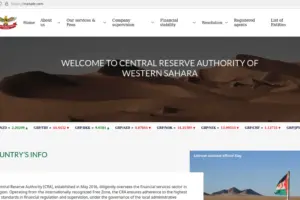
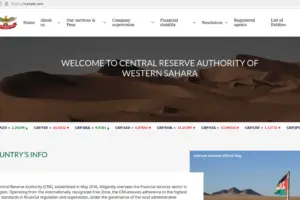
Cryptomus derived its pseudo-authority to offer international financial services through a network of shell institutions overseen by a completely fabricated regulatory body. Certa Payments’ corporate filings and previous web infrastructure (such as certa.website) shared server space with domains tied to the Central Reserve Authority of the Western Sahara (crasadr.com).
Western Sahara is a disputed territory in northwest Africa that lacks widespread international recognition as a sovereign state. Yet, this phantom regulatory body billed itself as an official overseer, granting licenses for cryptocurrency exchanges, foreign exchange brokers, and online gambling sites. This clever regulatory arbitrage allowed Cryptomus to wave away skeptical banking partners with official-looking documentation issued by a non-existent government entity that lacked any legal accountability or regulatory oversight.
Official Statements and Expert Analysis
The international enforcement action has drawn widespread commentary from top-tier blockchain security experts and intelligence analysts, who emphasize the qualitative difference between monetary fines and economic sanctions.

Richard Sanders, an independent blockchain investigator who spent months mapping Cryptomus’s complex payment infrastructure and interacting directly with its network of illicit customers, underscored why the U.K. sanctions represent a fatal blow to the platform where Canadian monetary penalties failed.
"A fine doesn’t stop a cryptocurrency payment processor from processing payments," Sanders wrote in a public analysis following the announcement. "Sanctions kill the operation. The distinction matters."
Sanders pointed out that because Canada’s CAD $176 million fine was ultimately unenforceable across international borders against an evasive, shell-corporation-backed entity, Cryptomus simply brushed it off, launched Heleket as a parallel shadow service, and continued business as usual. By contrast, sovereign economic sanctions criminalize the underlying infrastructure, choke off access to Western banking relationships, and compel international tech and hosting providers to sever ties immediately.
Chainalysis echoed these sentiments in their analytical briefing, emphasizing that the action against Cryptomus and TokenSpot forms part of a broader, necessary campaign to dismantle the digital financial plumbing that underpins global ransomware operations and Russian state-sanctioned sanctions evasion.
Future Outlook: The Crackdown on Chameleonic Crypto Gateways
The sanctioning of Cryptomus and Heleket marks a turning point in how Western governments approach decentralized and pseudo-anonymous financial crime. For years, illicit actors operated under the assumption that moving operations across international borders, cycling through shell companies, and rebranding under new names (from Certa Payments to Cryptomus, and finally to Heleket) would indefinitely shield them from accountability.
However, the October 2026 U.K. sanctions demonstrate that advanced blockchain analytics—combined with cross-border intelligence sharing among Five Eyes allies—can successfully pierce the corporate veils of fraudulent payment processors. By unmasking fictitious regulatory bodies like the Central Reserve Authority of Western Sahara and exposing the real human actors behind shell corporations, investigators have set a new precedent for corporate transparency in the digital asset space.
Going forward, cryptocurrency platforms operating in regulatory grey zones face an increasingly hostile environment. As international enforcement agencies shift from issuing civil fines to deploying aggressive economic sanctions, the era of the "chameleonic" crypto payment processor is drawing to a close. Platforms that choose to build their business models on ransomware laundering, darknet facilitation, and Russian sanctions evasion will find their operational lifelines systematically cut off, one jurisdiction at a time.