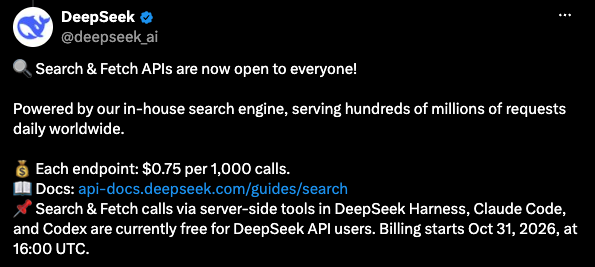
On October 17, 2026, DeepSeek fundamentally shifted the landscape of Generative Engine Optimization (GEO) by opening its proprietary search infrastructure to the public. Through the release of its "Search and Fetch" API, the company has provided developers and SEO professionals with a rare, transparent window into how an AI model perceives the web. By offering direct access to authority scores and source metrics, DeepSeek has effectively invited the industry to peek behind the curtain of its reasoning engine.
This development is not merely a feature update; it is a significant, if controversial, release. As AI-powered search becomes the primary interface for information retrieval, understanding the metrics that dictate "authority" and "quality" is now as critical as traditional search engine optimization once was.
Executive Overview: A New Frontier in Search Transparency
DeepSeek’s announcement coincided with a major update to its "Flash" model, highlighting the company’s push to dominate the infrastructure layer of AI. The platform claims its search engine already powers millions of daily queries and maintains an index of hundreds of billions of pages.
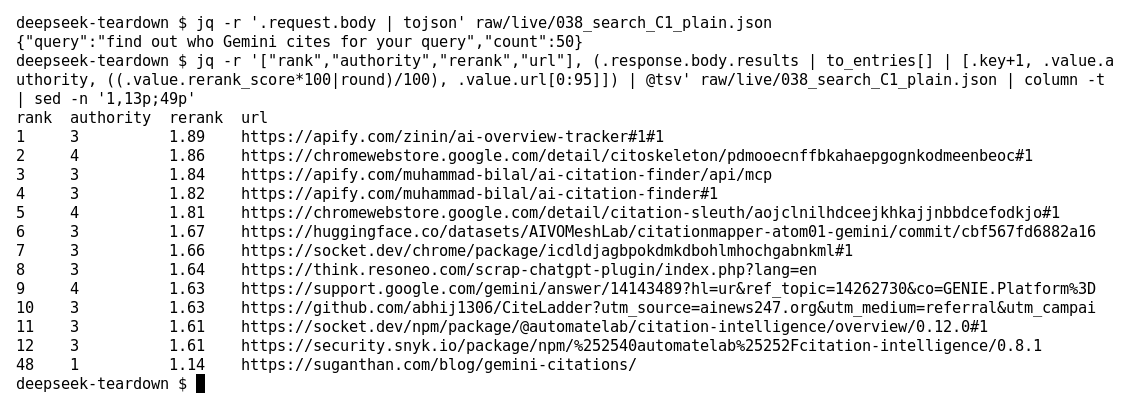
The most provocative aspect of this release is the provision of granular data: every result returned by the API is accompanied by an authority tier and a rerank_score. These metrics are intended to signal the reliability of a source before an AI model synthesizes that information into an answer. However, initial testing suggests that the reality of these scores is far more complex—and occasionally more flawed—than the documentation implies.

For the SEO community, this API represents a "grounding war" tool. It allows practitioners to audit how their content is perceived, identify if they are being filtered as "low-quality AI content," and observe how their sites rank in an environment that prioritizes machine-readable authority over traditional link-based popularity.
Detailed Chronology: The $0.08 Investigation
To understand the implications of this release, I conducted a series of empirical tests on October 17, 2026, from Dubai. The study involved 110 API calls, split between search and fetch operations, costing a modest $0.08. The goal was simple: test the robustness of DeepSeek’s spam filters, the consistency of its authority scoring, and its adherence to standard web protocols like robots.txt.
The Scoring Framework
DeepSeek categorizes its search results using two primary fields:
- Authority (0–4): An assessment of the source’s credibility. A score of -1 indicates an unknown entity, while 3 or 4 signifies high authority.
- Rerank Score (0–3): A composite metric reflecting relevance, authority, and freshness. Results with scores of 1.5 or higher are deemed "high quality."
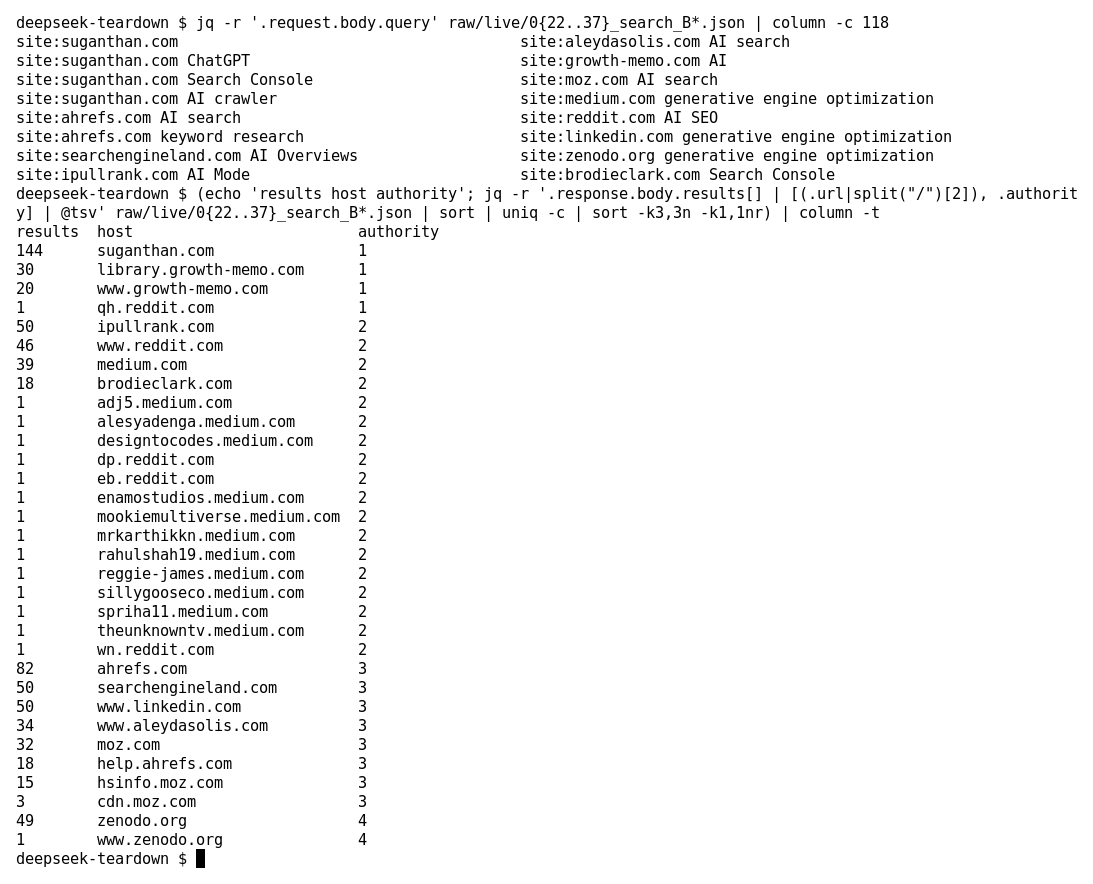
In a sample of 1,000 results collected across 20 SEO-related queries, the median rerank_score was 1.63, with 68% of results falling above the 1.5 threshold. The distribution of authority, however, revealed a striking pattern: the engine appears to assign scores at the host level rather than the page level.
The Host-Level Bias
One of the most significant takeaways from this investigation is that authority is not tied to the specific page, but to the domain or subdomain. For instance, my own site, Suganthan.com, consistently returned an authority score of 1 across all pages. Conversely, major aggregators and established platforms like Ahrefs and Moz consistently received scores of 3, and Zenodo received a 4.
The granularity of this observation was further validated by Reddit subdomains: qh.reddit.com returned a score of 1, while www.reddit.com was granted a 2. This confirms that DeepSeek’s assessment is not holistic; it is a segmented evaluation of host infrastructure.
Supporting Context: The Paradox of "Spam" Filtering
DeepSeek has publicly committed to filtering out SEO spam, GEO manipulation, and low-quality AI-generated content. Yet, my testing identified glaring vulnerabilities in these safeguards.
During the crawl, I encountered several high-authority (Score 4) results that were clearly problematic. These included:
- Government-Hosted Spam: PDFs on
oig.dc.govtitled "Free Robux Generator in 2025." - University-Hosted Clickbait: Webform uploads on
business.columbia.edupromoting "Forbidden" CBD gummies. - Reputation Hijacking: A former Member of Parliament’s domain serving "Minimum Deposit Casinos UK."
These results, carrying the highest possible authority tier, suggest that the engine heavily weights the TLD or the host’s historical reputation over the actual content of the page. This is a critical finding for SEOs: it validates the concern that "parasite content"—where spammers leverage the authority of legitimate government or educational domains—remains a persistent threat to AI search integrity.
The Fetch API and Protocol Compliance
The Fetch API, which retrieves the actual content of a page, presented further technical concerns. The bot identifies itself as a standard Firefox browser (Mozilla/5.0... Firefox/149.0) with a Chinese language preference (zh-CN).
Critically, my tests showed that this crawler ignored robots.txt directives. Pages explicitly disallowed for all crawlers were still fetched and returned in full by the API. While this may be a temporary technical oversight, it creates an immediate concern for site owners who rely on standard exclusion protocols to protect sensitive or proprietary content from being used as training data or grounding sources.
Official Statements and Technical Discrepancies
DeepSeek’s documentation paints a picture of a precise, well-oiled machine, but the observed data shows significant deviations.
- Snippet Lengths: The documentation claims snippets range from 100 to 200 characters. My observed median was over 300.
- Summaries: While documentation suggests 600–800 characters, I observed summaries reaching up to 3,570 characters.
- Localization: My tests indicated that the
localizationparameter is essential. Without it, the search engine defaults to the caller’s IP location. Interestingly, while changing the IP to US or UK-based locations reshuffled results, it did not dramatically shift the authority scores, suggesting that authority is a global metric for the engine, while relevance is localized.
Future Outlook: Navigating the GEO Landscape
The launch of the Search and Fetch API is a turning point for the industry. We are moving away from the era of "guessing" how an algorithm works and into an era of "auditing" the data pipeline.
Recommendations for Practitioners:
- Audit Your Host Authority: Use the API to check your current authority score. If you are stuck at a 1, prioritize infrastructure and host-level signals, as these appear to be the primary drivers of DeepSeek’s assessment.
- Monitor Your Logs: Implement a log filter to catch the
Firefox/149.0user agent coupled with thezh-CNlanguage header. While this is not a perfect signature, it is the best current way to identify when DeepSeek is inspecting your pages. - Optimize for Date-Sensitive Queries: Ensure your content uses structured, machine-readable dates. My tests confirmed that the engine effectively prunes "undated" content when a user adds a date filter to their query.
- Adopt a "Hard" Defense: Because the Fetch API ignores
robots.txtin these early stages, rely on server-side IP blocking or authentication layers if you have content that you strictly do not want to be indexed or processed by DeepSeek’s models.
As we look toward November 2026 and the end of the current free-tier access for server-side calls, the industry must prepare for a landscape where AI models are the primary arbiters of truth. By treating these search results as "live data" rather than a "black box," SEO professionals can begin to reverse-engineer the quality signals that will define the next generation of the web.
This is not the end of SEO; it is the beginning of a more technical, evidence-based discipline. The "Grounding Wars" have officially begun, and those who can decode the machine’s internal metrics will be the ones who define the future of digital visibility.