Executive Overview
In the rapidly expanding, multibillion-dollar ecosystem of modern sports, few phenomena rival the meteoric rise of pickleball. What began as a backyard pastime for retirees has transformed into a global obsession, drawing millions of recreational players, high-profile celebrity investors, and fiercely competitive professional circuits. Yet, for all its explosive cultural penetration, the sport’s manufacturing sector remained surprisingly stagnant—until a frustrated champion and a data-obsessed childhood friend decided to rewrite the rulebook.
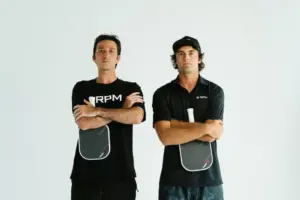
Enter James Ignatowich, a four-time Professional Pickleball Association (PPA) champion and former world No. 2 player, alongside his longtime friend Marwan Abaza, a former Division I tennis player and computational data science scholar. Frustrated by the sub-optimal equipment available on the market, the duo launched RPM Pickleball in September of last year. Operating entirely on bootstrapped capital without a single dollar of outside venture funding, the company has grown at a blistering pace.
Just one year after its debut, RPM Pickleball is on track to pull in an astonishing $31 million in annual sales, capped off by a staggering $4.5 million revenue month alone. To date, the brand has shipped over 35,000 high-performance paddles to enthusiasts across 100 countries. By identifying a glaring market inefficiency—the failure of incumbent brands to design equipment tailored specifically for elite competitors—Ignatowich and Abaza have disrupted an entire industry, turning childhood ambitions into an international commercial powerhouse.
Detailed Chronology: From South Florida Courts to Global Dominance
The Formative Years: A Friendship Forged in Competition
The story of RPM Pickleball does not begin in a corporate boardroom or a venture capital pitch meeting; it begins on the scorching tennis courts of South Florida. James Ignatowich and Marwan Abaza first crossed paths as pre-teens around the age of 12, competing fiercely against one another in local youth tennis tournaments. What started as a rivalry quickly blossomed into an enduring friendship.
Even as children, the pair shared an entrepreneurial itch. They spent countless hours daydreaming about launching a business together one day, mapping out grand schemes while navigating the grueling demands of competitive junior sports. However, life temporarily pulled them in divergent directions.
Ignatowich leaned heavily into his athletic pursuits, eventually transitioning away from tennis to catch the early wave of professional pickleball. His natural talent, relentless work ethic, and tactical mind propelled him to the pinnacle of the sport, earning him a reputation as a fierce competitor, a four-time PPA champion, and a former world No. 2.
Abaza took a more academic and analytical route. He parlayed his athletic background into playing Division I collegiate tennis, developing a deep appreciation for biomechanics, performance metrics, and equipment physics. Following his athletic career, Abaza dove into computational data science, sharpening an analytical mindset that would later serve as the operational backbone for their future enterprise.
The Catalyst: Venting That Sparked an Empire
Despite sitting near the top of the professional pickleball world, Ignatowich found himself wrestling with an unexpected annoyance: he disliked his paddle.
In professional sports, equipment can mean the difference between victory and defeat. Yet, despite winning a high volume of matches on the pro tour, Ignatowich remained deeply dissatisfied with the feel, responsiveness, and structural integrity of the gear he was forced to use. Night after night, he found himself picking up the phone to call his old childhood friend, Marwan Abaza, venting his frustrations about the subpar engineering plaguing the pickleball market.
These weren’t just casual complaints; they were diagnostic breakdowns of an industry’s blind spots. Ignatowich understood the kinetic nuances required at the highest level of play, while Abaza possessed the analytical framework to deconstruct those physical requirements into data points.
Eventually, the venting sessions reached a tipping point. During one conversation, Ignatowich stopped complaining and issued a challenge: they needed to stop talking about fixing the problem and actually do it. The childhood dream of going into business together was finally taking shape, catalyzed not by a market research report, but by an elite athlete’s sheer dissatisfaction with his gear.
Launching RPM Pickleball: Bootstrapping to Success
With zero prior experience running a manufacturing or direct-to-consumer retail brand, Ignatowich and Abaza took a massive leap of faith. In September of last year, they officially launched RPM Pickleball.
Crucially, the founders chose to bypass the traditional startup playbook. They elected not to pitch venture capitalists, angel investors, or private equity firms. Instead, they relied entirely on their own capital reserves, bootstrapping the enterprise from the ground up. This decision allowed them to retain absolute creative and operational control over their product line, ensuring that commercial compromises would not dilute their commitment to elite-tier quality.
The gamble paid off immediately—and spectacularly. What began as a passion project designed to solve a professional athlete’s equipment headache quickly caught fire among the global pickleball community. Driven by word-of-mouth endorsements from top-tier pros, digital marketing, and an undeniable product-market fit, sales skyrocketed. Within a single year, RPM Pickleball scaled into a $31 million enterprise, capped by a phenomenal $4.5 million revenue month. Having distributed more than 35,000 paddles across 100 countries, the brand transitioned overnight from a garage-startup concept into a dominant international player.
Supporting Context & Metrics: Decoding the Market Inefficiency
The Tennis vs. Pickleball Paradigm Shift
To truly understand the magnitude of RPM Pickleball’s success, one must examine the fundamental structural flaw that plagued the industry before their arrival.
In the sport of tennis—a mature, decades-old racket sport—the product development pipeline follows a top-down approach. Major racquet manufacturers like Wilson, Head, and Babolat design their high-end, technologically advanced racquets specifically for elite touring professionals like Roger Federer or Novak Djokovic. These professional-grade frames are engineered to maximize control, power, and spin under extreme velocity, often making them unforgiving for casual players.
Once these elite racquets hit the market, a fascinating consumer psychological loop occurs: everyday recreational players eagerly rush out to purchase the exact same equipment used by the pros. Amateurs want to emulate their heroes, wielding the same gear even if their skill levels do not fully harness its potential.
Prior to RPM Pickleball, the pickleball industry operated on the exact opposite—and deeply flawed—model. Because pickleball experienced a sudden, grassroots explosion among casual players, legacy manufacturers catered almost exclusively to beginners. Paddles were designed with wide, forgiving sweet spots, muted power profiles, and thick, basic cores intended to keep the ball in play for novices.
Consequently, professional players and advanced tournament competitors were forced to play with glorified beginner paddles. The market lacked high-performance equipment tailored to the lightning-fast reflexes, subtle touch shots, and explosive power generation demanded by elite competition.
Ignatowich and Abaza diagnosed this structural gap instantly. "We decided to make a paddle that was made for pros," Ignatowich explains. By inverting the industry standard and building from the top down, they unlocked a massive, underserved demographic of serious players hungry for professional-grade gear.
Financial and Global Reach Metrics
The numbers behind RPM Pickleball’s ascent underscore the viability of their thesis. A snapshot of the brand’s trajectory highlights its explosive growth:
- Annual Revenue Run Rate: On pace to hit $31 million in sales.
- Peak Monthly Revenue: Generated $4.5 million in a single month.
- Global Footprint: Over 35,000 paddles sold globally.
- Market Penetration: Active distribution and customer base spanning 100 countries.
- Funding Model: 100% bootstrapped with zero outside venture capital or institutional debt.
Despite these impressive figures, the company’s hyper-growth has not been without growing pains. The founders candidly admit that their greatest operational challenge has been keeping pace with global consumer demand. For roughly half of their inaugural year, RPM Pickleball struggled with persistent backorders, leaving eager customers waiting weeks—and sometimes months—to secure their gear.
"We were always dealing with angry customers that were waiting," Ignatowich recalls, highlighting the double-edged sword of launching a viral, high-demand product without an established global supply chain infrastructure.
Official Statements & Industry Insights
The Factory-Floor Philosophy: Becoming "Paddle Connoisseurs"
Unlike many modern direct-to-consumer brands that outsource their product design entirely via digital mockups and leave manufacturing oversight to distant third-party intermediaries, Ignatowich and Abaza take a relentlessly hands-on approach.
The co-founders spend approximately half of the year physically stationed on factory floors in China. There, side-by-side with manufacturing technicians, they meticulously fine-tune every microscopic detail of production. They experiment with varying foam densities, adjust thermoforming heating times, and calibrate surface grit textures to optimize spin and dwell time.
This deep dive into manufacturing physics has yielded tangible intellectual property. Along the way, the duo has developed multiple patent-pending technologies that set their paddles apart from mass-produced competitors.
Marwan Abaza describes their unique position in the marketplace by labeling himself and Ignatowich as true "paddle connoisseurs." Because Ignatowich plays at the highest professional level, he can provide manufacturers with hyper-specific, nuanced feedback regarding aerodynamic drag, core deflection, and vibrational feedback—insights that far exceed the generalized quality control metrics a large, bureaucratic legacy corporation could ever hope to provide.
Future Outlook: Beyond the Paddle
The Next Frontier: Training Tools
Having conquered the premium paddle market, James Ignatowich and Marwan Abaza are already casting their gaze toward the horizon, asking a critical entrepreneurial question: What is the next big opportunity in pickleball?
Drawing inspiration from more mature sports ecosystems, Ignatowich points directly to the golf industry as a blueprint for the future. Over decades, golf has cultivated a massive, highly lucrative market centered entirely around training aids—launch monitors, swing analyzers, putting mats, and resistance trainers designed to help players systematically improve their mechanics away from the course.
In contrast, the pickleball industry currently lacks sophisticated, high-end training tools. While players can easily purchase nets and balls, there is virtually no ecosystem of data-driven, specialized training equipment designed to refine hand speed, dinking accuracy, or third-shot drop mechanics.
Recognizing this massive white space, Ignatowich is already actively exploring the launch of a brand-new enterprise dedicated entirely to pickleball training technology. Given the duo’s track record of identifying hidden market inefficiencies, blending athletic intuition with computational data science, and bootstrapping a venture to multi-million-dollar status in just twelve months, the pickleball world should pay close attention to their next move.
RPM Pickleball proved that listening to a frustrated pro can build an empire. Their next venture may very well revolutionize how the entire sport trains to play tomorrow.