Executive Overview
The landscape of digital commerce is undergoing a structural paradigm shift. No longer confined to the traditional "human-browses-and-clicks" model, the internet is preparing for a new class of visitor: the autonomous AI agent. On October 15, at Vercel’s Ship 26 conference in San Francisco, a landmark collaboration between Shopify and Vercel was unveiled, signaling the transition toward "agentic ecommerce."
By marrying Shopify’s robust backend infrastructure with Vercel’s high-performance, AI-optimized frontend templates, the two companies are providing developers with the tools to build storefronts that are as legible to machines as they are to humans. This initiative, anchored by a rebuilt Hydrogen software development kit (SDK) and the launch of the "Vercel Shop" template, represents a fundamental rethinking of how data is surfaced, how assistants interact with shoppers, and how the next generation of commerce will be transacted.
Detailed Chronology: A Partnership in Evolution
The synergy between Shopify and Vercel did not emerge overnight; it is the culmination of a multi-year strategic alignment focused on solving the inherent frictions of headless commerce.
The Foundation (June 2024)
The cooperation was formally set into motion on June 30 with the comprehensive rebuild of Shopify’s Hydrogen framework. Prior to this, developers often struggled to maintain a consistent experience when integrating Shopify’s powerful commerce engine with various JavaScript frameworks. The Hydrogen rebuild decentralized these functions, allowing developers to treat ecommerce building blocks as modular components. This allowed for greater flexibility, enabling teams to build performant, custom storefronts without reinventing the wheel for basic tasks like cart management or catalog synchronization.
The Catalyst (October 2024)
The momentum accelerated at the Ship 26 conference. Shopify CEO Tobi Lütke and Vercel CEO Guillermo Rauch took the stage to address a core challenge: if the future of the internet is populated by AI agents, why are our websites still designed exclusively for human eyes? The unveiling of the Vercel Shop template was the answer. It is a blueprint designed to ensure that when an AI agent arrives at a store, it doesn’t have to "guess" or "scrape" the intent of a page—it is provided with structured, machine-readable data by default.
Supporting Context & Metrics: The Mechanics of Modern Storefronts
Building a custom storefront is a notorious challenge in software engineering. The complexity arises from the need for perfect synchronization between three critical pillars: catalog data, dynamic pricing, and checkout integrity.
The Three Pillars of Integration
- Catalog Data: Developers must ensure that product details—variants, descriptions, and imagery—are updated in real-time. Hydrogen provides the standardized hooks to pull this data from Shopify’s backend consistently.
- State Management: The "cart" is the most volatile part of the store. A user’s intent to purchase must be reflected immediately across both human-facing UI and AI-driven background processes.
- Checkout Integrity: As Tobi Lütke noted, checkout is a delicate instrument. It is the culmination of decades of security, regulatory compliance, and user experience testing. By allowing developers to "remix" pieces of the checkout process while relying on Shopify’s hardened infrastructure, the Vercel-Shopify collaboration strikes a balance between creative freedom and transactional security.
Why "Agent-Readable" Matters
Traditional websites rely on HTML, which is designed for visual rendering. For an AI agent to "shop," it currently must parse complex DOM trees, which is computationally expensive and prone to error. Vercel Shop shifts this by exposing clean, structured metadata that acts as an API for shopping. If an agent is looking for a specific shirt in a specific size, it can query the site’s data layer directly, bypassing the need to interpret CSS or layout logic.
Official Statements: The Vision for the Future
The philosophy driving this collaboration is rooted in the belief that commerce should be open and modular. Tobi Lütke’s remarks at Ship 26 underscored a commitment to the "open web" of commerce:
"Checkouts are ridiculously hard to get right. It’s one of those pieces of software that actually does need 20 years of tinkering with. And Shopify has always been very open, and so we invite people to remix pieces from our checkout just as much as you want. Basically, we provide the infrastructure that Shopify built, and you can build whatever you want with it."
This sentiment reflects a strategic move by Shopify to become the "operating system" of commerce, regardless of what the front-end looks like or who (or what) is interacting with it. Guillermo Rauch, meanwhile, has emphasized that Vercel’s role is to ensure that these storefronts remain lightning-fast and universally accessible, ensuring that the AI revolution doesn’t sacrifice the performance standards that human users have come to expect.
The Dual-Agent Experience
The Vercel Shop template introduces two distinct categories of agent interaction, both of which are critical to the future of the industry.
1. The External Agent
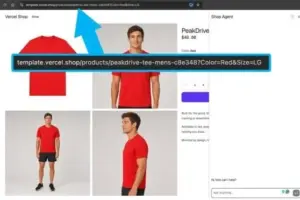
The external agent is an autonomous entity—perhaps a personal assistant AI residing on a consumer’s smartphone—that visits a store on behalf of a user. It can browse products, check color/size availability via clean URL parameters, and add items to a cart. Because the Vercel Shop template is built with machine-readability in mind, these external agents can perform these tasks with high reliability, effectively "negotiating" with the storefront before handing the final transaction over to the human user for secure payment.
2. The Internal Store Assistant
The internal assistant is a localized AI, often powered by the merchant’s own data. Much like Walmart’s "Sparky" or the sophisticated AI shopping assistants currently in development by tech giants, this tool lives within the store. It allows users to ask questions like, "Which of these jackets is most suitable for a rainy climate?" or "Can you add a matching belt to my cart?"
Crucially, this assistant is fully integrated with the Shopify cart. Any modification the AI makes—whether it is swapping a size or applying a bundle discount—is reflected in the same cart the human is using. This ensures that the user experience is seamless, preventing the "split-state" errors that often plague poorly integrated chatbot solutions.
Future Outlook: The Next Decade of Commerce
The collaboration between Shopify and Vercel is a harbinger of the "Autonomous Retail" era. As AI agents become more prevalent, the standard for a "good" website will no longer be limited to mobile responsiveness or SEO rankings. It will be defined by "Agent Optimization."
The Rise of Agent Optimization
Just as businesses invested in Search Engine Optimization (SEO) to cater to the rise of Google, they will soon invest in "Agent Optimization." This will involve ensuring that their product catalogs, store policies, and inventory levels are optimized for AI retrieval. The Vercel Shop template serves as the first standardized template for this new frontier.
Security and Ethical Considerations
While the prospect of AI agents handling the nuances of shopping is exciting, it brings new challenges. The current implementation wisely keeps the AI in a supportive role—it can manage the cart, but it cannot process payments. This "Human-in-the-Loop" approach to checkout ensures that while AI can assist in the discovery and selection process, the sensitive act of payment remains firmly in the hands of the consumer.
A New Standard for Developers
For the developer community, this collaboration lowers the barrier to entry for building world-class, AI-integrated commerce experiences. By providing a pre-configured template that handles the heavy lifting of state management and API connectivity, Shopify and Vercel are empowering smaller teams to compete with the technology stacks of global enterprises.
As we look toward 2027 and beyond, the storefront will cease to be a static page and will instead become a dynamic, conversational, and autonomous interface. Through the partnership between Shopify and Vercel, the architecture for this future is not only being discussed—it is being built today. Whether it is a human shopper in Tokyo or an AI assistant in New York, the store of the future is being designed to serve them both, marking a significant milestone in the evolution of the global digital economy.