Executive Overview: A Paradigm Shift in Digital Commerce
The landscape of online retail is undergoing a seismic shift, moving away from static, human-centric web interfaces toward a dynamic, machine-readable ecosystem. At the forefront of this transformation is a strategic collaboration between ecommerce giant Shopify and cloud development powerhouse Vercel.
During the "Ship 26" conference in San Francisco on October 15, Shopify CEO Tobi Lütke and Vercel CEO Guillermo Rauch unveiled a vision for "agentic ecommerce." This new paradigm seeks to bridge the gap between traditional storefronts and the burgeoning world of autonomous AI agents. By leveraging a rebuilt version of Shopify’s Hydrogen software development kit (SDK) and the introduction of Vercel’s open-source, AI-enabled storefront template—aptly named "Vercel Shop"—the two companies are providing developers with the tools to build commerce experiences that cater simultaneously to human shoppers and AI assistants.
This collaboration is not merely an aesthetic update; it is a foundational change in how e-commerce architecture is structured. By optimizing storefronts so that AI can "read" and navigate them with the same efficiency as a human, Shopify and Vercel are effectively laying the groundwork for the next generation of the internet, where autonomous agents act as personal shoppers, negotiating the complexities of inventory, pricing, and cart management on behalf of their users.
Detailed Chronology: From SDK Integration to Agentic Storefronts
The partnership between Shopify and Vercel has been a methodical progression, designed to decouple the complex backend of commerce from the highly customizable frontend.
The Foundation: The Hydrogen Rebuild
The current momentum traces back to June 30, when the two companies announced a significant overhaul of Shopify’s Hydrogen SDK. Historically, building high-performance, headless commerce storefronts was a resource-intensive endeavor requiring deep technical expertise. The rebuilt Hydrogen SDK changed this by modularizing common e-commerce functions. It allows developers to utilize Shopify’s robust backend infrastructure while deploying their frontends across various JavaScript frameworks and runtimes, providing unprecedented flexibility.
The Milestone: Ship 26 and Vercel Shop
Building upon the Hydrogen foundation, the October 15 announcement at Ship 26 marked the arrival of the Vercel Shop template. This open-source template serves as a "plug-and-play" solution for merchants who want to integrate AI capabilities immediately. Vercel Shop is engineered with "agent-readable" metadata, ensuring that when an AI bot visits a product page, it can instantly extract key details like SKU, pricing, variants, and availability without needing to parse complex HTML or visual elements.
Supporting Context & Metrics: The Mechanics of Modern Retail
Custom storefronts have long been the "Holy Grail" for brands, yet they are notoriously difficult to maintain. The integration process requires a seamless handshake between the shopping experience and the systems of record.
Solving the Integration Trilemma
The Vercel Shop template and the Hydrogen SDK tackle the three core pillars of e-commerce integration:
- Catalog Syncing: Ensuring real-time availability and product information across all frontends.
- State Management: Maintaining a consistent, synchronized shopping cart whether the user is browsing via a browser or interacting through a chat-based AI assistant.
- Checkout Integrity: Providing a secure, high-conversion path that remains consistent regardless of how the user reached the final stage of the funnel.
The Power of Structured Data
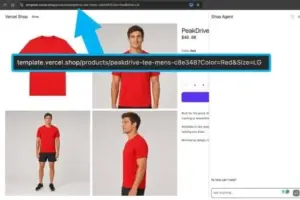
A critical component of this evolution is the transition toward structured data that machines can parse natively. Traditional web pages are built for human eyes; they rely on CSS and layout cues that are inefficient for AI to interpret. By embedding structured information directly into URL parameters and metadata, Vercel Shop allows an external AI agent to perform complex tasks—such as finding a specific color-size combination of a garment—with pinpoint accuracy. This removes the "black box" of web navigation for bots, enabling them to verify options and add items to a cart with near-zero latency.
Official Statements: The Philosophy of Open Infrastructure
During the Ship 26 keynote, Tobi Lütke provided a philosophical framework for why Shopify is pursuing such an open, collaborative approach to its infrastructure.

"Checkouts are ridiculously hard to get right," Lütke stated. "It’s one of those pieces of software that actually does need 20 years of tinkering with. And Shopify has always been very open, and so we invite people to remix pieces from our checkout just as much as you want. Basically, [you are] taking all the infrastructure that Shopify built, and you can build whatever you want with it."
This statement highlights Shopify’s strategic pivot: instead of forcing merchants into a rigid, monolithic interface, they are positioning themselves as the "backbone" of commerce, allowing developers to create highly personalized, AI-augmented storefronts. By abstracting the difficulty of checkout and payment processing, Shopify enables developers to focus entirely on the "discovery" phase of the customer journey—the interface where AI agents and human shoppers interact.
Future Outlook: The Role of the AI Shopping Assistant
Perhaps the most consumer-facing element of this partnership is the optional, AI-powered shopping assistant integrated into the Vercel Shop template.
Bridging the Gap: The "Sparky" for Every Store
Comparable to high-profile retail assistants like Walmart’s "Sparky" or Amazon’s "Alexa for Shopping," the Vercel Shop assistant acts as an on-site concierge. It is designed to handle queries, navigate product variants, explain store policies, and manage the shopping cart via natural language chat.
Importantly, the assistant is deeply integrated with the visual storefront. A shopper might start their journey by browsing photos on the website, then toggle to the chat interface to ask, "Do you have this in a size large, and does it pair well with the denim jacket I already have in my cart?" Because the assistant shares the same state as the visual UI, the cart updates in real-time, regardless of the interaction method.
Privacy and Control
Crucially, these assistants are designed with strict guardrails. They are not empowered to finalize transactions or process payments independently. Instead, they act as facilitators, handing off the finalized selection to the secure, battle-tested Shopify checkout flow. This ensures that while the shopping experience becomes more conversational and AI-driven, the security and compliance of the financial transaction remain uncompromised.
The Long-Term Trajectory
Looking ahead, the collaboration between Shopify and Vercel points to a future where "the store" is no longer a static URL. Instead, it becomes an ambient service. As AI agents become more prevalent, consumers will increasingly delegate the "boring" parts of shopping—finding the best price, checking return policies, and managing sizes—to their own personal AI models.
By building the infrastructure today that allows these external agents to communicate natively with merchant data, Shopify and Vercel are ensuring that their ecosystem will not be left behind in the AI revolution. For the developer, the message is clear: the future of web development is not just about building better websites for people; it is about building open, interoperable systems that can speak the language of the machines that will inevitably do the shopping of the future.
As more merchants adopt the Vercel Shop template and leverage the Hydrogen SDK, we can expect a rapid proliferation of "agent-first" storefronts. This will fundamentally change competitive dynamics in e-commerce, favoring brands that offer high-fidelity data and seamless, bot-friendly pathways over those that rely on legacy, visual-only interfaces. The era of the silent, autonomous shopper has arrived, and the infrastructure to support it is now officially live.