Executive Overview
In the architecture of the modern web, few elements are as frequently misunderstood or underutilized as the sitemap. While they appear to be mere navigational footnotes, sitemaps serve as the foundational blueprints that dictate how search engines interpret, prioritize, and index the vast expanse of an ecommerce ecosystem.
For site owners and digital marketers, the distinction between XML and HTML sitemaps is not merely technical—it is a strategic imperative. XML sitemaps act as a direct communication channel to search engine bots, facilitating discovery, while HTML sitemaps serve as a user-centric navigational aid that reinforces site hierarchy and internal link equity. To ignore the synergy between these two is to leave organic search visibility to chance. This report investigates the evolution, mechanics, and strategic implementation of sitemaps, providing a definitive guide for ecommerce professionals aiming to optimize their site’s presence in an increasingly competitive search landscape.
Detailed Chronology: From Static Directories to Algorithmic Blueprints
To understand the necessity of modern sitemaps, one must revisit the early, chaotic days of the World Wide Web. In the mid-1990s, the internet was a fragmented landscape of disparate pages. Developers, grappling with the challenge of organizing burgeoning content, began crafting simple text-based summaries. These "sitemaps"—often relegated to the footer or a dedicated "site map" page—were designed solely for human navigation, providing a hierarchical table of contents to ensure users didn’t get lost in the digital wilderness.
The turning point occurred in 2005. As the web expanded exponentially, search engines struggled to keep pace with the sheer volume of new URLs. Recognizing the need for a standardized, machine-readable format, Google introduced the XML (Extensible Markup Language) sitemap. This shift transformed the sitemap from a mere convenience for users into a mission-critical tool for SEO. By allowing webmasters to explicitly "submit" their site structure to Google via what would eventually become Google Search Console, the industry moved away from relying solely on "crawler discovery" (where bots stumble upon pages through links) toward "proactive indexing."
Over the following two decades, the industry settled into the current binary classification: the HTML sitemap, designed for human readability and internal link distribution, and the XML sitemap, engineered for algorithmic consumption.
Supporting Context & Metrics: The Mechanics of Discovery
The confusion surrounding these two formats often stems from a lack of clarity regarding their primary functions. To maximize search performance, ecommerce owners must view them as distinct assets within a broader SEO strategy.
The XML Advantage: Direct Communication
XML sitemaps are the "official manifest" provided to search engines. They operate independently of the site’s user-facing navigation, allowing bots to discover URLs without having to traverse the entire site hierarchy. However, submission is not a guarantee of indexing. The efficacy of an XML sitemap is governed by several critical variables:
- Crawl Budget: Search engine bots have limited resources. A well-optimized XML sitemap helps prioritize the most valuable pages, preventing bots from wasting resources on low-quality or irrelevant URLs.
- Site Authority and Relevance: XML sitemaps communicate the existence of a page, but the algorithm decides whether to index it based on depth, originality, and the presence of external backlinks.
- Dynamic Updates: Unlike the static nature of early web pages, modern XML sitemaps are dynamic. They are generated via content management systems (CMS) and updated in real-time as products are added, removed, or modified.
The HTML Advantage: Navigational Equity
If XML is for the bot, HTML is for the ecosystem. HTML sitemaps are essentially pages that link to every significant section of a website. Because they exist within the site’s actual architecture, they provide a secondary path for crawlers to discover content via internal links.
More importantly, HTML sitemaps serve as a powerful tool for distributing "link equity." When a sitemap is linked in the footer, it ensures that every page listed receives a share of the site’s authority. This is particularly effective at reducing the number of pages trapped in the "Crawled, currently not indexed" limbo within Google Search Console. By linking to these orphaned or hard-to-reach pages through an HTML sitemap, owners provide the necessary internal signals to prove to search engines that the content is important enough to warrant indexing.

Official Statements: The Google Perspective
The industry has long debated the necessity of HTML sitemaps, with many SEOs arguing that in an age of AI-driven indexing, human-focused sitemaps are redundant. However, recent discourse from Google suggests a more nuanced reality.
In a recent episode of the Search off the Record podcast, John Mueller, a Search Advocate at Google, addressed this skepticism. While he has historically downplayed the necessity of HTML sitemaps for large, well-structured sites, he conceded a critical point: "They would help crawling because from this place we can find all the links."
Mueller’s commentary is particularly instructive for ecommerce site owners. He noted that a common mistake is the attempt to list every individual product in an HTML sitemap—a move that creates a bloated, unhelpful page. Instead, he advocates for a logical hierarchy: "If you have an ecommerce site, you wouldn’t list all of your products in an HTML sitemap file. You would list the categories so people can go to the right place, then pick out the product individually."
This distinction confirms that the HTML sitemap should act as a navigational map for the user experience, rather than a raw database dump.
Strategic Implementation for Ecommerce
To build a robust indexing strategy, ecommerce professionals should adhere to the following best practices:
1. The XML Workflow
- Automate: Utilize your CMS (Shopify, Magento, WooCommerce, etc.) to generate and maintain your XML sitemap. Manual updates are a recipe for failure.
- Verify: Use professional auditing tools like Screaming Frog to regularly scan your XML sitemap for broken links, 404 errors, or pages that have been blocked by
robots.txtornoindextags. - Submit: Ensure your sitemap URL is submitted to both Google Search Console and Bing Webmaster Tools.
2. The HTML Strategy
- Prioritize: Focus your HTML sitemap on main categories, subcategories, and essential procedural pages (shipping policies, contact information, FAQ).
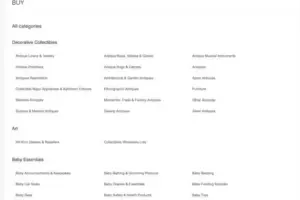
- UX-Centric Design: View your HTML sitemap as a tool for the customer. If a human cannot navigate your site using your sitemap, it is poorly designed. Look at industry leaders like eBay, which uses a clean, categorized approach to guide users through millions of products.
- Temporary Usage: If you are in the midst of a site migration or a significant restructuring, an HTML sitemap can serve as a "bridge" to ensure search bots can find new, unlinked content while the permanent internal structure is being finalized.
Future Outlook: The Role of AI and Site Structure
As search engines transition toward AI-driven search experiences (such as Google’s SGE), the traditional role of the sitemap is evolving. Search engines are becoming increasingly adept at inferring the importance of a page through user behavior and semantic analysis.
However, the "crawlable" web remains the bedrock of search visibility. No sitemap—no matter how perfectly constructed—can compensate for a poorly architected website. A site that lacks a logical, hierarchical flow will always struggle to maintain its search rankings.
The future of indexing lies in the marriage of high-quality, structured data and clean, efficient navigation. The XML sitemap will remain the primary vehicle for algorithmic discovery, while the HTML sitemap will increasingly be recognized as a key element of "site quality"—a signal that search engines use to determine how well a site is maintained for its users.
In conclusion, sitemaps are not legacy tools to be set and forgotten. They are living components of a site’s SEO strategy. By mastering the distinction between the two, providing clear paths for both bots and humans, and maintaining a site structure that prioritizes user value, ecommerce businesses can ensure they remain visible, relevant, and authoritative in a crowded digital marketplace. The sites that succeed will be those that treat their sitemaps not as a technical formality, but as the master blueprint for their digital presence.