Executive Overview
The landscape of digital commerce is undergoing a structural transformation, moving from static, human-navigated interfaces toward an ecosystem capable of supporting "agentic" interaction. On October 15, at the Vercel Ship 26 conference in San Francisco, Shopify CEO Tobi Lütke and Vercel CEO Guillermo Rauch unveiled a strategic collaboration designed to bridge the gap between human shoppers and the burgeoning world of autonomous AI agents.
At the heart of this initiative is the convergence of Shopify’s newly overhauled Hydrogen software development kit (SDK) and Vercel’s AI-enabled, open-source storefront template, aptly named "Vercel Shop." This partnership represents a fundamental shift in how e-commerce architecture is conceived: rather than building stores solely for human eyes, developers are now being empowered to build stores that are simultaneously accessible to human visitors and machine-learning agents. By providing a framework where AI can "read" product data, manage cart states, and assist in discovery, Shopify and Vercel are effectively standardizing the infrastructure for the next generation of the internet.
Detailed Chronology: A History of Deep Integration
The October announcement was not an isolated event, but rather the culmination of a multi-year effort to modernize the "headless" commerce stack. The partnership between Shopify—the world’s dominant e-commerce platform—and Vercel—the leader in frontend development and edge computing—has been systematically removing the friction that historically plagued custom storefront builds.
The Foundation: The Hydrogen Rebuild
The current collaboration builds upon the significant milestone reached on June 30, when the companies announced a comprehensive rebuild of Shopify’s Hydrogen SDK. Historically, building custom e-commerce storefronts required a daunting amount of "plumbing"—manually connecting catalog data, price updates, inventory availability, and checkout flows.
The rebuilt Hydrogen SDK transformed this process by abstracting complex commerce functions into modular, reusable tools that function across various JavaScript frameworks and runtimes. By making these tools framework-agnostic, Shopify and Vercel enabled developers to focus on the creative aspects of the user experience rather than the grueling mechanics of backend integration.
The Ship 26 Catalyst
The Vercel Ship 26 conference served as the public debut for the practical application of this research. By showcasing the Vercel Shop template, the companies demonstrated that the "headless" era is moving beyond simple site performance and into the realm of semantic, AI-friendly data structures. The template provides a blueprint for developers to deploy high-performance, SEO-optimized stores that include native support for AI interaction, effectively future-proofing the merchants who adopt it.
Supporting Context & Metrics: Why "Agentic" Matters
To understand why Shopify and Vercel are prioritizing agent-readability, one must analyze the limitations of current e-commerce architecture. Traditional web stores rely on visual elements—HTML, CSS, and interactive design—to convey information to humans. While this works for people, it creates a "brittle" experience for AI agents, which are often forced to scrape or "parse" visual code to understand product specs, pricing, or availability.
The Technical Shift
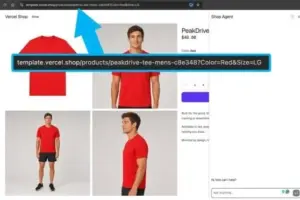
The Vercel Shop template resolves this by exposing product information in a structured, machine-readable format. Imagine an AI agent tasked with finding a specific men’s tee in a particular color and size. In a traditional store, the agent would have to navigate through multiple clicks, interpret UI state, and potentially struggle with dynamic content rendering.
In the Vercel Shop model:
- Semantic Routing: The URL parameters (e.g.,
?Color=Red&Size=LG) act as an API for the agent, allowing it to navigate the store’s inventory programmatically. - Standardized Data: By utilizing the Hydrogen SDK, the store exposes catalog data in a way that AI models can ingest directly without needing to "see" the visual layout.
- Cart Persistence: The cart state is handled at the API level, meaning an agent can add items to a cart, adjust variants, and prepare a checkout session that the human user can then finalize in a trusted environment.
The Rise of the "Store Assistant"
Beyond external agents, the template integrates an internal "Shopping Assistant." This is not merely a chatbot; it is a sophisticated interface designed to emulate the utility of Amazon’s Alexa for Shopping or Walmart’s Sparky.
The assistant functions as a bridge between the shopper’s natural language queries and the store’s backend. If a customer is browsing for a jacket, the assistant can immediately surface variants, provide policy information, or suggest complementary items. Because it is powered by the same underlying logic as the visual storefront, the cart is always in sync. If a shopper adds an item via the chat, it appears in the visual cart; if they remove it via the UI, the assistant is immediately aware of the change.

Official Statements: The Philosophy of Open Infrastructure
During the joint presentation at Ship 26, Tobi Lütke provided a candid look into the philosophy driving these developments. Addressing the complexity of checkout systems, Lütke emphasized that the goal is not to force merchants into a rigid template, but to provide a robust, reliable backbone that they can remix.
"Checkouts are ridiculously hard to get right," Lütke noted. "It’s one of those pieces of software that actually does need 20 years of tinkering with. And Shopify has always been very open, and so we invite people to remix pieces from our checkout just as much as you want. Basically, [we are] taking all the infrastructure that Shopify built, and you can build whatever you want with it."
This sentiment underscores the shift in Shopify’s strategy: from being a "walled garden" to acting as an "infrastructure provider." By allowing developers to pull apart the components of the checkout flow and the storefront, Shopify is ensuring that their platform remains the engine room for the next era of commerce, regardless of what the "front end" looks like.
Guillermo Rauch, in turn, highlighted the importance of the developer experience. For Vercel, the goal is to make the "impossible" trivial. By embedding AI-readiness into the very template that developers use to start their projects, Vercel is ensuring that the next generation of commerce is "born intelligent."
Future Outlook: The Autonomous Commerce Horizon
The implications of this collaboration are profound. We are moving toward a world where a significant portion of retail transactions may be initiated, curated, and even finalized by non-human agents.
The End of the "Visual-Only" Store
The most immediate impact will be the decline of the "visual-only" storefront. Merchants who fail to adopt structured, AI-readable architectures risk becoming invisible to the digital assistants that consumers will increasingly rely on for shopping. As these agents become more prevalent, the ability for a store to communicate its inventory, pricing, and shipping policies directly to an AI will become a primary competitive advantage.
Security and Trust
A critical question remains: how do we maintain consumer trust when AI is involved? The current implementation strikes a balance by keeping the "checkout" and "payment" portions of the process under the human user’s direct control. The assistant cannot finalize a transaction; it can only prepare the cart. This "human-in-the-loop" model is likely to persist as the industry standard, ensuring that AI agents act as facilitators of convenience rather than autonomous spenders.
The Developer as Architect
Looking ahead, the role of the e-commerce developer will evolve from "web designer" to "commerce architect." Developers will be tasked with designing the "personality" and "logic" of their store’s AI assistant, choosing how it interacts with the brand’s specific catalog, and ensuring that the agentic experience is as seamless as the human one.
As the Vercel Shop template gains traction, we can expect an explosion of innovation in how stores present themselves. From personalized, voice-activated assistants to agents that autonomously reorder supplies based on usage, the infrastructure laid by Shopify and Vercel provides a playground for developers to redefine the retail experience.
In conclusion, the collaboration between Shopify and Vercel is more than just a tech update—it is the setting of a new standard. By prioritizing the needs of both the human browser and the machine agent, these two companies are ensuring that the future of commerce is as open, flexible, and intelligent as the internet itself. For the merchant, the message is clear: the future is agentic, and the tools to build it are already here.