Executive Overview
In the fast-paced landscape of modern feature animation, producing a visually stunning, emotionally resonant, and stylistically distinct film usually requires a marathon timeline of four to five years. Yet, Warner Bros. Pictures Animation achieved the seemingly impossible: completing their ambitious, full-length feature adaptation of Dr. Seuss’s classic The Cat in the Hat in a blistering two-year window.
This unprecedented feat of logistical and creative engineering was not born of luck, but of cutting-edge production pipelines, borderless global collaboration, and foundational industry-standard technology. The story behind this lightning-fast turnaround forms the premiere episode of Made to Make, a brand-new documentary series launched on YouTube by tech giant Autodesk and hosted by acclaimed chef, entrepreneur, and lifelong animation enthusiast José Andrés.
By uniting an international crew across Los Angeles, London, Montreal, and multiple digital production hubs in India, the creative team pulled off a high-wire act of visual storytelling. Through the lens of Autodesk’s advanced ecosystem—including Maya and Flow Production Tracking—this article investigates how the creators behind The Cat in the Hat redefined the boundaries of modern animation pipelines, setting a new benchmark for speed, style, and scale in the process.
Detailed Chronology & Production Pipeline
Bringing a beloved literary icon to the silver screen while expanding its narrative universe requires more than just artistic vision; it requires a meticulously synchronized global infrastructure.
[Global Studio Hubs: LA, London, Montreal, India]
       │
       ├──► Autodesk Maya (Creative Core / Character Rigging)
       │
       ├──► Flow Production Tracking (Asset & Data Management)
       │
       └──► RV & Autodesk Flow Capture (Cross-Border Review & Iteration)
Expanding the Seussian Universe on an Accelerated Timeline
When writer-directors Alessandro Carloni and Erica Rivinoja first sat down to conceptualize the film, they faced a dual challenge: honor the whimsical, unmistakable aesthetic of Dr. Seuss while injecting enough fresh narrative depth to sustain a feature-length film. The traditional book follows a relatively contained, afternoon-disaster narrative within a single household. The film version, however, significantly expands the scope.
The story introduces a complex emotional core: siblings Gabby and Sebastian are struggling to adapt after a difficult move to a new town. Enter the Cat, who is handed his toughest professional assignment yet by the I.I.I.I. (Institute for the Institution of Imagination and Inspiration, LLC): cheer the children up. Crucially, the narrative doesn’t just stop when the mother returns home; it follows the Cat beyond the domestic walls, exploring entirely new worlds and dimensions.

To bring this expansive vision to life in a fraction of the standard production schedule, the production was decentralized across multiple continents. Teams in Los Angeles, London, Montreal, and various technological hubs across India worked synchronously. Managing time zones, terabytes of data, and thousands of unique assets could easily have descended into chaos. Instead, the studio leaned heavily into specialized production management software to keep the ship upright.
The Creative Engine: Autodesk Maya
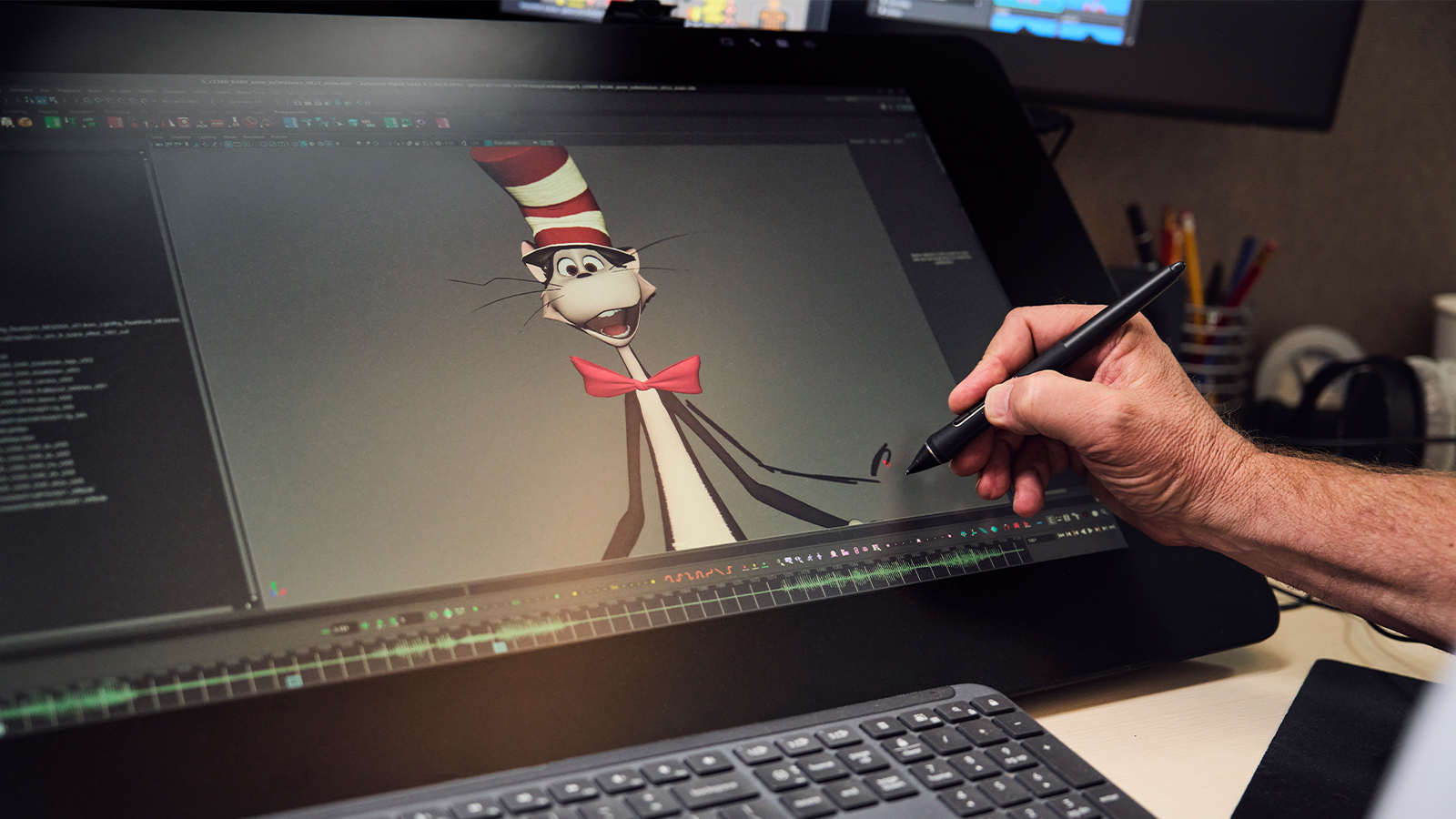
At the heart of the artistic execution was Autodesk Maya. Long considered the industry-standard software for 3D modeling, rigging, and animation, Maya served as the digital canvas where the film’s disparate worlds—the mundane real world, the hyper-stylized Seussian environment, and three distinct character-driven realms—took shape.
Marek Kochout, an animator on the project, described the software’s intimate role in the creative process:
"It’s essential. I have no other way of touching these characters other than through Maya. It’s my porthole into the marionette. This is my tool."
Whether artists were shaping the physics of the Cat’s unpredictable movements or sculpting the exaggerated, fluid architecture of Dr. Seuss’s imaginative landscapes, Maya provided the computational flexibility required to push visual boundaries without breaking the pipeline.
Orchestrating Global Collaboration: Flow Production Tracking
Coordinating hundreds of artists spread across the globe within a strict 24-month window demanded ironclad organizational oversight. Jessica Killiam, central supervisor on the film, highlighted the role of Autodesk Flow Production Tracking (formerly ShotGrid) in maintaining cohesion across international borders.

"We use Flow Production Tracking to track the entire movie, so you can find a variety of different things in here," Killiam explains. "We have our assets, all of the characters, the environments, the props."
By centralizing asset management, the platform ensured that an animator in India, a lighting artist in London, and a director in Los Angeles were always looking at the exact same iteration of a shot. Furthermore, RV—integrated directly within Flow Production Tracking—allowed remote teams to review and iterate on high-resolution assets seamlessly. Meanwhile, PIX (now part of Autodesk Flow Capture) streamlined the secure sharing of film clips across departments and with external studio reviewers, eliminating the traditional bottlenecks that usually plague multi-studio productions.
Supporting Context & Metrics: The Anatomy of a Two-Year Feature
To fully appreciate what Warner Bros. Pictures Animation accomplished with The Cat in the Hat, it is helpful to contextualize the metrics of traditional animated feature production.
| Production Metric | Traditional Animated Feature | The Cat in the Hat (2026) |
|---|---|---|
| Average Timeline | 4 to 5 Years | 24 Months |
| Geographic Footprint | Typically 1–2 Central Studios | Multi-City, Multi-Continent (LA, London, Montreal, India) |
| Asset Complexity | High (Single/Dual World Styles) | Extreme (5 Distinct Visual Worlds) |
| Pipeline Management | Fragmented / Custom Tools | Centralized via Autodesk Flow Production Tracking |
Achieving a feature-film quality output in 24 months required eliminating redundancies. By utilizing cloud-connected workflows and standardized toolsets, the studio bypassed the months of pipeline R&D that typically bog down early-stage animation projects. Instead, artists could focus purely on performance, lighting, and texture, resulting in a vibrant, tactile aesthetic that feels both faithful to the original illustrations and thoroughly modern.
Official Statements and Industry Insights
The philosophy driving this technological sprint is explored in-depth in Made to Make, Autodesk’s new branded content series.
Writer-director Alessandro Carloni summed up the delicate balance between wild imagination and technical execution during the premiere episode:
"In a way, our job is to come up with something absurd, entertaining, and crazy, and then discover: can we make it happen with technology?"
Erica Rivinoja echoed this sentiment, emphasizing the unique freedom that the medium affords storytellers:
"The exciting thing about animation is that it can do so much more than other types of filmmaking."
The documentary series itself represents a strategic shift in how technology providers communicate their value. Hosted by chef José Andrés—a figure renowned for his creative ingenuity in the culinary arts and his deep appreciation for narrative arts (having voiced characters in Disney’s Firebuds and Netflix’s Green Eggs & Ham, alongside comic collaborations with Marvel and DC)—Made to Make bridges the gap between cold software metrics and human-centric artistry. The series highlights innovators, designers, and filmmakers who push the limits of what is possible when robust tools meet unbounded creativity.
Future Outlook: A New Era for Fast-Turnaround Animation
As The Cat in the Hat prepares for its theatrical release, its production model offers a compelling glimpse into the future of the entertainment industry.
The film boasts a star-studded voice cast led by Bill Hader as the titular Cat, alongside Matt Berry, Quinta Brunson, Xochitl Gomez, Giancarlo Esposito, and America Ferrera. With North American audiences able to experience the vibrant, boundary-pushing animation style in cinemas and IMAX starting November 6, 2026 (and international audiences getting access beginning November 4), the ultimate test of the film’s two-year sprint will be how it resonates with moviegoers.
However, from an industry perspective, the barrier between ambitious scale and rapid delivery has permanently shifted. By proving that a sprawling, multi-world animated feature can be successfully executed across four global territories in just two years through unified software ecosystems like Autodesk Maya and Flow Production Tracking, Warner Bros. Pictures Animation has established a new blueprint.
As studios face mounting pressures to optimize budgets and production schedules without sacrificing artistic integrity, the methodologies pioneered on The Cat in the Hat may well become the gold standard for the next generation of digital filmmaking.