Executive Overview
As the retail landscape shifts toward the highly anticipated Black Friday window, consumers are witnessing a significant recalibration in the television market. Traditionally, "entry-level" has been synonymous with compromised performance and sluggish refresh rates. However, the early holiday pricing on the Samsung M80H Mini-LED series—now available at a record-low $497.99 for the 65-inch model—marks a pivotal moment in consumer electronics.
By offering a 144Hz refresh rate, AMD FreeSync Premium integration, and advanced AI-driven upscaling at a sub-$500 price point, Samsung is effectively democratizing features that were, until very recently, reserved for the premium tier. This report examines the technical specifications, market positioning, and practical trade-offs of the M80H, providing a comprehensive guide for those looking to upgrade their home entertainment ecosystem without the premium cost of OLED technology.
Detailed Chronology: The Road to the $497.99 Price Point
The journey of the Samsung M80H to its current promotional valuation reflects a broader industry trend of aggressive pre-Black Friday positioning.
- Initial Market Entry: When the M80H series was introduced, it was positioned as a bridge between budget 4K displays and mid-range performance sets. Its MSRP of $697.99 placed it in direct competition with generic big-box store models, though it immediately distinguished itself through its proprietary Tizen operating system and AI-processing capabilities.
- The Q3 Pricing Correction: Throughout late summer and early autumn, retail data showed a gradual decline in M80H pricing, hovering between $580 and $620. This was a strategic move by major retailers to clear inventory ahead of the holiday shipping crunch.
- The Early Black Friday Drop: As of this week, the 29% discount—bringing the unit to $497.99—represents the most aggressive price action seen for this model line to date. Beyond the 65-inch iteration, the tiered discounts extending to the 55, 75, and 85-inch models indicate that Samsung is pushing for market saturation across all common living room dimensions.
Supporting Context & Metrics: Beyond the Marketing Speak
To understand why the M80H is generating significant industry buzz, one must look past the surface-level specs and analyze the performance metrics that actually impact the user experience.
The Mini-LED Advantage
While the M80H lacks the infinite contrast ratio of OLED displays, it utilizes Mini-LED backlighting technology. This allows for a more granular control of light zones compared to traditional edge-lit or direct-lit LED TVs. The result is a significantly brighter image, which is vital for users who frequently watch content in ambient or direct sunlight.
Gaming Performance Metrics
The inclusion of a 144Hz native refresh rate is the most critical differentiator here. Most budget TVs are locked at 60Hz, which results in visible motion blur during high-octane gaming or sports broadcasts. By incorporating AMD FreeSync Premium and Variable Refresh Rate (VRR), the M80H addresses the two most common pain points for modern console and PC gamers: screen tearing and input latency. These metrics place the M80H in a category of its own for budget-conscious gamers.
The Tizen Ecosystem
Running on the latest iteration of the Tizen interface, the M80H benefits from Samsung’s mature software stack. The integration of "Vision AI" assists in real-time upscaling, taking lower-resolution content—such as standard cable television or older streaming media—and sharpening it to appear closer to 4K quality. Furthermore, the inclusion of native AirPlay 2 and Alexa integration ensures that the television acts as a centralized smart home hub, rather than a mere passive display.

Official Statements and Technical Trade-offs
In assessing the value of the M80H, it is essential to remain objective regarding where corners were cut to reach this aggressive price point.
Industry analysts note that while the color accuracy is highly commendable in "Filmmaker Mode," the lack of advanced local dimming hardware means that users may experience "blooming" (light bleed) when viewing high-contrast scenes in pitch-black rooms. For those who prioritize "true blacks" and cinema-grade contrast, this is a noteworthy limitation.
However, the commerce teams vetting these deals emphasize that for the average consumer—whose usage profile includes daytime news, afternoon sports, and evening streaming—the trade-off is negligible compared to the massive gains in brightness and refresh rate. As one industry expert remarked, "The M80H isn’t trying to be an OLED killer; it is trying to be the best possible value proposition for the 95% of households that don’t need a professional-grade color-grading monitor."
Future Outlook: The Shift in Consumer Expectations
The success of the M80H promotion serves as a bellwether for the future of the home theater market. We are entering an era where "good enough" is being replaced by "high-performance standard."
The Long-Term Viability of Mid-Range Mini-LED
As manufacturing processes for Mini-LED continue to scale, we expect the technology to migrate further down the price spectrum. The M80H is essentially the vanguard of this movement. Consumers who purchase this unit today are investing in a future-proofed display capable of handling modern gaming standards (VRR/144Hz) for the next 3–5 years.
What to Expect in Post-Holiday Trends
Following the conclusion of the Black Friday and Cyber Monday cycles, market analysts anticipate a slight price correction back toward the $550 range. For prospective buyers, the current $497.99 price point likely represents the "floor" for the remainder of the 2026 fiscal year.
Final Recommendations for the Consumer
- Evaluate Your Lighting: If your television is placed directly across from a window, the M80H’s high brightness makes it an ideal choice.
- Prioritize Your Usage: If you are a competitive gamer, the 144Hz refresh rate is an absolute necessity. If you are a dedicated film buff who watches exclusively in a dark basement, you might consider saving for an OLED, though the price disparity will remain significant.
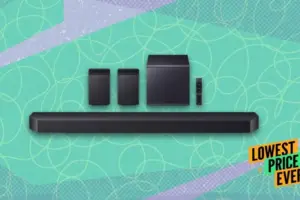
- Check for Bundle Offers: As the holiday season progresses, look for retailers bundling the M80H with entry-level soundbars, as the thin profile of these modern panels often necessitates an external audio solution for a truly immersive experience.
In conclusion, the Samsung M80H at its current price is more than just a seasonal deal—it is a clear signal that the entry-level market has matured. For those who have been waiting to replace an aging 1080p set or a sluggish 60Hz 4K screen, the current window provides the most compelling value for money seen in the post-pandemic electronics market. By balancing high-end gaming features with smart, adaptive software, the M80H proves that high performance no longer requires a premium, four-figure investment.