Executive Overview
The intersection of folklore, the natural world, and tactile traditional media continues to yield captivating work in contemporary illustration. Australian watercolour artist Lavera Grace has carved out a distinct niche within this space, creating whimsical yet deeply atmospheric illustrations that bridge classic fairy tales and organic landscapes. Utilizing a signature technique of precise inky linework paired with luminous, layered watercolours, Grace’s portfolio evokes a sense of timeless wonder.
Originally featured in ImagineFX, Grace’s body of work offers a masterclass in narrative illustration, demonstrating how traditional materials can be harnessed to construct fully realized fantasy ecosystems. This article explores Grace’s artistic philosophy, examines four of her defining pieces—The Faerie Frog Prince, The Gloaming, Spellbound, and Kelp Harvest—and provides broader context regarding the enduring appeal and technical demands of watercolour and ink illustration in the digital age.
Detailed Chronology & Creative Evolution
Lavera Grace’s artistic journey is rooted in a lifelong fascination with magical storytelling and the intricate patterns of the natural world. Rather than leaning into the dominant digital illustration trends that define much of the modern commercial art landscape, Grace consciously chose a traditional path. She found that the organic unpredictability of watercolours combined with the structural clarity of ink provided the exact friction and harmony needed to bring her visions to paper.
Phase 1: Finding the Medium
In her early developmental stages as an illustrator, Grace experimented with various digital and traditional mediums. However, she continually gravitated back to paper and pigment. The fluid nature of watercolours allowed ideas to flow organically, mirroring the ephemeral qualities of the magical realms she sought to depict. By anchoring these fluid washes with sharp, expressive inky lines, she developed a signature style defined by structural precision wrapped in atmospheric softness.
Phase 2: Narrative Exploration and World-Building
As her technical confidence grew, Grace began moving away from standalone character portraits toward narrative-driven pieces. This evolution is clearly traceable through her recent series of works, where classic tropes—such as the amphibian royalty of European folklore or the twilight chill of modern fantasy—are reinterpreted through an intensely personal lens. Her creative process often involves periods of deep immersion in literature, nature observation, and structural experimentation, allowing compositions to emerge naturally rather than through rigid planning.
The Works: A Closer Examination
Grace recently presented four distinct examples of her work, each highlighting a different facet of her storytelling ability, technical range, and evolving compositional philosophy.
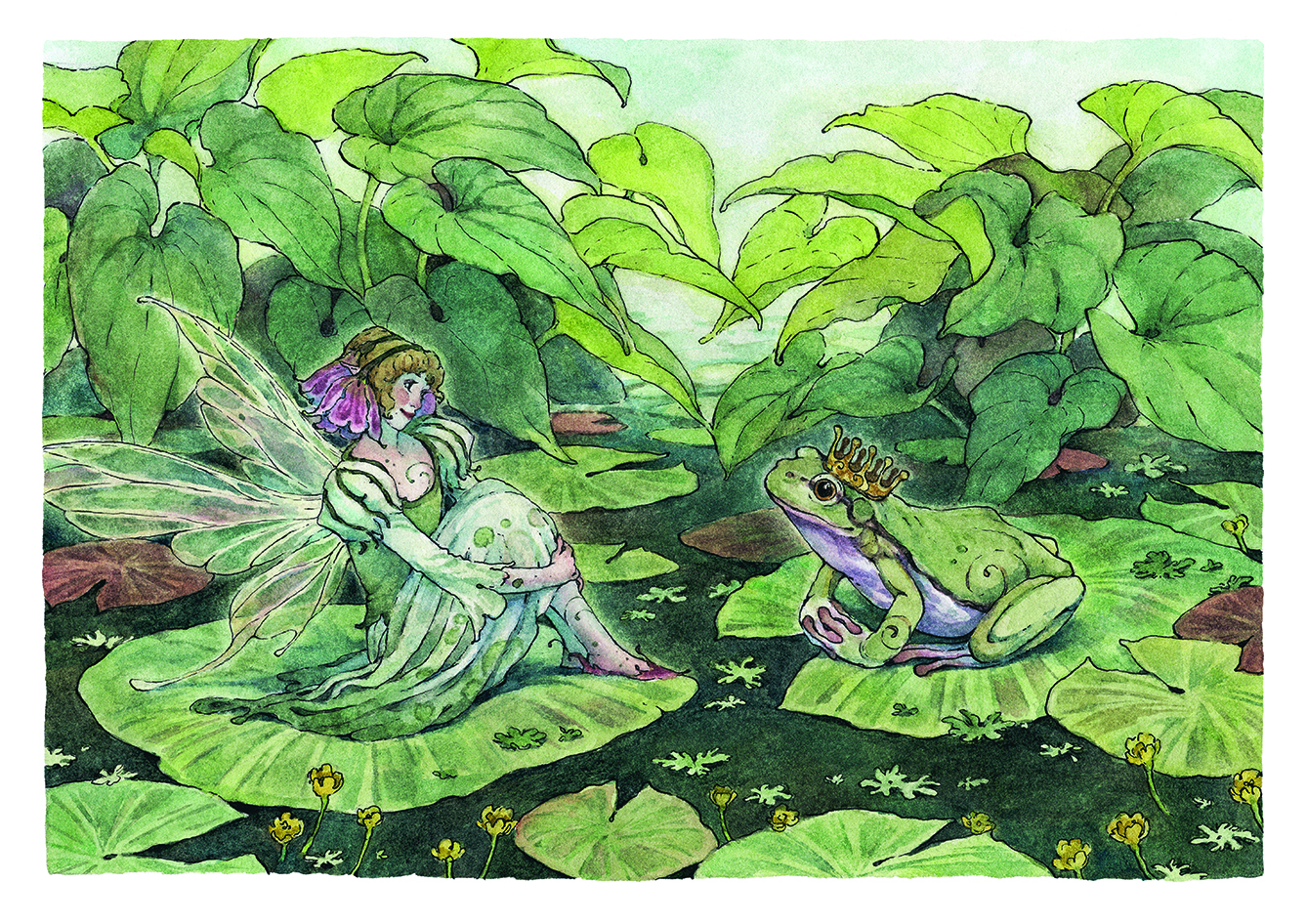
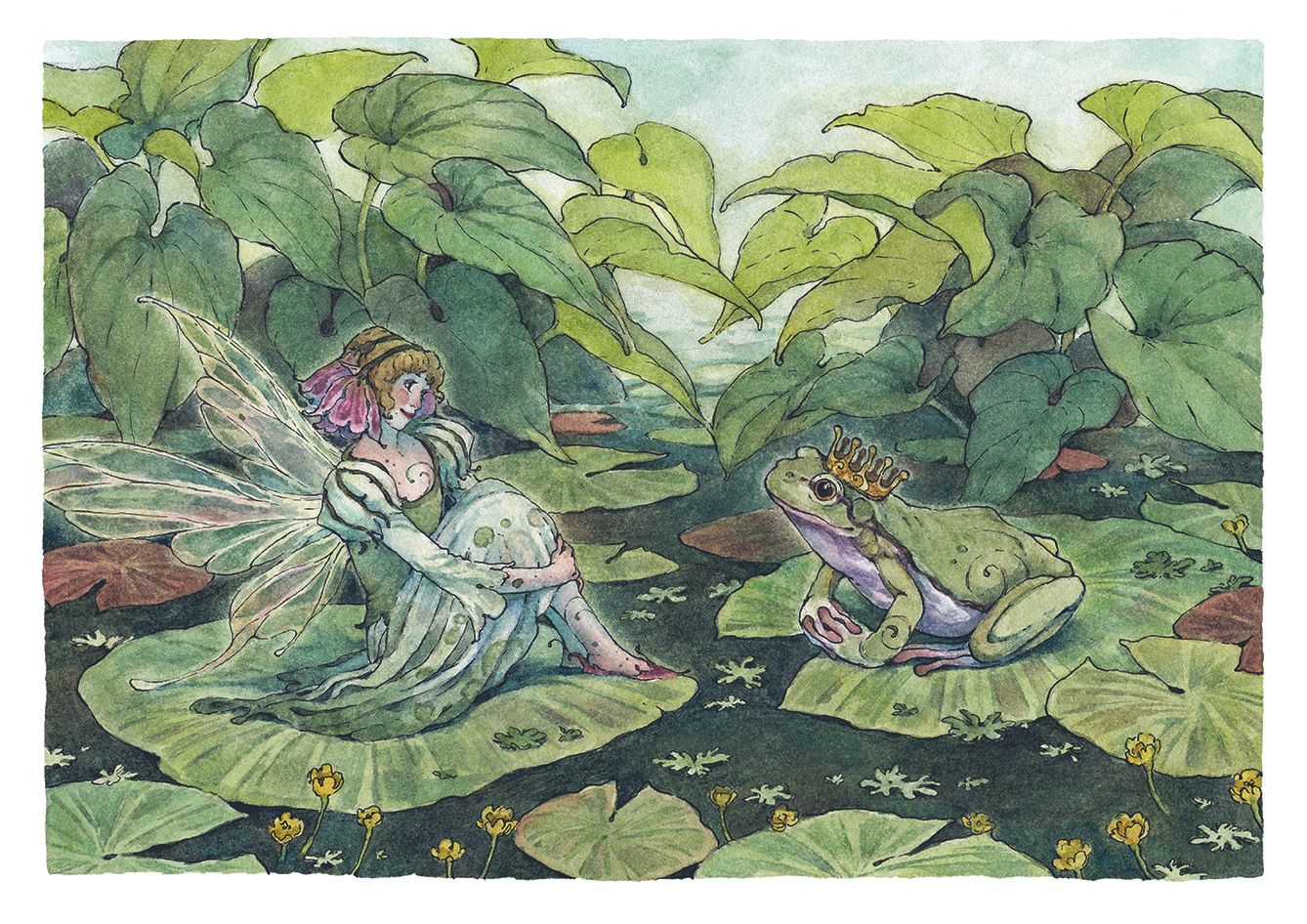
1. The Faerie Frog Prince
- Inspiration: The classic fairy tale, The Frog Prince.
- Concept: Grace sought to transport the traditional narrative out of its standard European domestic setting and directly into the heart of a vibrant faerie kingdom.
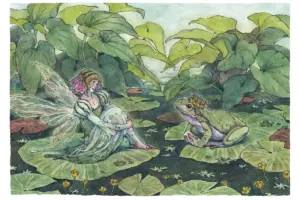
- Visual Execution: The Faerie Frog Prince captures a moment of quiet, charged enchantment between two characters. The interaction is rendered with delicate washes of green and gold, grounded by intricate ink details on the flora and fauna surrounding the figures. The piece highlights Grace’s ability to imbue small moments with grand, mythic resonance.
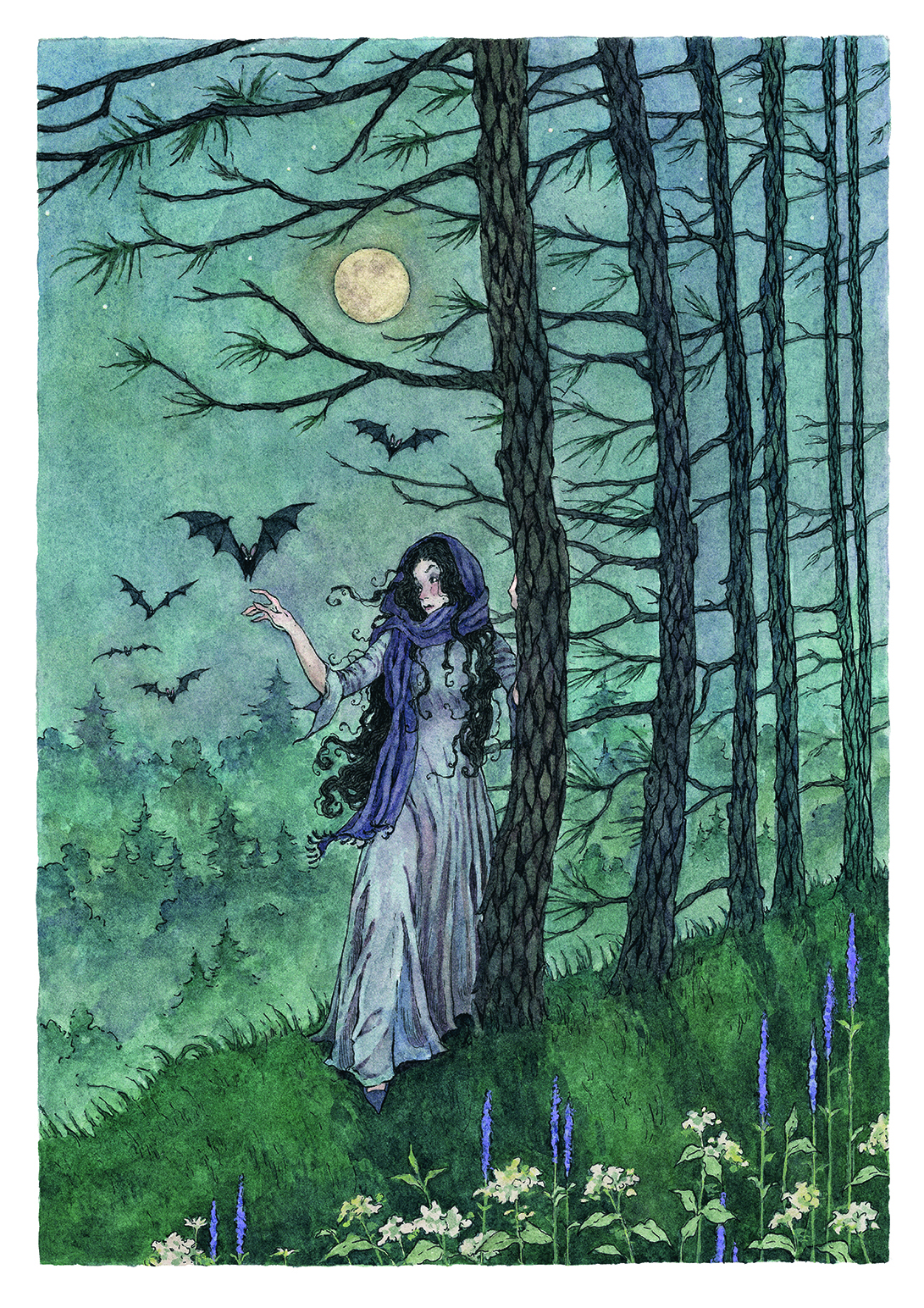
2. The Gloaming
- Inspiration: The cinematic atmosphere and color grading of the Twilight film series.
- Concept: To capture the chill and quiet stillness of the twilight hour—that fleeting threshold immediately before absolute darkness settles beneath a luminous, full moon.
- Visual Execution: Utilizing a cool, desaturated palette dominated by icy blues, deep indigos, and stark lunar whites, The Gloaming stands as one of Grace’s most atmospheric pieces. The watercolours are layered carefully to build depth, creating a chillingly immersive nocturnal environment that feels both desolate and enchanted.
3. Spellbound
- Inspiration: A period of intense, obsessive reading and a longing to escape into the pages of books.
- Concept: When creative block struck, Grace channeled her desire to return to her literary worlds directly into her sketchbook. The concept emerged organically from the feeling of being utterly consumed by a narrative.
- Visual Execution: Spellbound serves as a visual manifestation of bibliomania mixed with magic. The composition relies on warm, inviting tones that contrast with her colder nocturnal pieces, demonstrating her versatility across different emotional and thermal color palettes.
4. Kelp Harvest
- Inspiration: A deliberate push to break away from traditional rectangular framing and explore organic design.
- Concept: To use the subject matter itself—underwater flora—to naturally frame the scene, breaking free from the psychological confines of standard borders.
- Visual Execution: In Kelp Harvest, the twisting fronds of underwater vegetation curl around the edges of the paper, creating an organic window into a subaquatic world. This piece marks a significant stylistic pivot for Grace, showing an increased willingness to let subject matter dictate the geometric boundaries of her compositions.
Supporting Context & Metrics: The Revival of Traditional Illustration
Grace’s success reflects a broader cultural appreciation for traditional media within the global illustration market. In an era dominated by generative AI and hyper-polished vector graphics, audiences and art collectors increasingly value the visible human hand—the happy accidents, brush strokes, and paper textures that define traditional painting.
The Anatomy of Watercolour and Ink
For artists looking to emulate or understand Grace’s technique, working with watercolours and inks requires a specific set of tools and methodologies:
- Pigment Layering: Unlike opaque mediums like acrylic or oil, watercolour relies on transparency. Artists must plan their light sources from the brightest white of the paper downward, building shadows and mid-tones through successive transparent glazes.
- Inky Line Integration: Whether ink is applied before painting (ink-and-wash) or added afterward as linework, the interaction between water-soluble or waterproof inks and wet paper creates unique textural effects.
- Material Quality: As highlighted by professional art resources, achieving luminosity requires high-grade artist watercolours (which feature high pigment loads and minimal fillers) paired with heavy-weight, 100% cotton cold-press or hot-press watercolor paper that can withstand multiple washes without buckling.
The Digital Shift in Art Education
Ironically, while traditional physical media is experiencing a renaissance in popularity, the dissemination of knowledge surrounding these techniques has migrated almost entirely to digital platforms. Artists like Lavera Grace frequently utilize platforms like YouTube to share their work-in-progress (WIP) videos, time-lapses, and technical breakdowns. This hybrid approach—creating entirely analog art while leveraging digital distribution networks—allows independent creators to build global audiences without the backing of traditional gallery gatekeepers.
Future Outlook
As Lavera Grace continues to refine her craft, her trajectory points toward an increasingly bold exploration of composition and narrative scale. Her recent experiments with organic borders—as seen in Kelp Harvest—signal a departure from conventional framing that is likely to define her upcoming projects.
Furthermore, the growing demand for tactile, story-driven art suggests that Grace’s whimsical aesthetic will find fertile ground across multiple mediums, whether in children’s book illustration, collectible print markets, or gallery exhibitions. For aspiring artists and fans alike, Grace’s work serves as a reminder that the oldest tools—paper, water, pigment, and ink—remain some of the most powerful instruments for imaginative world-building.
You can follow Lavera Grace’s ongoing artistic journey and watch her processes unfold via her official YouTube channel, or explore back issues of ImagineFX for deeper dives into professional fantasy illustration techniques.