Executive Overview: A Shift in the Health-Tech Narrative
For the better part of the last decade, the wearable technology market has been obsessed with the “quantified self” movement. It was a race for metrics: faster heart rates, longer runs, and the relentless pursuit of an arbitrary daily step count. However, as the industry matures, a quiet revolution is taking place. Oura, the 11-year-old Finnish pioneer of the smart ring, is pivoting away from this performance-centric dogma, opting instead for a philosophy that emphasizes attunement over exhaustion.
With its latest campaign, “Wear Your Best Life,” Oura is attempting to decouple health from the gym. By focusing on the holistic, day-to-day realities of its users—ranging from those managing chronic conditions to those simply seeking a better night’s sleep—the brand is positioning itself not just as a tracker, but as a silent partner in the human experience. This strategic pivot, led by CMO Doug Sweeny, marks a maturation of the brand from a niche sleep-tracking tool into a mainstream wellness disruptor that eschews the cold, binary logic of Silicon Valley in favor of something far more tactile and human.
Detailed Chronology: From Finnish Startup to Global Phenomenon
Founded in 2013 in Oulu, Finland, Oura began with a singular, laser-focused mission: to perfect the science of sleep. While competitors like Fitbit and Apple were busy counting calories, Oura was quietly mapping the body’s recovery signals through the finger’s arteries.
The Rise of the Ring
For the first several years, Oura operated in the periphery of the mainstream tech consciousness. It was a tool for “biohackers” and elite athletes—a sophisticated instrument that required a steep learning curve. However, the company’s trajectory shifted dramatically around 2021. As the global pandemic brought health to the forefront of the public consciousness, the demand for non-intrusive, continuous health monitoring skyrocketed.
According to internal company data, as recently as three years ago, nearly 95% of the American public had no familiarity with the brand. Today, it is a fixture in the lives of cultural icons, from Hollywood A-listers like Gwyneth Paltrow to members of the British Royal Family, such as Prince Harry.
The “Give Us the Finger” Turning Point
The precursor to the current campaign was the 2023 “Give Us the Finger” initiative. This campaign was a bold, tongue-in-cheek move that repositioned the index finger as the most valuable piece of real estate on the human body. By showcasing the ring in non-athletic contexts—playing the piano, engaging in a game of chess, or simply resting—Oura began to break the association between wearables and sweat. It was an exercise in rebranding the device from an “exercise tracker” to an “everyday companion.”
The Present Moment: “Wear Your Best Life”
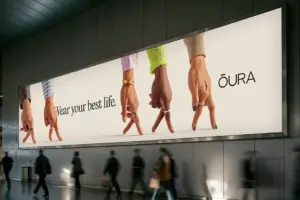
The launch of “Wear Your Best Life” on October 8 marks the next chapter. By opting for a high-production, handmade, tactile aesthetic, Oura is distancing itself from the sterile, AI-generated imagery that currently dominates the advertising landscape. By collaborating with creative agency Nice & Frank, the brand has created a one-tenth-scale miniature city, filmed with intricate choreography, to illustrate that wellness happens in the subway, in the park, and at the kitchen table—not just on the treadmill.

Supporting Context: Metrics and Market Positioning
The transition from a sleep-focused tool to a comprehensive health platform is supported by a rapid expansion of the ring’s technical capabilities.
Technical Evolution
In May of this year, the company launched the Oura 5, a device that represents a significant leap in miniaturized computing. The hardware now tracks over 50 unique health and wellness metrics. Among the most significant additions are:
- AI-Powered Glucose Monitoring: Moving beyond simple heart-rate variability, the device now offers insights into metabolic health.
- Live Exercise Tracking: While the marketing emphasizes “non-performance,” the underlying hardware has become significantly more capable of handling high-intensity data streams.
- Women’s Health Integration: Oura has leaned heavily into cycle tracking and hormonal health, carving out a massive demographic of users who felt alienated by the hyper-masculine focus of early fitness trackers.
The Financial Backdrop
Despite this success, the road has not been without its obstacles. As of last week, Oura officially confirmed a pause in its plans for an initial public offering (IPO). Industry analysts point to “market uncertainty” as the primary culprit—a common refrain for tech companies in the current interest-rate environment. However, the decision to hold off on public markets suggests that Oura is choosing to focus on stabilizing its product ecosystem and refining its brand narrative rather than chasing the immediate capital injection of an IPO.
Official Statements and Philosophy
The core of Oura’s strategy is a rejection of the “one size fits all” approach to human physiology. Doug Sweeny, CMO, has been vocal about the dangers of the current health-tech landscape.
“Most health tech talks to people as if there’s one finish line,” Sweeny noted in a recent briefing. “Our members don’t live that way. Some are chasing a personal best, some are just trying to sleep through the night, and some are managing chronic health conditions.”
This philosophy extends to the creative execution of their latest advertisements. By removing faces from the film, Oura is making a deliberate choice to let the viewer project themselves into the narrative. Sweeny explains, “We chose to tell that story through hands because they’re so personal. Hands are how people work, create, care for others, and move through their day. Taking faces out of the picture meant the film could belong to a lot of different people, and it pushed us to rely on gesture, humor, and small moments to build the emotion.”
The decision to build a physical, miniature city rather than relying on AI-generated environments is equally intentional. In an era where deepfakes and generative media have created a sense of visual fatigue, Oura’s tactile, handmade approach serves as a metaphor for the brand’s mission: a return to the grounded, physical reality of the body.

Future Outlook: The Wellness Disruptor
Oura’s ambition is clearly to become the “operating system” for personal health. By moving beyond the binary of “fit vs. unfit,” they are expanding their Total Addressable Market (TAM) to include virtually everyone.
The Challenges Ahead
The primary challenge for Oura moving forward is maintaining its premium status while scaling its user base. As competitors like Samsung and Apple deepen their integration with health ecosystems, Oura must ensure that its ring remains the “gold standard” for comfort and data accuracy. The company’s focus on long-term health, rather than short-term performance gains, is a compelling differentiator, but it requires a high degree of trust from the consumer.
The Road Ahead
With the IPO currently on ice, Oura has the luxury of time. They are not beholden to quarterly earnings calls that demand constant, explosive growth at the expense of brand integrity. Instead, they can continue to refine the Oura experience, perhaps moving further into medical-grade diagnostic capabilities or deeper partnerships with healthcare providers.
As the lines between consumer wellness and medical monitoring continue to blur, Oura is uniquely positioned. They have successfully moved the conversation away from the “finish line” and toward the “journey.” By focusing on the nuances of human behavior—the way we hold a cup of coffee, the way we wait for a train, the way we rest—Oura is betting that the future of tech is not about being faster or stronger, but about being more in tune with the quiet, daily rhythms of life.
Ultimately, Oura’s latest campaign is a mirror. By showcasing a miniature world where the ring is a constant, subtle presence, the brand is asking its users a profound question: If you were more attuned to your body’s needs, what would your life look like? It is a question that suggests the most important health metrics aren’t the ones you reach for at the end of a sprint, but the ones you carry with you every single day.