Executive Overview
The widespread commercial adoption of Large Language Models (LLMs) has largely obscured a fundamental engineering vulnerability: the illusion of structural reliability. Modern developers frequently rely on high-level orchestration tools and API abstractions, such as OpenAI’s Responses API or local vLLM deployments powered by xgrammar, under the assumption that syntax enforcement guarantees semantic correctness. When an application passes a JSON schema or a Pydantic model to an inference engine, it receives a neatly parsed object, instigating a dangerous industry-wide habit of treating syntactic validity as synonymous with factual accuracy.
This investigative report examines the severe limitations of native JSON parsing in enterprise applications and details a robust, multi-layered defensive architecture. Moving far beyond the conventional paradigm—which terminates execution the moment a model outputs well-formed JSON—this guide explores a disciplined methodology combining rigorous contract enforcement, source-text grounding, targeted retry loops, and constrained decoding. Operating within a Python 3.10 and Pydantic 2.14 ecosystem, we demonstrate how engineering teams can construct deterministic, verifiable, and fail-safe extraction pipelines that bridge the hazardous gap between probabilistic generation and deterministic business logic.
Detailed Chronology: The Anatomy of a Structural Illusion
To understand why traditional parsing fails, we must examine a concrete extraction failure. Consider a standard enterprise invoice processing pipeline handling raw textual data.
The Source Context
INVOICE 2026-0417
Bill to: Northwind Traders
Total due: EUR 1,250.00
Due 30 days from issue.
An application queries an LLM to extract specific fields: the invoice identifier, the currency, the total amount converted into cents to prevent floating-point inaccuracies, and the exact source line from which the total was extracted. A standard, unconstrained model response might look like this:
  "invoice_id": "2026-0417",
  "currency": "EUR",
  "total_cents": 12500,
  "total_quote": "Total due: EUR 1,250.00"
At first glance, this response appears pristine. It is valid JSON. Every requested key is present. The data types match expectations (int, str). The currency "EUR" falls within the pre-defined allowed set, and the quoted string genuinely exists within the source document.
Yet, this payload contains a critical logical error. The invoice explicitly states a total due of 1,250.00 EUR, which equates to 125,000 cents. The model, however, has returned an integer value of 12,500—representing 125 euros.
No standard JSON parser will catch this error. No JSON schema validator will flag it, because 12500 is a valid, well-formed integer. The parsing framework accepts the output unquestioned because it conforms to the structural contract. The only mechanism capable of identifying this discrepancy is a secondary, context-aware comparison against the original source text executed by the application layer.
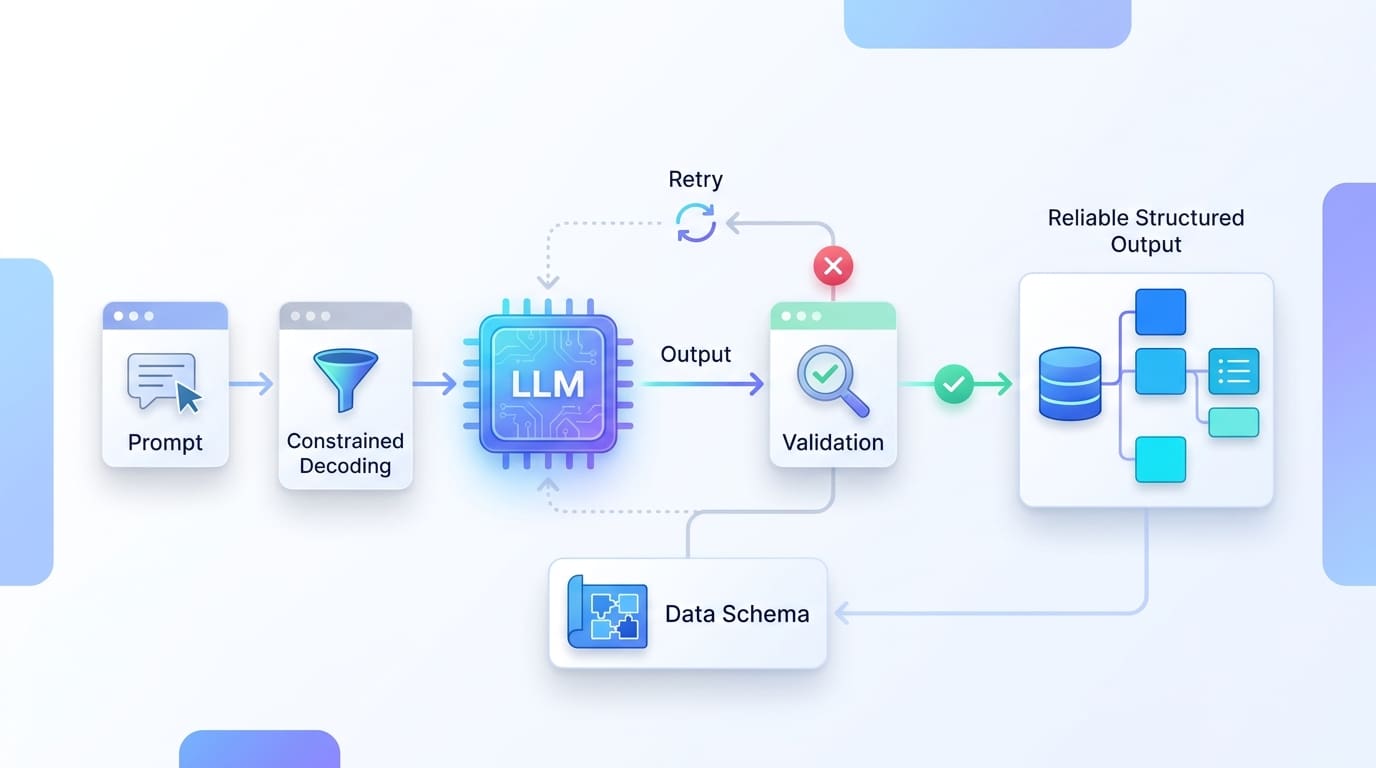
To prevent such silent failures, engineers must implement three distinct, collaborative defensive layers:
- Validation: Code-level verification against an application-owned contract, followed by cross-referencing against the source text.
- Retries: Controlled, bounded re-generation attempts triggered only when structural or syntactical errors can be actively repaired by feedback, capped at a hard limit of three attempts.
- Constrained Decoding: Token-masking mechanisms implemented at the inference engine level that structurally prevent the generation of invalid schema shapes before they ever reach the validation layer.
Supporting Context & Metrics: The Mechanics of Defensive Architecture
1. Defining the Contract Before Model Interaction
The schema contract must be owned entirely by the application, never left to the improvisational nature of the prompt. Utilizing Pydantic in strict mode prevents subtle coercion bugs—such as strings being silently converted to integers or boolean values being parsed as numeric flags.
from typing import Literal
from pydantic import BaseModel, ConfigDict

class Invoice(BaseModel):
    model_config = ConfigDict(strict=True, extra="forbid")

    invoice_id: str
    currency: Literal["USD", "EUR"] | None
    total_cents: int | None
    total_quote: str | None
In this contract, every key is strictly required; omitting a key immediately triggers a validation failure. Furthermore, critical fields are defined as nullable (| None) rather than optional with default values. This empowers the model to explicitly signal that an invoice lacks a specific piece of data without resorting to silence or inventing a fabricated number.
Enabling strict=True disables Pydantic’s default type coercion. For instance, passing the string "125000" to an integer field or the boolean True will immediately raise distinct ValidationError types (int_type), while extra="forbid" catches unexpected hallucinated keys (extra_forbidden) instead of silently ignoring them.
2. Validating the Object Against the Source Text
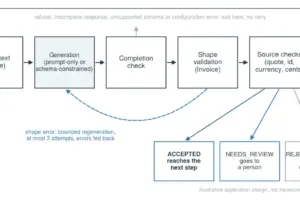
Once structural validation succeeds, the candidate object enters semantic validation via an accept() function. This function systematically evaluates four verification steps, categorizing the output into one of four deterministic states: accepted, needs_review, rejected, or shape_error.
import json
from dataclasses import dataclass
from pydantic import ValidationError

@dataclass
class Outcome:
    status: str  # "accepted" | "needs_review" | "rejected" | "shape_error"
    invoice: Invoice | None
    reasons: list[str]

def accept(response_text: str, source_text: str, expected_invoice_id: str) -> Outcome:
    # Step 1: Parse and validate structural shape
    try:
        candidate = Invoice.model_validate(json.loads(response_text))
    except json.JSONDecodeError as e:
        return Outcome("shape_error", None, [f"not JSON: e.msg at position e.pos"])
    except ValidationError as e:
        reasons = [f"'.'.join(str(p) for p in err['loc']): err['msg']" for err in e.errors()]
        return Outcome("shape_error", None, reasons)

    reasons: list[str] = []

    # Step 2: Verify verbatim presence of the quoted line
    if candidate.total_quote is not None and candidate.total_quote not in source_text:
        reasons.append("total_quote does not appear in the source")

    # Step 3: Validate identity and currency grounding
    if candidate.invoice_id != expected_invoice_id:
        reasons.append(f"invoice_id candidate.invoice_id!r is not expected_invoice_id!r")
    if candidate.currency is not None and candidate.currency not in source_text:
        reasons.append(f"currency candidate.currency is not stated in the source")

    # Step 4: Mathematical consistency check against source evidence
    if candidate.total_cents is not None and candidate.total_quote is not None:
        digits = "".join(ch for ch in candidate.total_quote if ch.isdigit())
        if digits and int(digits) != candidate.total_cents:
            reasons.append(f"total_cents candidate.total_cents does not match the quoted line")

    if reasons:
        return Outcome("rejected", candidate, reasons)
    if candidate.total_cents is None or candidate.currency is None:
        return Outcome("needs_review", candidate, ["source did not state the amount or currency"])

    return Outcome("accepted", candidate, [])
3. Smart Retries: When to Try Again and When to Stop
A foundational rule of resilient LLM architecture is that retries should only occur when another attempt can feasibly resolve the error.
- Shape Errors: Malformed JSON, incorrect data types, or missing required keys are symptomatic of generation drift and warrant a controlled retry, feeding the specific Pydantic validation error messages back into the context window.
- Semantic Rejections: If an object is structurally valid but semantically incorrect (such as our 12,500 vs 125,000 cents discrepancy), retrying the model is pointless; the source document remains unchanged, and identical prompts will likely yield identical fabrications.
- Missing Data: When documents genuinely omit data, routing the payload to human oversight (
needs_review) is mandatory rather than permitting automated hallucinations.
from typing import Callable

MAX_ATTEMPTS = 3

class GenerationRefused(Exception):
    """The provider refused or the request is not repairable by another attempt."""

def extract_with_retries(
    generate: Callable[[str, dict, list[str]], str],
    source_text: str,
    expected_invoice_id: str
) -> tuple[Outcome, int]:
    schema = Invoice.model_json_schema()
    feedback: list[str] = []
    attempts = 0

    while attempts < MAX_ATTEMPTS:
        attempts += 1
        try:
            response_text = generate(source_text, schema, feedback)
        except GenerationRefused as e:
            return Outcome("rejected", None, [f"stopped: e"]), attempts

        outcome = accept(response_text, source_text, expected_invoice_id)
        if outcome.status != "shape_error":
            return outcome, attempts  # Terminal: source text is immutable

        feedback = outcome.reasons[:5]  # Bounded feedback payload

    return Outcome("rejected", None, ["attempt budget exhausted"]), attempts
Official Guidelines & Failure Classification Matrix
To maintain absolute operational transparency, enterprise pipelines must categorize every execution pathway. The following taxonomy maps distinct failure modes to their corresponding architectural responses:
| Failure Category | Primary Diagnostic Marker | Mandatory Pipeline Action |
|---|---|---|
| Shape & Type Mismatch | Parser exceptions or Pydantic ValidationError logs. |
Bounded content regeneration feeding error messages back into the context window; re-validate. |
| Semantic Contradiction | Failure of mathematical consistency checks against source text. | Terminal rejected status; human review or pipeline termination. Never accept based solely on syntax. |
| Ambiguous / Missing Data | Model correctly populating fields with null. |
Route to needs_review queue; prohibit automated default value substitution. |
| Provider Refusal | API safety filters or policy-filtered generation flags. | Immediate termination or escalation; do not programmatically rephrase to bypass safety controls. |
| Stream Truncation | Incomplete completion status flags. | Discard payload; adjust output token budgets or simplify extraction scope. |
| Infrastructure / Config Error | Authentication failures, HTTP 4xx/5xx, unsupported schemas. | Halt execution and alert systems administrators; disable blind content-repair loops. |
Constrained Decoding: Enforcing Shape at the Token Level
Relying entirely on post-hoc prompt engineering ("Please output valid JSON") is fundamentally flawed. Modern high-performance inference servers (such as vLLM utilizing xgrammar or OpenAI’s native Responses API) allow engineers to enforce constrained decoding.
During constrained generation, the model’s logits are dynamically masked at each token-generation step. The decoding engine outright prevents the selection of any token that would violate the provided JSON schema. Consequently, whole classes of shape errors—such as trailing commas, extra keys, or incorrect primitive types—are mathematically eliminated before generation completes.
# Conceptual implementation leveraging native structured parsing endpoints
def extract_constrained(client, model: str, source_text: str, expected_invoice_id: str) -> Outcome:
    response = client.responses.parse(
        model=model,
        input=[
            "role": "system", "content": "Extract the invoice fields. Use null when the text does not state a value.",
            "role": "user", "content": source_text,
        ],
        text_format=Invoice,
    )

    if response.status != "completed":
        return Outcome("rejected", None, [f"response status response.status"])
    if response.output_parsed is None:
        return Outcome("rejected", None, ["no parsed output; treat as a refusal"])

    return accept(response.output_parsed.model_dump_json(), source_text, expected_invoice_id)
Even when employing advanced constrained decoding, engineers must never omit the secondary source-validation layer (accept()). While constrained decoding guarantees structural compliance (ensuring total_cents is an integer), it possesses zero awareness of semantic truth (it cannot verify whether that integer accurately reflects the textual invoice data). Structure is what the decoder enforces; correctness is what the application must verify.
Future Outlook
As enterprise AI architectures transition from experimental chatbots to autonomous, transactional agentic workflows, the demand for absolute data integrity will intensify. The era of blind faith in LLM outputs is reaching a definitive close.
Future developments in machine learning infrastructure will likely see tighter integration between formal symbolic verification engines and probabilistic neural decoders. We can anticipate native runtime assertion frameworks embedded directly into inference runtimes, allowing developers to specify arbitrary mathematical and relational constraints alongside standard JSON schemas.
Until native semantic verification becomes ubiquitous across inference providers, engineering teams must maintain rigorous application-owned defense-in-depth strategies. By synthesizing strict contractual definitions, source-text grounding, intelligent and bounded retry budgets, and token-level decoding
constraints, developers can successfully transform unpredictable probabilistic models into reliable, enterprise-grade components of modern software architecture.