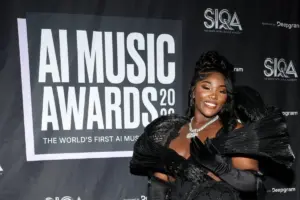
The intersection of artificial intelligence and the commercial music industry officially stepped out of the shadows of Silicon Valley server racks and into the glaring lights of downtown Los Angeles last Friday. The inaugural “AI Music Awards,” organized and powered by the Sonic Intelligence Academy (SIQA), transformed the nearly century-old Mayan Theater into a crucible for the future of digital audio. Designed explicitly to counter the mainstream music establishment’s persistent aversion to synthetic and augmented audio, the event aimed to establish a parallel universe of validation, complete with dedicated charts, categories, and a red carpet.
Yet, for all its grand ambitions of rewriting the rules of modern composition, the ceremony served as a messy, highly symbolic microcosm of the broader artificial intelligence movement: a fascinating collision of technological innovation, desperate industry legitimation, and deeply human vulnerabilities, all bogged down by relentless technical glitches and infrastructural growing pains.
While artists, tech founders, and independent creators celebrated milestones—most notably digital persona Xania Monet sweeping the top categories—the evening’s chaotic execution revealed that building a counterculture institution from scratch is no simple feat. From locked front doors and malfunctioning AI speech agents to erratic teleprompters and improvised run-of-shows, the night proved that while AI can rapidly generate a song, it cannot yet seamlessly orchestrate a live awards gala.
Detailed Chronology: From Locked Doors to the Downtown Rain
The Arrival and the Red Carpet
Things felt slightly off before the event even officially commenced. Arriving 30 minutes prior to the scheduled red-carpet rollout, attendees and press were met with locked heavy wooden doors at the Mayan Theater. A mandatory physical tug-of-war on each handle finally yielded an entrance, bypassing any visible security apparatus.
Once inside the foyer, a makeshift red carpet played host to roughly a dozen independent media outlets. Originally, 29 news ventures had registered to cover the event, but a sudden afternoon flight ground-stop issued by the Federal Aviation Administration (FAA) at 12:30 p.m. PT clipped the wings of several out-of-town journalists.
The red carpet itself was a study in contrasts. Rather than projecting cold, faceless screens displaying digital avatars, the physical creators behind the AI-generated personas arrived dressed in their Sunday best. Sequined gowns, vibrant blazers, and fiery red mohawks—courtesy of "The Iconic Punk Oz" host Oz Powers—graced the step-and-repeat backdrops.
Tucked quietly against a wall sat an AI red-carpet correspondent housed inside a tall, white faux-stone vessel. Developed by the event’s top sponsor, Deepgram—an AI startup specializing in text-to-speech agents—the device attempted to interview arrivals. However, its stationary nature limited its effectiveness, and creators overwhelmingly bypassed the robot to speak with human journalists.
Rap veteran Fredro Starr, one half of the iconic group Onyx, used the carpet to debut his new moniker, “Mad AI.” Promoting his record It All Started in Brooklyn—touted as the first AI-augmented album pressed on vinyl—Starr emphasized the irreplaceable nature of human vocal spirit.
“You can’t replace [humans],” Starr told reporters. “The feeling that you get was what we bring with the spirit of hip-hop. So vocally, you can hear that, but the AI just took it to another level.”
Inside the Mayan Theater: Party Atmosphere and Brewing Chaos
Inside the venue, SIQA attempted to foster an energetic, club-like atmosphere. A back bar kept well-flowing drinks within reach, surrounded by stacks of a sponsored version of the newspaper Rolling Out, featuring cover interviews with SIQA founder Timirah “TJ” James and prominent nominees.
Among them was Telisha “Nikki” Jones, the mastermind behind Xania Monet, whose music previously triggered massive industry discourse when her tracks cracked Billboard genre charts. Speaking near the bar, Jones brushed off concerns regarding industry pushback.
“AI is just a tool,” Jones remarked. “It just emphasizes what we do. I just feel like we should all be one.”
Despite the optimistic rhetoric, the 6:15 p.m. scheduled start time slipped by 30 minutes. Organizers skipped a planned opening video montage, launching straight into a choreographed dance break by actor Giovanni Wilson and eight dancers, soundtracked by an explicitly literal, AI-produced track announcing the arrival of the inaugural awards.
This delay forced producers to streamline the broadcast, skipping nominee introductions for the first half of the evening and having presenters simply read winning names aloud—depriving several independent creators of hearing their hard work formally acknowledged on stage.
Technical Malfunctions and Teleprompter Turmoil
Hosted by Wilson and podcast personality Lana Hout (half of the "AI Chicks" duo), the ceremony relied on a three-member live house band of human musicians playing guitar, bass, keys, and drums. Unfortunately, the night’s logistical backbone quickly crumbled.
Sharing just two physical microphones, Hout and Wilson wrestled with a Claude-generated run-of-show and a rapidly shifting teleprompter. At one juncture, the hosts grew audibly confused over whether to cut to a commercial break or introduce the country music presenters. After bringing the presenters out, Hout abruptly interrupted mid-introduction to announce an immediate commercial break—only for the category to be presented 13 minutes later by an entirely different slate of guests.
Deepgram’s AI voice technology, intended to dynamically introduce nominees and presenters, frequently malfunctioned or talked directly over human speakers. Meanwhile, Deepgram’s sponsored commercial spot played erratically at random intervals, unprompted by any designated commercial break.
The evening’s multimedia presentations fared no better. When Wilson attempted to introduce a trailer for his Terrence Howard-led film, A Good Hand Wasted—which utilized AI for post-production finishing—the system initially refused to play the media. When it finally flickered to life, it broadcast only a truncated portion of the reel before Howard’s face even appeared on screen.
“So, ugh,” Wilson muttered, raising a hand to prompt awkward audience applause. Surveying the chaos, Wilson joked to the room that they were “dealing with a prompter that has Tourette’s.”
Commercials and Copyright Concerns
Compounding the technical hurdles was the event’s promotional content. Ads for a new social network called “Trinity Social” featured an AI-generated persona wearing a necklace bearing the Rockstar Games logo, encouraging a generated stadium crowd to download the application.
A spokesperson for Rockstar Games did not immediately respond to requests for comment regarding authorization. If unauthorized, the incident underscored the deeply ironic reality of an event celebrating generative AI technologies—which are currently facing severe legal scrutiny and multi-million-dollar copyright lawsuits from major record labels over unauthorized training data and intellectual property lifting.
The Performances: Lip-Syncing, Lookalikes, and Live Soul
Despite running nearly 40 minutes behind schedule throughout the night, the ceremony forged ahead with nearly 10 musical performances. Speculation regarding how AI-generated music and virtual avatars would translate to a physical stage was answered through a mixture of lip-syncing, theatrical staging, and human proxies.
Some acts, such as country artist Ava Bentley and R&B singer EJ Rogers, lip-synced their recorded tracks. Others deployed hired lookalikes: for “Chaisen Hale”—a project built around an AI-generated boy with synthetic vocals—14-year-old human singer John Victor was brought out to lip-sync the performance. Despite the artifice, the audience—including one particularly dedicated duo dressed as Frankenstein and his bride—remained heavily engaged.
Crucially, SIQA provided the live house band and dancers to performing artists free of charge. Many independent creators turn to generative AI precisely because they cannot afford the high costs of studio musicians, making the house band an invaluable vehicle to realize their creative visions.
True live vocals were a rare, highly prized commodity during the evening. Rapper GodFellow and Grammy-winning vocalists Eric Bellinger and Candace Wakefield delivered genuine live performances. Wakefield explicitly noted the evening’s structural “hiccups” while delivering a soaring rendition of a track by AI artist “Aria Blue.”
Supporting Context & Metrics: The Scale of the SIQA Ecosystem
To understand the weight of Friday’s ceremony, one must examine the institutional framework built by sisters Timirah “TJ” James and Mia James since the launch of the Sonic Intelligence Academy in January.
- The Verified Registry: To qualify for consideration, artists must register their tracks through SIQA’s proprietary registry, which classifies songs into distinct tiers: fully AI-generated, AI-assisted, or "human + AI hybrid" (featuring cloned human vocal leads).
- Categories and Scope: The awards featured 25 distinct categories, ranging from traditional markers like AI Song of the Year and Best AI Pop Song to niche divisions like Best AI Comedic Song and Best AI Gospel Song.
- Dominant Winners: Xania Monet (the digital persona representing Telisha “Nikki” Jones) dominated the evening, securing AI Album of the Year at the preceding summit, alongside AI Artist of the Year and Song of the Year at the main gala. Producer DJ Shawn Q secured the fourth top tier category, Producer of the Year.
- Geographic Reach: Nominations and attendance drew global participants, including 56-year-old Swiss disability support worker Ramona Höffel, who flew from Switzerland to represent her AI persona, “Vireya.”
Official Statements & Industry Perspectives
The philosophical core of the event rested on positioning AI not as an existential threat to musicianship, but as an indispensable democratization tool.
“Because there will be a next year because this is the new music industry,” SIQA founder Timirah James told the dwindling crowd at 9:45 p.m., just as the venue hit its hard curfew. “SIQA has created the infrastructure for that industry and for all the artists coming up in that industry.”
For independent creators locked out of traditional Nashville and Los Angeles hit factories, the sentiment resonated deeply. Ramona Höffel, speaking candidly about her creative outlet through her avatar Vireya, encapsulated the personal liberation driving many participants:
“I have a lot of ideas and wishes, and for a long time I paint, then I write, and that’s not enough,” Höffel said on the red carpet. “The music gives me room to all this bring outside of my brain.”
Conversely, mainstream skepticism remains deafening. Major record labels, publishers, and streaming giants continue to view generative AI companies—such as Suno and Udio—as predatory entities engaged in mass copyright infringement. Artists like Kehlani have publicly lambasted multimillion-dollar deal structures awarded to synthetic acts, while industry standard-bearers like the Recording Academy (governing the Grammys, located just a 12-minute walk from the Mayan Theater) have implemented stringent eligibility rules regarding human authorship.
Future Outlook: Can the Counterculture Go Mainstream?
As the lights at the Mayan Theater finally powered down just past 10:00 p.m. and attendees spilled out into the downtown Los Angeles rain, patrons of the venue’s subsequent event—"Club 2010s"—formed a damp, delayed queue outside.
The overarching question left in the wake of the inaugural AI Music Awards is whether synthesized and augmented audio can generate an enduring cultural monoculture comparable to the physical pop eras of the past. The mainstream music industry has effectively pulled up the drawbridge, ostracizing generative tools through litigation and policy.
Yet, organizations like SIQA are determined to build a parallel fortress. Despite the disorganized run-of-shows, malfunctioning text-to-speech agents, and teleprompter anomalies, the event proved that a passionate, global community of non-traditional creators is mobilizing around AI infrastructure.
Whether these technical and legal kinks can be ironed out before next year’s ceremony remains to be seen. But for creators like Höffel, Jones, and Starr, the infrastructure now exists to project their inner worlds onto a public stage—validating an alternative music industry that is here to stay, whether the mainstream is ready for it or not.