Executive Overview
In the cutthroat world of the fast-moving consumer goods (FMCG) industry, building a category-defining brand is often thought to require decades of legacy experience, multi-million-dollar venture capital funding out of the gate, and a traditional pedigree forged in the boardrooms of multinational conglomerates. Yet, occasionally, an industry outsider shatters these conventions entirely.
Enter Kevin McCarthy, CEO of Unreal Snacks. Joining the burgeoning better-for-you chocolate company in 2014 at the tender age of 22—fresh off a grueling stint on a congressional political campaign and boasting absolutely zero prior experience in the food sector—McCarthy stepped into an early-stage startup consisting of just three total employees.
Fast-forward to today, and Unreal Snacks has firmly cemented its status as the largest better-for-you chocolate brand in the United States. Its reimagined, lower-sugar, all-natural alternatives to childhood classics like peanut butter cups and candy-coated chocolates are now stocked on the shelves of more than 35,000 retail storefronts across the U.S. and Canada, spanning giants like Costco, Target, and Whole Foods.
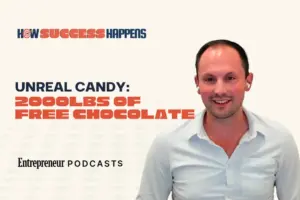
Recently, McCarthy sat down as a guest on the How Success Happens podcast for a candid, wide-ranging discussion detailing the winding, often unpredictable path of scale, operational retrenchment, and product obsession. Far from a conventional corporate playbook, McCarthy’s blueprint for success offers a masterclass in modern entrepreneurship. Below is a deep-dive exploration of his journey, featuring five foundational business principles extracted from his conversation designed to inject a high-octane sugar rush into your career and enterprise.
Detailed Chronology: The Evolution of Unreal Snacks
The Genesis and the Overexpansion Trap (2011–2014)
When Unreal Snacks originally burst onto the confectionary scene in 2011, its trajectory was meteoric—and dangerously fast. Armed with a mission to strip artificial dyes, high-fructose corn syrup, and GMOs out of America’s favorite candy styles, the brand caught fire with consumers seeking cleaner labels.
However, corporate infrastructure rarely scales overnight. In its initial push for market penetration, the company expanded into roughly 34,000 retail doors virtually simultaneously. The supply chain, manufacturing partnerships, and logistics networks simply could not keep pace with the demand. The brand was moving too fast to sustain deep operational learning or iterate effectively on its product-market fit.
The Great Retrenchment and McCarthy’s Arrival (2014)
When Kevin McCarthy entered the picture in 2014 at 22 years old, the company was forced to undergo a humbling, high-stakes operational reset. Rather than pushing forward on momentum alone, leadership made the radical decision to pull back.
When McCarthy joined the three-person team, Unreal had temporarily contracted its footprint from tens of thousands of stores down to a microscopic 38 pilot locations.
"We were trying to do way too much way too quickly, and we weren’t learning at an appropriate pace," McCarthy reflects.
By shrinking the footprint, the tiny team could intensely monitor consumer behavior, iron out supply chain kinks, test packaging iterations, and master the micro-economics of running a clean-label candy company. Only after nailing these fundamentals did Unreal begin the methodical, step-by-step climb back up to national prominence.
Supporting Context & Metrics: The Anatomy of a Better-For-You Chocolate Empire
The modern landscape of consumer packaged goods (CPG) is littered with health-conscious brands that prioritized nutritional metrics over taste profiles, ultimately alienating mainstream consumers who still view snacking as an indulgence. Unreal bypassed this trap by anchoring its entire value proposition in a single, uncompromising philosophy: taste comes first.
Key Business Metrics & Milestones
- Current Retail Footprint: Over 35,000 stores across the United States and Canada.
- Major Retail Partners: Costco, Target, Whole Foods, and major regional grocery chains.
- Team Evolution: Expanded from a hyper-lean 3-person operation in 2014 to a powerhouse industry leader.
- Corporate Perk Scale: Employees collectively consume and test nearly a ton of chocolate annually in-house for market research and competitive analysis.
5 Bite-Sized Success Principles for Modern Entrepreneurs
1. Sometimes the Smartest Move Is Shrinking
In business, the reflexive urge is almost always to scale, expand, and chase top-line revenue at all costs. McCarthy’s experience at Unreal proves that contraction can sometimes be a prerequisite for sustainable expansion. If your organizational growth is currently outpacing your capacity to learn, adapt, and refine your core mechanics, slowing down is not a failure—it is a strategic recalibration.
- The Takeaway: If growth is outpacing your team’s learning curve, intentionally slow down, pull back to a smaller operational footprint, and master the fundamentals of your business before attempting to conquer the wider market.
2. The First Bite Is Your Real Marketing Plan
In an era dominated by algorithmic ad spend, influencer partnerships, and expensive digital marketing funnels, it is easy to forget that the ultimate validator of a product is the product itself. McCarthy fiercely maintains that healthier ingredients or clever brand positioning are useless if the product fails to deliver raw, unadulterated pleasure.
- The Takeaway: The "moment of truth" happens the exact second a consumer experiences your product. Before allocating a single dollar to advertising acquisition costs, ensure your product possesses the intrinsic quality required to organically earn a second purchase on its own merit.
3. Give Your Team a Perk That Makes Them Smarter
Corporate perks are often treated as superficial incentives—ping-pong tables, catered lunches, or casual dress codes designed to boost morale. Unreal takes a uniquely functional approach by offering an unlimited chocolate policy. Employees are explicitly encouraged to buy as much chocolate as they want—not just Unreal’s products, but those of major competitors as well—and bring them back to the office to dissect, debate, and analyze.
This policy fuels rigorous internal product development debates, such as testing thousands of variations to determine whether a peanut butter filling should have a gritty, crunchy, or smooth mouthfeel. Everyone is given a voice in the formulation process, culminating in a decisive strategic path forward.
- The Takeaway: Design organizational perks that actively transform your workforce into sharper, more deeply engaged students of your specific industry and market landscape.
4. Good Surprises Are Dangerous Too
High-growth startups often experience wild emotional swings—celebrating massive retail wins one day while panicking over supply chain disruptions the next. McCarthy’s leadership philosophy emphasizes emotional equilibrium: "You can never get too excited. You can never get too down." Interestingly, he extends this caution even to positive surprises. Landing a massive national retail account like Costco is undeniably cause for celebration, but it also creates an immediate operational liability.
- The Takeaway: Treat every major corporate victory not as a celebratory finish line, but rather as the abrupt start of a brand-new, high-stakes to-do list. Success requires being just as operationally prepared for sudden positive windfalls as you are for negative setbacks.
5. Think Massive, Act One Step at a Time
For the aspiring entrepreneur sitting in their kitchen—receiving constant encouragement from friends who insist, "You should sell this recipe!"—the path forward can feel paralyzingly abstract. McCarthy advises founders to maintain a crystal-clear vision of their target consumer and unique value proposition. While you should boldly dream about building a multi-national empire, your daily focus must remain anchored in the unglamorous, tactical execution of the immediate task at hand.
- The Takeaway: Write down precisely who your product serves and why it stands apart from competitors. Dream of building a massive enterprise, but focus entirely on taking the very next actionable step toward reaching your audience.
Official Statements and Industry Insights
Reflecting on the unpredictable nature of his professional rise, McCarthy frequently emphasizes that traditional resumes often gatekeep talent out of industries where fresh perspectives are desperately needed. By entering the food and beverage sector without preconceived notions of how things "must be done," he was able to question standard manufacturing assumptions, optimize packaging efficiency, and lean heavily into consumer-driven trends.
Industry analysts have frequently pointed to Unreal Snacks as a case study in modern brand evolution. By successfully bridging the gap between indulgence and health consciousness—without falling into the "taste-free" trap that plagued early clean-food iterations—the company has carved out an unassailable moat in the confectionery aisle.
Future Outlook
As Unreal Snacks looks toward the horizon, the brand shows no signs of slowing down its momentum. Having established dominant positioning across 35,000 doors in North America, the company’s future roadmap centers on deepening household penetration, expanding product line extensions into adjacent snacking categories, and maintaining the relentless product obsession that built its reputation.
For Kevin McCarthy, who transitioned from political campaigns to managing tons of chocolate, the journey serves as an enduring testament to the power of operational humility, product integrity, and stepping boldly into the unknown—one calculated, bite-sized step at a time.
To dive deeper into Kevin McCarthy’s entrepreneurial journey and hear more candid business insights, subscribe to the How Success Happens podcast on Apple Podcasts, Spotify, or YouTube. To explore Unreal’s full product catalog, visit unrealsnacks.com or look for them on shelves at Costco, Target, and Whole Foods.