Executive Overview: A Paradigm Shift in Campaign Control
For years, the digital advertising community has operated under the shadow of Google’s "black box" philosophy. Advertisers have long lamented the lack of granular control within automated campaign types, most notably Performance Max (PMax) and broad-match Search campaigns. The prevailing sentiment among industry veterans was one of frustration: the "all-or-nothing" approach forced budget allocation into channels that might not align with specific business goals, leaving advertisers with little recourse but to accept the machine-learning-driven distribution.
This cycle of restricted autonomy may finally be breaking. In a significant strategic pivot, Google recently announced the rollout of "channel prioritization," a feature designed to grant advertisers the ability to assign "High" or "Low" priority status to specific ad channels. This development marks a transition from purely algorithmic control toward a hybrid model of human-guided automation. By enabling advertisers to influence where their budget flows within campaigns, Google is tacitly acknowledging that its automated systems require guardrails to satisfy the diverse needs of modern performance marketers. This article explores the mechanics, the implications, and the lingering limitations of this long-awaited update.
Detailed Chronology: From Total Automation to Managed Flexibility
The trajectory of Google Ads over the last half-decade has been characterized by the aggressive expansion of Performance Max. Introduced to unify inventory across Search, Discover, Gmail, Maps, YouTube, and the Display Network, PMax was marketed as a seamless solution for maximizing conversions. However, for many, the lack of channel-level exclusion or weighting felt like a loss of strategic control.
The Problem of the "All-or-Nothing" Ecosystem
Historically, when an advertiser launched a Performance Max campaign, they were effectively signing a blank check for Google’s algorithm to distribute spend across all available touchpoints. While the system was designed to optimize for conversions, many advertisers found that their budgets were being disproportionately consumed by lower-intent channels like the Display Network, often at the expense of high-intent search traffic. Similarly, within traditional Search campaigns, the inclusion of "Search Partners" remained a binary choice: you either opted in completely or opted out entirely, with no middle ground to test the waters.

The Announcement
In late 2026, Google formally unveiled the "Channel Prioritization" feature. This move, while perhaps overdue in the eyes of agency experts, represents a substantial evolution in the platform’s interface. By allowing advertisers to toggle channels between "High" and "Low" priority, Google is introducing a lever of control that was previously non-existent. This update is not merely cosmetic; it changes the underlying logic of how budget is allocated during the real-time bidding process, allowing for a more nuanced approach to campaign management.
Supporting Context: Metrics and Data-Driven Decision Making
To understand the value of this feature, one must look at how it integrates with existing reporting tools. The true utility of channel prioritization is realized only when paired with the "Channel Performance Report" found within the Google Ads "Insights and Reports" dashboard.
Decoding the Conversion Efficiency
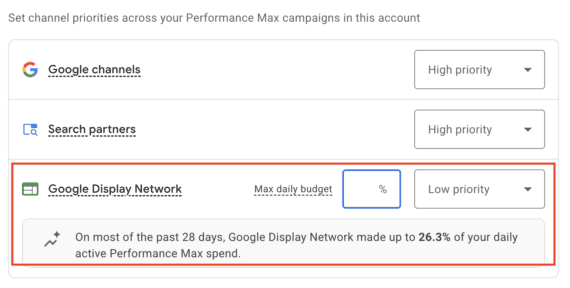
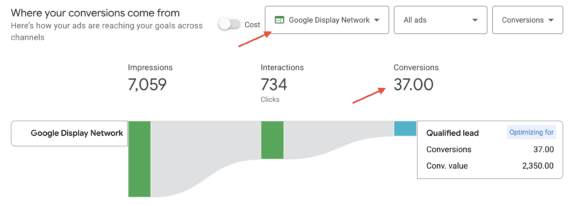
Consider an illustrative scenario: An advertiser runs a PMax campaign that has generated 77 total conversions over a 28-day cycle. Without the new prioritization tools, the advertiser might observe that 26.3% of their budget was funneled into the Display Network. In the past, this might have triggered alarm bells, leading the advertiser to pause the campaign or switch to manual bidding.
With the new tool, the advertiser can verify the actual performance of that spend. If the data reveals that the Display Network contributed 37 of those 77 conversions—representing roughly 48.1% of total conversions for only 26.3% of the spend—it becomes objectively clear that the channel is a high performer. In this instance, the advertiser would mark the Display Network as "High Priority."
The "Low Priority" Safety Net
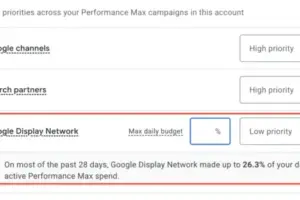
Conversely, if a channel is consuming a large share of the budget with a disproportionately low conversion rate, it is a prime candidate for "Low Priority" status. When an advertiser selects this option, they are not necessarily disabling the channel, but rather signaling to the algorithm that it should be restrained. Advertisers can further refine this by entering a "maximum daily spend percentage" for these low-priority channels. This allows for controlled experimentation: instead of cutting a channel off entirely, an advertiser can test whether that channel adds value at a reduced, cost-efficient volume.
Official Statements and Strategic Rationale
Google’s communication regarding this update has been centered on "budget optimization" and "efficiency." While the company often champions its automated systems as the gold standard for performance, the move toward channel prioritization suggests an admission that human marketers still possess contextual knowledge that the algorithm lacks.
The Human-in-the-Loop Advantage
By providing these controls, Google is effectively inviting advertisers to guide the machine. The rationale, according to internal insights, is to help advertisers reduce wasted spend on underperforming placements while protecting the overall campaign ecosystem. For example, an advertiser who has long suspected that "Search Partners" generate unqualified traffic can now allocate a minimal budget to that channel, allowing them to verify their hypothesis without risking the entire campaign budget. This shift validates the "test-and-learn" methodology that has been the bedrock of digital marketing for decades.
Future Outlook: Limitations and the Road Ahead
While channel prioritization is a major step forward, it is not a panacea. The current iteration of the feature contains structural limitations that power users will undoubtedly find frustrating.
The "Google Channels" Grouping Problem
The most glaring issue is the aggregation of channels. Within the Performance Max interface, Google groups several distinct platforms under the umbrella of "Google Channels." Despite these channels having vastly different intent levels and user behaviors, Google forces the advertiser to apply a single priority setting to the entire group.
This creates a "new" version of the old "all-or-nothing" problem. If an advertiser realizes their campaign performs exceptionally well on Search but poorly on Maps, they have no current mechanism to set them apart. They must choose to prioritize the entire bundle or downgrade the entire bundle. It is, in many ways, an incomplete solution that suggests Google is still hesitant to grant full, granular control over its proprietary inventory.
The Question of Algorithmic Compliance
There is also a lingering question regarding the algorithm’s adherence to these new settings. Will Google strictly respect the maximum daily spend percentages set by advertisers, or will it find "loopholes" to continue spending where it deems necessary for its own performance targets? History suggests that the system will prioritize its own conversion-prediction models. Advertisers will need to monitor their performance reports vigilantly over the next few months to ensure that "Low Priority" actually translates into lower spend.
The Strategic Conclusion
Despite these limitations, the introduction of channel prioritization is a victory for the advertising community. It represents a shift in the power dynamic between the platform and the user. As we move into 2027, the role of the campaign manager will evolve from "set it and forget it" to "strategic curator." By leveraging these new controls, savvy marketers can prune away the inefficiency of the "black box" and craft a more surgical, high-ROI approach to Google Ads. The era of total algorithmic reliance is fading; the era of human-steered, AI-assisted advertising is finally beginning.