Executive Overview
The proliferation of generative artificial intelligence has fundamentally altered the digital landscape. Tools capable of producing hyper-realistic imagery, audio clips, and video files are now accessible to billions of people, democratizing content creation in unprecedented ways. However, this technological leap has introduced a dark side: the rapid escalation of deepfakes, disinformation campaigns, and unverified synthetic media capable of undermining public trust, manipulating elections, and distorting historical records.
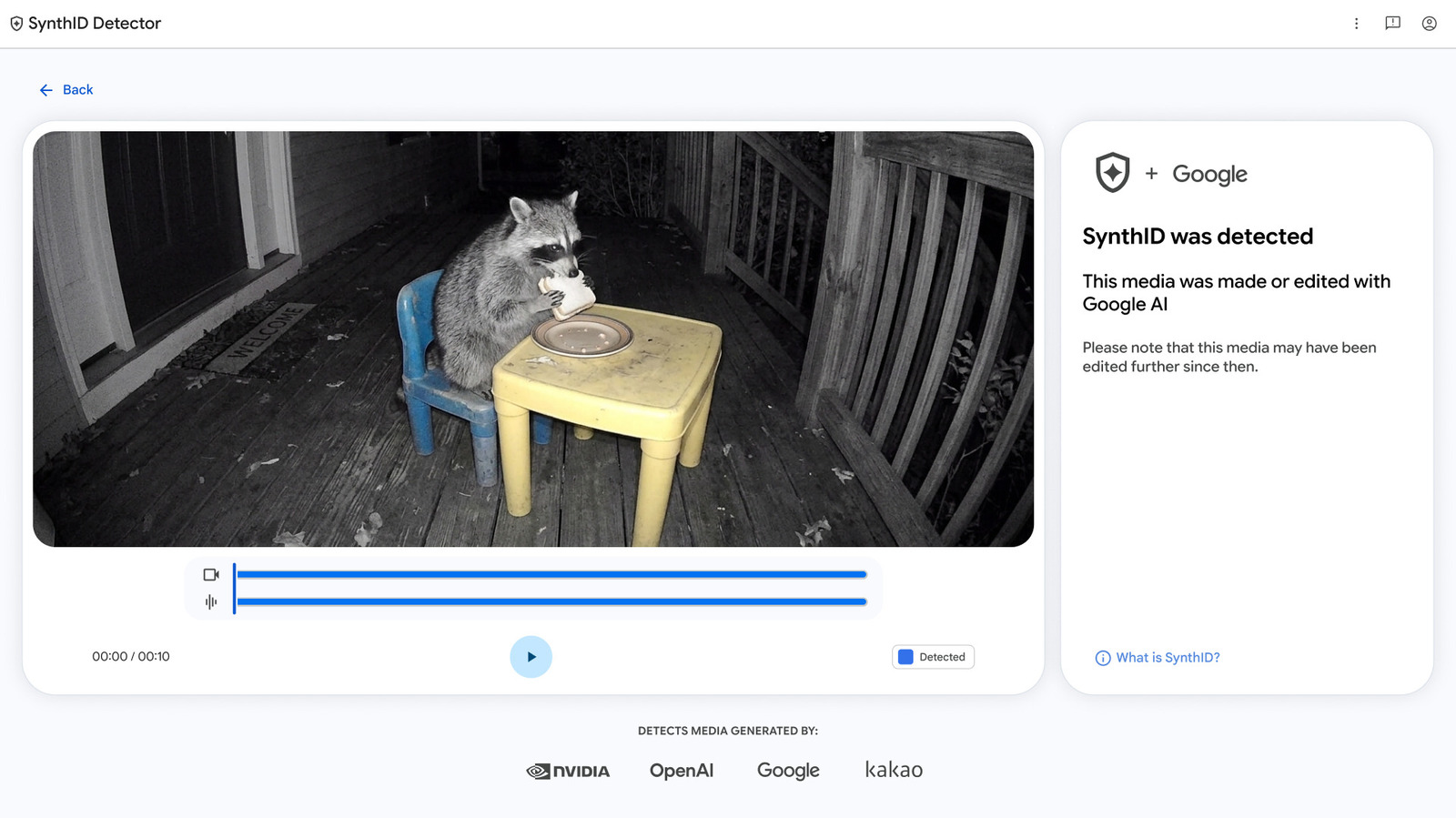
In response to this mounting crisis, Google has officially opened its SynthID Detector web tool to the general public. Previously restricted to select media professionals, journalists, and specialized partners, the platform is now live at synthid.com. It allows everyday internet users to scan and verify images, audio files, and videos to determine if they contain digital watermarks embedded by major artificial intelligence systems.
By expanding access to this technology, Google is taking a significant step toward transparency and accountability in the digital ecosystem. The tool is capable of flagging content generated or edited by leading AI platforms, including models from OpenAI, NVIDIA, Kakao, and Google itself. Furthermore, Google has announced upcoming support for Apple Intelligence features, such as Image Playground.
Yet, as the tech giant rolls out this free service, industry experts emphasize that the battle for authenticity is far from over. The landscape of AI detection remains fragmented, hindered by competing industry standards, easily stripped watermarks, and the inherent technical limitations of spotting synthetic media. This comprehensive report explores the genesis of SynthID, its capabilities and shortcomings, the fractured state of cross-industry verification standards, and what the future holds for digital media authenticity.
Detailed Chronology: The Evolution of SynthID
To understand the significance of the public launch of SynthID Detector, it is necessary to examine how Google developed the technology over several years of rigorous research and targeted deployment.
The Inception at Google DeepMind
The roots of SynthID trace back to Google DeepMind, the company’s premier artificial intelligence research laboratory. As generative models like Imagen (for images) and Lyria (for music) began producing increasingly indistinguishable outputs, researchers recognized that traditional post-hoc detection methods—which analyze pixel irregularities or statistical artifacts—would eventually fail as generative models improved.
Instead, Google pivoted toward embedded watermarking. Rather than trying to guess whether an image or audio file was synthetic after the fact, SynthID injects an invisible, imperceptible digital watermark directly into the content at the moment of creation. For images, this involves altering the pixel values in a way that remains invisible to the human eye but easily detectable by an algorithmic scanner. For audio, it involves embedding inaudible audio waves into the frequency spectrum. Crucially, these watermarks are designed to survive common transformations, such as cropping, screenshotting, filtering, and compression.
The Beta Phase: Restricting Access to Professionals
Google initially rolled out variations of SynthID incrementally.
- August 2023: Google DeepMind introduced SynthID for images generated by its Imagen model, making it available primarily to select Vertex AI customers.
- May 2024: The company expanded the technology to audio files produced by its generative music and voice tools.
- Late 2023 to Early 2024: Google provided specialized versions of the detection tool to journalists, human rights investigators, and select media organizations to help them combat disinformation during critical global election cycles.
During this beta phase, the tool was walled off from the general public. Verification required specialized software pipelines or enterprise-level integration into Google’s closed ecosystem.
Integration into Google’s Broader Ecosystem
Over the past year, Google began weaving SynthID checks into everyday consumer products. The company integrated watermark detection into its Circle to Search feature on Android devices, allowing users to query the authenticity of images directly from their screens. Similar verification capabilities were woven directly into the Gemini app interface.
However, these integrations still required users to be embedded within Google’s proprietary hardware and software environments. A user browsing the open web on a desktop computer or using a non-Google mobile device lacked a straightforward, centralized way to check media authenticity.
The Public Release at synthid.com
The launch of the dedicated web portal at synthid.com marks the first time Google has decoupled SynthID verification from its own consumer apps and enterprise pipelines. Anyone with an internet connection can now drag and drop a media file into the browser window to verify its origin. While the service is free, Google requires users to authenticate via a Google, OpenAI, or Apple account—a measure designed to prevent automated, malicious scraping and abuse of the verification infrastructure.
Supporting Context & Metrics: How SynthID Works and Where It Stands
To evaluate the utility of SynthID Detector, one must analyze its technical framework, its interoperability with other industry players, and its hard limitations.
Interoperability and Industry Adoption
A watermark is only as useful as the network of companies willing to implement it. Recognizing that Google cannot dictate a universal standard unilaterally, DeepMind designed SynthID to be an open framework that other major tech players could adopt.
At launch, SynthID Detector supports content generated not only by Google’s proprietary tools but also by systems from OpenAI, NVIDIA, and Kakao. Furthermore, Google has secured commitments from third-party generative audio giants like ElevenLabs, which has pledged to integrate SynthID watermarks into its voice-generation platform.
One of the most notable upcoming integrations is with Apple. With Apple rolling out its suite of generative AI features under the "Apple Intelligence" banner—including Image Playground and Genmoji—Google has confirmed that support for images created or edited via Apple’s tools will arrive on the SynthID Detector website "soon." This cross-industry collaboration signals a rare moment of alignment among Silicon Valley rivals who recognize that unverified synthetic media poses an existential threat to the credibility of the digital medium as a whole.
Limitations of the Technology
Despite its advanced engineering, SynthID Detector is far from a silver bullet. Industry analysts and security researchers have highlighted several core limitations:
- The Inability to Detect All AI Content: Because many AI companies rely on proprietary watermarking systems or use no watermarking at all, SynthID can only flag content that carries its specific digital signature. Images generated by Midjourney, certain open-source Stable Diffusion models, or localized custom weights will bypass the detector entirely.
- Fragility Under Extreme Manipulation: While SynthID watermarks are engineered to survive minor edits like compression, resizing, and color correction, aggressive modifications—such as heavy pixel reconstruction, extensive painting over, or adversarial perturbation attacks—can strip or corrupt the embedded signature, rendering the content unreadable to the detector.
- Lack of Granular Diagnostics: SynthID Detector provides a binary or probabilistic readout of whether a watermark is present, but it cannot differentiate between content that was entirely generated by an AI model versus content that was merely edited using AI tools (such as using an AI eraser to remove an object from a real photograph). It offers no breakdown of which specific layers, elements, or segments of a file are synthetic.
- The Fractured Detection Ecosystem: Google is not alone in building these tools. Meta has developed its own proprietary web detection tools capable of identifying images and videos produced by its Muse Image models. However, Meta’s tool cannot read Google’s watermarks, and SynthID cannot read Meta’s. The result is a fractured, Balkanized verification ecosystem where users must consult multiple competing platforms to check a single piece of media.
Official Statements and Industry Perspectives
The release of Synthid.com has drawn widespread commentary from industry leaders, policy experts, and technologists.
In its official launch blog post, Google DeepMind emphasized the necessity of collaboration in the fight against synthetic media:
"As generative AI tools become more powerful and accessible, empowering people to identify synthetic content is critical to maintaining public trust in digital information. No single company can solve this challenge alone. By making SynthID Detector freely available to the public and expanding our partnerships across the industry, we are taking a crucial step toward establishing transparency as a universal standard."
Independent cybersecurity and digital forensics experts have offered a more measured assessment. While praising the removal of access barriers, researchers point out that voluntary watermarking schemes suffer from a compliance gap.
Dr. Elena Vance, a senior researcher in digital media forensics at the Oxford Internet Institute, noted in a recent advisory:
"Watermarking technologies like SynthID are brilliant engineering achievements, but they operate on an opt-in basis. Bad actors, state-sponsored disinformation groups, and malicious creators using open-source models will simply disable or bypass watermarking modules. A public detector is exceptionally useful for catching casual or institutional AI generation, but it gives a false sense of security regarding malicious, adversarial deepfakes."
Meanwhile, representatives from the Coalition for Content Provenance and Authenticity (C2PA)—an open technical standards body backed by Adobe, Microsoft, Intel, and others—have stressed that watermarking is only one piece of a larger puzzle. C2PA champions cryptographic metadata credentials that trace the entire history of an asset from capture to publication. Google’s support for C2PA standards, alongside its proprietary SynthID watermarks, indicates that the industry is moving toward a multi-layered defense strategy combining cryptographic provenance with invisible digital watermarks.
Future Outlook: The Road Ahead for Digital Authenticity
As we look toward the horizon of digital media consumption, the release of SynthID Detector to the general public represents a foundational milestone, but also a stark reminder of the challenges yet to be resolved.
Toward Universal Standards
The immediate future of AI detection will likely hinge on consolidation. For tools like SynthID Detector to achieve maximum efficacy, the tech industry must bridge the gap between competing frameworks. Whether through regulatory mandates—such as the European Union’s Artificial Intelligence Act, which strongly encourages watermarking—or through market pressures driven by consumer demand for verified media, tech platforms will be forced to interoperate.
We can expect to see increased pressure on open-source model developers to adopt standardized watermarking protocols. If platforms like GitHub and Hugging Face begin baking mandatory watermarking layers into foundational model repositories, the blind spots currently exploited by bad actors will shrink significantly.
The Arms Race Between Generation and Detection
The cat-and-mouse game between generative AI developers and forensics engineers shows no signs of slowing down. As watermarking techniques become more robust, bad actors are investing heavily in adversarial machine learning designed to scrub, overwrite, or spoof digital watermarks without visibly degrading the underlying media. Consequently, future iterations of SynthID Detector will need to incorporate advanced machine-learning-based heuristic analysis alongside cryptographic watermark scanning to catch altered media that has had its digital signatures stripped away.
Empowering the Everyday Consumer
Ultimately, the success of tools like synthid.com will be measured by user adoption. If checking the provenance of a viral image or audio clip becomes as routine as checking a weather forecast or reading a source citation, the potency of disinformation campaigns will be severely diminished.
Google’s decision to democratize access to SynthID moves the needle away from exclusive enterprise-level security and places the tools of verification directly into the hands of the public. While it is not a cure-all, and while the limitations of current detection technology must be kept firmly in mind, the public availability of SynthID Detector marks a critical turning point in the ongoing effort to defend truth and transparency in the digital age.