By [Author Name]
Published: Investigative Tech & Marketing Desk
Executive Overview
In less than 200 days since its commercial rollout, OpenAI’s advertising ecosystem for ChatGPT has blasted past a staggering $1 billion in annualized revenue run rate. Attracting over 100,000 active advertisers within this hyper-accelerated timeframe, the platform has established itself overnight as a heavyweight contender in digital marketing. Yet, alongside this meteoric financial climb, profound questions linger regarding transparency, performance benchmarks, and the true return on investment (ROI) experienced by brands staking capital on conversational AI.
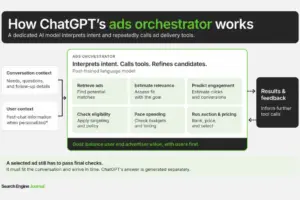
To demystify how its platform operates, OpenAI recently released a comprehensive technical breakdown shedding light on the underlying architecture of ChatGPT Ads. The documentation details how a dedicated "orchestrator" language model interprets complex user dialogues, dynamically queries vector embeddings, and submits options to a separate auction pipeline. Crucially, OpenAI emphasizes an architectural firewall: the ad-selection mechanism runs entirely decoupled from the core language generation models, ensuring that commercial incentives theoretically never corrupt organic answers.
However, a deep dive into the mechanics reveals a labyrinth of eligibility gates, post-auction safety checks, and strict timing constraints. An ad can successfully win an auction, clear strict policy guidelines, and still never see the light of day if it misses a strict millisecond delivery window or fails contextual appropriateness checks. Furthermore, while OpenAI’s staggering growth figures underscore massive initial market adoption, the company has conspicuously withheld critical performance indicators—such as cost-per-acquisition (CPA), return on ad spend (ROAS), and conversion-rate benchmarks—leaving modern marketers navigating a high-stakes ecosystem largely in the dark.
Detailed Chronology: The Anatomy of an Ad Delivery
To understand how ChatGPT delivers advertisements without compromising user experience, one must trace the multi-layered pipeline from a user’s initial keystroke to the final rendered pixel on the screen. OpenAI’s technical framework relies on strict modularity, separating natural language generation from ad orchestration and auction mechanics.
1. Dual-Track Processing: Answers vs. Ads
At the core of OpenAI’s system architecture is a strict separation of concerns. The primary language model responsible for drafting ChatGPT’s conversational responses operates entirely independently of the ad-selection system.
While both systems draw context from the ongoing user dialogue, they execute completely separate codebases and distinct models. As ChatGPT synthesizes a response token by token, a parallel ad-selection pipeline checks whether a relevant commercial offering matches the discourse. Critically, this process is non-blocking: ChatGPT never waits for the ad system. If the ad infrastructure encounters latency or processing bottlenecks, the organic answer delivers uninterrupted, and any ad arriving late is automatically dropped. This asynchronous design provides the structural foundation for OpenAI’s claim that monetization does not influence algorithmic answers.
2. The Orchestrator and Contextual Memory
When evaluating potential ads, the system employs what OpenAI terms an "orchestrator." This specialized model continuously reads the conversation history, capturing shifts in intent across multiple messages. OpenAI refers to these as stateful sessions, meaning the model maintains conversational continuity rather than evaluating every prompt in isolation.
For example, a user might open a session asking general questions about scaling a remote team, transition to evaluating operational tools, and finally inquire about pricing for project management software three messages later. The orchestrator tracks granular variables shared earlier in the discussion—such as the need for client approvals or the desire to avoid paying for guest user seats.
[User Dialogue] ──> [Orchestrator Model] ──> [Query Embeddings] ──> [Ad Inventory Retrieval]
                                                                        │
[Core ChatGPT] ──(Asynchronous Generation)──> [Final UI Render] <── [Auction & Delivery Filters]
To find relevant inventory without requiring exact keyword matches, the orchestrator converts parts of the conversation into numerical representations known as embeddings. If the conversation evolves, the orchestrator updates its search queries dynamically, pulling forward relevant commercial intent while filtering out obsolete constraints or hypothetical tangents.
3. The Auction Pipeline and Eligibility Gates
Once potential ads are retrieved via embeddings, they face a gauntlet of algorithmic filters. The system evaluates eligibility based on:
- Geographic and demographic targeting parameters.
- Strict advertising policy restrictions.
- Available campaign budgets and pacing controls (which dictate how quickly a brand’s daily budget is consumed).
The orchestrator assesses each candidate’s relevance, historical performance, and predictive metrics (likelihood of a view, click, or conversion) before submitting qualified options to a separate auction tool. This auction module handles final ranking and pricing. Once an ad wins the auction, however, it still faces final validation checks to confirm contextual appropriateness before rendering below the response with a mandatory "Sponsored" label.
Supporting Context & Metrics: Growth, Gaps, and the Impression Black Box
While the technological elegance of OpenAI’s orchestrator is clear, the practical realities for advertisers deploying capital within the platform reveal significant friction points.
The $1 Billion Milestone vs. The Advertiser Blind Spot
OpenAI’s announcement that ChatGPT Ads crossed a $1 billion annualized revenue run rate in under 200 days marks one of the fastest commercial scaling events in SaaS history. Paired with an adoption base exceeding 100,000 advertisers, the numbers project undeniable market momentum.
However, industry analysts caution against conflating a run-rate projection with collected cash or proven profitability. Crucially, the reported advertiser count fails to delineate between:
- Brands running one-time exploratory tests versus long-term recurring spenders.
- Advertisers who successfully scaled their budgets versus those who abandoned the platform after exhausting initial credits.
- Industries achieving high conversion rates versus sectors plagued by high customer acquisition costs (CAC).
Without baseline metrics regarding cost-per-acquisition, return on ad spend (ROAS), or vertical-specific conversion rates, marketers are forced to pilot campaigns based purely on platform novelty rather than empirical performance data.
The Mystery of the Missing Impressions
One of the most profound revelations in OpenAI’s technical breakdown is that winning an auction does not guarantee an impression. An ad can successfully navigate eligibility filters, win the pricing auction, and clear policy checks, only to be withheld because:
- The system deems the ad contextually misaligned with the final nuances of the response.
- The ad processing latency exceeds the strict delivery window, causing it to drop before rendering.
For brands experiencing low delivery volumes, this creates a frustrating diagnostic loop. In traditional programmatic advertising, low impressions typically signal uncompetitive bids or poor creative relevance. On ChatGPT, however, an advertiser might be losing out due to orchestration latency, stateful intent mismatches, or internal delivery pacing.
OpenAI notes that its internal logging infrastructure tracks these exact drop-off points—recording whether a search returned zero ads, failed eligibility, or lost out post-auction. Yet, the technical post does not clarify the exact granularity of reporting available within the advertiser dashboard. If brands cannot see where their ads stall in the pipeline, optimizing campaigns becomes an exercise in costly guesswork.
Official Statements and Industry Perspective
OpenAI’s leadership has consistently framed the introduction of advertising as a necessary financial engine to support the massive compute costs of scaling frontier AI models, while fiercely defending user trust.
"Our architecture is engineered from the ground up to protect the integrity of the conversation," OpenAI noted in its technical documentation. "The systems that reason, write, and synthesize answers operate in a completely isolated domain from the commercial orchestrator and auction tools. Relevance is matched through dynamic, stateful context, but monetization will never dictate intelligence."
Independent marketing technologists have welcomed the technical transparency while urging caution. Digital advertising veterans point out that while architectural separation prevents direct algorithmic bias in text generation, the nature of conversational AI introduces novel intent-matching challenges. Unlike traditional search engines where a user types a concise query like "buy enterprise CRM software," ChatGPT conversations meander through problem-solving phases.
As a result, brands must rethink their creative strategies. Advertisers can no longer rely solely on keyword matching; they must build landing pages and ad copy that address specific operational nuances—such as pricing tiers, integration capabilities, or licensing structures—that surface naturally during AI-driven problem exploration.
Future Outlook: What Brands Must Watch Next
As ChatGPT Ads transitions from its explosive introductory phase into a mature digital marketing channel, several critical milestones will dictate its long-term viability:
- Granular Reporting Dashboards: For enterprise brands to reallocate meaningful budgets from Google, Meta, and Amazon into OpenAI, platform dashboards must evolve to expose the funnel drop-off points mentioned in engineering logs. Advertisers need clear visibility into auction win rates, latency drops, and contextual rejection frequencies.
- Attribution and Conversion Validation: The industry desperately needs independent, controlled attribution studies. Proving that ChatGPT Ads generate incremental sales—rather than capturing users who would have converted organically anyway—will be the litmus test for sustained spending.
- Refining Stateful Intent: As OpenAI integrates more personalized, cross-session user contexts, managing the boundary between historical preferences and current intent will become exponentially complex. Advertisers must monitor how effectively the orchestrator distinguishes between immediate purchasing intent and long-term speculative research.
For now, OpenAI’s ad stack stands as a technological marvel—a high-speed, decoupled orchestrator capable of monetizing the deepest nuances of human-AI dialogue. But until the black box of advertiser reporting is opened wide, brands would be wise to treat ChatGPT Ads as an innovative frontier for experimentation rather than a predictable, performance-guaranteed direct response channel.