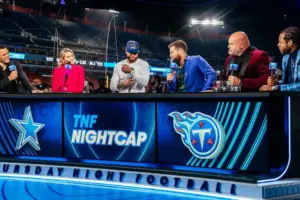
Executive Overview: A New Era of Sports Media
As the NFL’s media landscape undergoes its most radical transformation in half a century, Amazon Prime Video stands at the vanguard of a shift from traditional linear broadcasting to data-driven, interactive streaming. Now in the fifth year of its landmark 11-year exclusive rights deal for Thursday Night Football (TNF), Amazon is moving beyond the initial hurdle of infrastructure and technical delivery. The company is now aggressively scaling its commercial ecosystem, transforming the weekly prime-time broadcast into a multifaceted engine for advertiser growth.
Recent performance data from the ongoing season reveals a compelling narrative: despite the fragmented nature of modern media consumption, Thursday Night Football has become a powerhouse for brand acquisition and retention. With a 6% year-over-year increase in advertisers and a significant influx of new market participants, Amazon is successfully proving that streaming is not merely a replacement for cable—it is a superior platform for targeted, measurable, and integrated advertising.
Detailed Chronology: From Innovation to Integration
The journey of Thursday Night Football on Prime Video has been characterized by a calculated transition from "proof of concept" to "commercial dominance."
Phase I: Establishing the Beachhead (2020–2022)
When Amazon first secured the rights to TNF, industry skeptics questioned the stability of the streaming infrastructure for live, high-concurrency events. The early seasons were defined by technical optimization—ensuring that latency was minimized and the picture quality remained pristine for millions of concurrent viewers.
Phase II: The Expansion of the Playbook (2023–2024)
By the third and fourth seasons, the focus shifted from technical stability to user experience and ad-tech integration. Amazon began experimenting with interactive overlays, X-Ray features, and deeper integration with the Amazon shopping ecosystem.
Phase III: The Current Season (2024–2025)
We are currently witnessing the maturation of the product. The recent high-scoring thriller between the Chicago Bears and the New England Patriots—which saw the Bears edge out a 30-24 victory—served as more than just a gridiron spectacle. It functioned as a live laboratory for Amazon’s ad-tech stack, showcasing how the platform can handle peak audience loads while simultaneously serving personalized, high-conversion ad creative to a diverse demographic.
Supporting Context & Metrics: The Anatomy of Growth
The financial health of the Thursday Night Football franchise is best understood through its recent performance metrics, which paint a picture of a platform that is maturing far faster than traditional broadcast peers.
The 6% Growth Catalyst
Amazon’s reported 6% year-over-year increase in total advertisers on TNF is statistically significant in an era where traditional linear television is experiencing a steady decline in ad spend. This growth is not monolithic; it is being driven by specific, high-intent sectors:
- Financial Services: With complex offerings requiring trust and high-frequency brand reminders, banking and investment firms are flocking to Amazon’s data-rich environment.
- Retailers: Capitalizing on the "Prime" synergy, retailers are utilizing the platform to bridge the gap between brand awareness and immediate transactional conversion.
- Auto and Travel: These sectors are leveraging the high-income demographic that characterizes the Prime subscriber base, utilizing the platform to reach consumers at pivotal moments of purchasing intent.
The "New Blood" Factor
Perhaps the most telling metric is that 17% of advertisers this season are entirely new to both the Thursday Night Football environment and the broader Amazon Ads ecosystem. This suggests that Amazon is successfully lowering the barrier to entry for brands that previously found the cost and opacity of traditional NFL broadcast advertising prohibitive.
By offering granular audience targeting—leveraging first-party data that cable providers simply do not possess—Amazon is attracting a new class of mid-to-large-cap advertisers who demand a clear Return on Ad Spend (ROAS).
The Strategic Vision: Insights from Leadership
At the heart of this commercial evolution is a shift in how Amazon approaches its partnership model. Amy McDevitt, Head of Live Sports Sales Partnerships at Amazon Ads, emphasizes that the current season’s strategy is predicated on a concept of "leaning in."
"The goal is not just to sell a 30-second spot during a commercial break," McDevitt noted in a recent briefing. "We are working with partners to integrate their brand identity into the broader Prime Video experience. We want advertisers to lean into our offerings, ensuring their campaigns are not just visible, but additive to the fan experience. By expanding the relationship across the entire company—from Twitch and IMDb to Fire TV and the Amazon marketplace—we are creating a holistic ecosystem that traditional broadcast networks cannot replicate."
This "lean-in" philosophy is the cornerstone of Amazon’s competitive advantage. By moving beyond the interruptive nature of traditional commercials, Amazon is attempting to create an environment where the ad is as relevant and engaging as the game itself.
Future Outlook: The Next Six Years of the Deal
With six years remaining on the current 11-year deal, Amazon is not resting on its laurels. The company is actively positioning Thursday Night Football as the anchor for a broader sports-media dominance strategy.
The Rise of Shoppable TV
The next frontier for TNF is the seamless integration of "Shoppable TV." Amazon is currently iterating on features that allow viewers to purchase products featured in ads—or even products associated with the team merchandise—directly through their remote control or mobile device. As the technology behind frictionless commerce matures, the boundary between "watching" and "buying" will continue to blur.
AI and Personalization
Amazon’s advantage in artificial intelligence and machine learning is likely to be the next major disruptor. Future seasons of TNF will almost certainly feature hyper-personalized ad streams, where the same broadcast feed delivers different, contextually relevant advertisements to different viewers based on their purchase history and demographic profile.
Expanding the Sports Portfolio
While Thursday Night Football is the flagship, it serves as the prototype for potential future acquisitions. Whether Amazon chooses to pursue additional league rights or continues to focus on the optimization of its current assets, the playbook remains the same: use sports as a high-frequency driver for the Prime ecosystem.
Conclusion: A Paradigm Shift for the Industry
The success of Thursday Night Football under the Amazon banner represents a fundamental shift in the economics of live sports. The league has successfully transitioned from a television product to a digital-first experience, and in doing so, it has opened the door for advertisers to participate in a way that was previously unimaginable.
For the NFL, the deal is a validation of the move to streaming. For Amazon, it is a masterclass in platform monetization. And for the consumer, it is the beginning of a more interactive, personalized, and efficient sports-viewing experience. As we look toward the remainder of this season and the years to follow, the metrics are clear: the "Prime" playbook is not just working—it is rewriting the rules of the game for everyone else.
The integration of commerce and content, fueled by an advertiser base that is growing in both size and diversity, signals that the digital gridiron is open for business. As Amazon continues to refine its offerings, the industry must watch closely. In this new era of streaming, the winners will be those who can best translate the excitement of the game into the precision of a purchase.