Executive Overview
Federal investigators probing the notorious cybercrime collective known as ShinyHunters have uncovered a deeply troubling nexus between high-profile cybersecurity executives and international extortionists. According to sources close to the investigation, the probe has expanded far beyond traditional hacking suspects, landing squarely on executives at prominent ransomware negotiation and consulting firms.
The ongoing federal inquiry—sparked by a brazen September cyberattack on the Federal Bureau of Investigation’s recruitment portal, fbijobs.gov—has revealed
that certain trusted intermediaries in the cyber incident response ecosystem maintained unusually close, illicit relationships with the threat actors. In some instances, investigators allege these executives possessed advance knowledge of data breaches before the actual victims, failed to report severe intrusions, and even actively participated in running extortion platforms designed to pressure corporations into meeting ransom demands.
The fallout from the investigation has already resulted in high-profile arrests, international cooperation, and unprecedented scrutiny of the cyber extortion industry. As federal authorities peel back the layers of the ShinyHunters operation, the case is laying bare an uncomfortable truth about modern cyber defense: the financial incentives driving some commercial remediation and negotiation firms may be fundamentally misaligned with the security of their clients and the rule of law.
Detailed Chronology: From the Netherlands to Canada and the Fall of Rey
The current crackdown on ShinyHunters and its alleged enablers represents one of the fastest-moving cybercrime investigations in recent history. The sequence of events accelerated sharply in the fall of 2026, driven by a combination of aggressive international law enforcement operations and critical digital intelligence.
The Downfall of Pepijn van der Stap
The catalyst for the broader conspiracy probe occurred on the evening of September 15, 2026. In a high-stakes raid, Dutch law enforcement authorities deployed flash-bang grenades to stun and apprehend Pepijn van der Stap, a convicted hacker and senior ShinyHunters suspect. Police successfully detained Van der Stap while he was actively logged into his Signal instant messaging account.

This tactical execution proved to be a goldmine for investigators. Because Van der Stap was caught mid-session, authorities were able to access and preserve a real-time trail of communications connecting the Dutch hacker to frequent contacts across North America, including prominent ransomware negotiators based in Canada and the United States.
Sources indicate that analysis of Van der Stap’s Signal messages revealed a dark plot: instructions pointing to a murder-for-hire scheme targeting individuals abroad (though there is no indication those plans were executed). More critically, the chats exposed a web of close contacts between Van der Stap and figures within the Western cybersecurity consulting community.
The Rise and Fall of "Rey"
Following Van der Stap’s arrest, leadership of the ShinyHunters brand temporarily fell to a teenager from Amman, Jordan, known online as "Rey" (identified last year as the administrator of the "Scattered Lapsus Hunters" network). According to FBI estimates, ShinyHunters has successfully extorted more than $70 million from victims globally over the course of 2026.
In late September, Rey and his associates made a critical miscalculation: they hacked fbijobs.gov, taunting federal law enforcement by threatening to publish highly sensitive personnel files, including Social Security numbers, home addresses, medical and psychological records, and specialized unit details.
The attack on the FBI’s backyard triggered an immediate, aggressive response. On October 3, Reuters reported that Jordanian authorities had detained Rey, who quickly began cooperating with the FBI.
Arrest of Edward Dubrovsky
Armed with the intelligence gathered from Van der Stap’s decrypted communications, the FBI struck on October 9, arresting Edward Dubrovsky, a 54-year-old Canadian cybersecurity executive. Dubrovsky, who had recently published a book on handling cyber extortion advocating for direct engagement with hackers, was charged with threatening to disclose stolen data and interfering with interstate commerce through extortion.

Federal prosecutors subsequently requested that Dubrovsky remain in custody pending trial, with court records placed under seal. According to sources close to the investigation, Dubrovsky’s chats with Van der Stap demonstrated that the Canadian executive knew ShinyHunters had compromised FBI servers well before the agency’s data was publicly leaked on social media platforms, yet chose not to alert federal authorities.
Supporting Context & Metrics: The Mechanics of "Shinywire" and the "Ghostbyte" Connection
As federal investigators dug deeper into the infrastructure used by ShinyHunters, they uncovered direct involvement from corporate executives in managing the group’s extortion infrastructure.
The "Shinywire" Extortion Portal
Investigators believe that at least one executive at a prestigious U.S.-based consulting firm—an entity with over 1,000 associates—played an active role in operating shinywire[.]com, a now-defunct victim shaming and pressure website. Active from May 3 until October 16, 2026, Shinywire featured profiles of nearly 100 organizations breached by ShinyHunters.
Each listing on Shinywire served as a digital billboard designed to coerce victims, displaying samples of stolen data and warning that failure to engage or negotiate within seven days would result in the complete public release of corporate and personal records on the Dark Web via Tor. Cached records from platforms like urlscan.io documented extortion demands targeting major enterprises, such as American medical technology giant Intuitive Surgical, which was breached in March 2026 via a targeted employee phishing attack.
Corporate Feuds and the "Ghostbyte" Persona
The legal and professional fallout has also exposed bitter internal conflicts within the cybersecurity industry. Earlier this year, Edward Dubrovsky filed a lawsuit in Ontario against Daniel Tobok, former CEO of Cypfer, a prominent incident response firm with global reach. Dubrovsky alleged he had been sidelined in a campaign to destroy his professional standing following a falling out between the former business partners. Tobok denied the allegations, filing a counterclaim accusing Dubrovsky of misappropriating confidential information and competing unfairly through another entity, CyberSteward Inc.
Adding a strange historical dimension to the probe, former colleagues of Tobok revealed to investigators that he was known among ransomware purveyors as far back as 2018 by the alias "Ghostbyte."

Evidence recovered from historical breach data shows that when a Canadian company was compromised by the Russian-language Dharma ransomware affiliate program in 2018, the threat actors explicitly directed the victim to contact an IT professional using the email address [email protected], noting that the individual frequently solved such crises in Canada. Cybersecurity intelligence firm Constella Intelligence later linked an email address frequently used by Tobok ([email protected]) to online accounts bearing the "ghostbyte" moniker, including a Snapchat profile. Furthermore, blockchain analysis tied the Dharma representative’s fallback cryptocurrency wallet to transactions totaling approximately 43 bitcoins—valued at roughly $3.5 million today.
Official Statements and Industry Conflict of Interests
The revelations surrounding the cozy relationships between remediation executives and cyber extortionists have ignited a fierce debate regarding systemic conflicts of interest within the incident response marketplace.
Corporate Posturing and Industry Fallout
In statements issued following Dubrovsky’s arrest, Cypfer distanced itself from the criminal charges, asserting that the firm does not facilitate ransomware payments, had no prior knowledge of Dubrovsky’s arrest, and has not been targeted by law enforcement. Cypfer noted it was recently acquired by the Apros Group, a holding company led by former FBI special agent Jason Hogg.
However, industry watchdogs argue that the structural design of many ransomware negotiation services creates an inherent moral hazard. Mark Camillo, Chief Executive of CyberAcuView—an industry group founded by major cyber insurance carriers—pointed out that while some firms charge flat retainers, others take a percentage of the total ransom paid.
"This makes no sense if they are also the negotiator," Camillo noted. "There needs to be more transparency in the process as no one in the ecosystem should be profiting purely on the size of the ransomware transaction or payment itself."
The War on Intermediaries
Reputable incident response firms, including Coveware and Unit 221B, have long advised victims against paying ShinyHunters, warning that cybercriminals routinely retain, resell, or weaponize stolen data regardless of whether a ransom is paid. The FBI echoed these warnings in an official May 2026 Public Service Announcement.

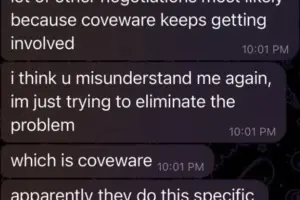
Leaked internal Telegram communications from ShinyHunters leaders reveal just how damaging these anti-ransom advisories were to the hackers’ bottom line. In private chats from April and May 2026, the primary operator of the ShinyHunters account lamented that Coveware was actively interfering with their business model, complaining that victims would have paid were it not for Coveware’s "misinformation." The group went so far as to discuss ways to "eliminate the problem."
Federal prosecutors are increasingly targeting compromised intermediaries who cross the line from remediation to active criminal conspiracy.
- In July 2026, Florida ransomware negotiator Angelo Martino was sentenced to 70 months in prison for conspiring with the BlackCat/ALPHV group to feed confidential client negotiating strategies back to the hackers to maximize payouts.
- On October 7, the Department of Justice charged MonsterCloud CEO Zohar Pinhasi with wire fraud and conspiracy for allegedly billing clients millions for remediation while secretly paying out ransoms behind their backs.
Future Outlook
The multi-jurisdictional takedown of the ShinyHunters network and the concurrent prosecution of trusted cybersecurity executives mark a watershed moment for the information security industry. The investigation demonstrates that law enforcement is no longer solely focused on anonymous hackers hiding behind keyboards in foreign jurisdictions; it is actively pursuing domestic and international enablers who monetize and facilitate corporate extortion from within the defense ecosystem.
Moving forward, the fallout from the ShinyHunters probe is expected to trigger sweeping regulatory and structural reforms:
- Stricter Oversight of Ransomware Negotiators: Insurance carriers and corporate boards will likely demand greater transparency regarding fee structures, eliminating percentage-based commissions that incentivize higher payouts.
- Mandatory Breach Reporting for Intermediaries: Legislators are expected to weigh new compliance mandates penalizing cybersecurity firms and consultants who withhold critical intelligence about active compromises from law enforcement.
- Erosion of Trust in Incident Response: Organizations targeted by ransomware will face heightened scrutiny when selecting third-party responders, necessitating rigorous vetting to ensure remediation partners do not maintain untoward ties to threat actor syndicates.
As the federal cases against Edward Dubrovsky and other co-conspirators proceed through the courts under seal, the cybersecurity community remains on high alert. The illusion that the ransomware negotiation market operates entirely above board has been shattered, leaving an urgent imperative for the industry to purge bad actors and realign its professional ethics with the defense of its clients.