Executive Overview
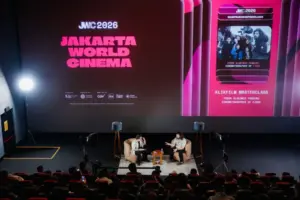
At the prestigious Jakarta World Cinema festival, acclaimed cinematographer Tudor Vladimir Panduru captivated audiences and industry professionals alike during an extensive, career-spanning masterclass. Known worldwide for his long-term creative partnership with Romanian auteur Cristian Mungiu, Panduru pulled back the curtain on the meticulous, high-pressure world of contemporary European art-house filmmaking.
Moderated by Benh Zeitlin—the Oscar-nominated director of Beasts of the Southern Wild, who admitted he spearheaded the session in the hopes of future collaboration—the masterclass offered a rare, technical, and philosophical deep dive into the craft of visual storytelling. Spanning seminal works such as Graduation, R.M.N., and the latest collaboration Fjord, alongside international projects like Iraqi director Hasan Hadi’s The President’s Cake, the session illuminated how restraint, rigorous preparation, and absolute trust between director, actor, and cinematographer can forge cinematic milestones.
Panduru’s body of work challenges conventional Hollywood editing paradigms. Instead of relying on fast-paced cuts and coverage-heavy shooting styles, Panduru champions the plan-séquence—the unbroken, single-take scene—where performances dictate the rhythm of the film, and the camera acts as a silent, objective observer rather than an intrusive narrator. This comprehensive report examines the technical breakdowns, collaborative dynamics, and artistic philosophies shared during this landmark masterclass.
Detailed Chronology: A Career Forged in Rigor and Restraint
The masterclass was structured chronologically, tracing Panduru’s trajectory from an aspiring trainee under veteran cinematographer Oleg Mutu to becoming one of Europe’s most sought-after visual artists.
The Breakthrough: Graduation and the Mungiu Method
Panduru’s introduction to Cristian Mungiu occurred while Panduru was still cutting his teeth as a trainee under Oleg Mutu, the visionary DP behind Mungiu’s Palme d’Or-winning masterpiece 4 Months, 3 Weeks and 2 Days. When Panduru stepped up to lens Graduation, it was only his second feature film as a lead cinematographer, yet it propelled him onto the international stage.
Discussing Mungiu’s directorial philosophy, Panduru explained that the camera is intentionally designed to maintain a low profile. It refuses to lead or manipulate the audience’s emotional responses, operating on the foundational belief that viewers are astute enough to decode subtext independently.
"With Cristian Mungiu’s work, he usually shoots plan-séquence, one scene per shot. There is no editing, no cuts," Panduru told the Jakarta audience. "From a cinematographer’s point of view, things can be quite difficult because we end up shooting a lot of takes, and the performance comes as somehow the most important thing on set. We end up shooting 20, 30, 40 takes sometimes to reach the best outcome."
Despite the grueling physical and mental repetition, Panduru noted that the atmosphere on set rarely turns monotonous. Mungiu expertly maintains energy levels across exhaustive schedules, though Panduru stressed that the primary duty of staying present falls upon the individual. Shooting in continuous takes is about living authentically in the moment alongside the cast and crew.
R.M.N.: Orchestrating Chaos in a Single Frame
Moving forward in his career timeline, the masterclass examined a tour-de-force sequence from Mungiu’s R.M.N.—a harrowing, 20-minute uninterrupted take featuring over 100 extras packed tightly inside a bustling town hall.
The technical hurdles of this scene were immense. Panduru revealed a fascinating logistical sleight-of-hand: the sequence, which appears to take place during broad daylight, was actually shot entirely at night.
Because the camera remained completely stationary, traditional methods of reframing or cutting to hide coverage were rendered impossible. Instead, Panduru and his focus puller had to rely on dynamic focus-pulling techniques to shift the viewer’s attention organically across the crowded room, acting as an in-camera editing suite.
"You’re basically using the focus pulling as a way to edit and also reframe in the same shot without having the camera moving at all," Panduru explained, detailing the high-stakes coordination required to keep more than a hundred individuals in sharp focus within a single, continuous frame.
Venturing Beyond: The President’s Cake and Visual Diversity
A stylistic pivot in the masterclass occurred with the screening of a clip from Iraqi director Hasan Hadi’s The President’s Cake. Benh Zeitlin admitted that upon viewing the film, he was initially stunned to discover it shared the same cinematographer as Mungiu’s grim social dramas, noting its vastly different aesthetic fingerprint.
Panduru explained that because The President’s Cake is structured as a children’s fairytale, it naturally demanded an entirely separate visual lexicon. The natural, sweeping landscapes inspired a more fluid, mobile approach to camera movement. Panduru embraced running jib arms and specialized wheels—techniques that fundamentally expanded his toolkit and later informed his work on subsequent projects.
Fjord: Magic Hour Illusions and the Ultimate Leap
The session concluded with an analysis of Mungiu’s latest feature, Fjord. The film blended the signature long-take methodology with heightened technical dexterity.
In one scene, a family gathering appears to be bathed in the warm, fleeting amber of "magic hour"—the coveted window just before sunset. Panduru detailed the rigorous lighting controls required to achieve this, explaining how his crew blocked out natural exterior light to artificially manufacture time, thereby granting the actors a wider window to refine their performances without the relentless pressure of a disappearing sun.
The masterclass culminated with a screening of a breathtaking, continuous sequence in which the camera shadows star Renate Reinsve from her initial grounded search all the way to a dramatic leap into the freezing sea.
"It was really important to have the entire arc of the scene of the emotional trajectory of the characters, [so] it was really important for Cristian not to cut in this moment," Panduru noted.
Describing the physical toll of the shoot, Panduru admitted he ultimately decided the most straightforward way to capture the moment was to leap into the icy water right alongside Reinsve. The primary challenge, he recalled with a laugh, was synchronizing his movements with the actor mid-air and safeguarding the camera gear from water damage, a feat made possible only by a deeply reliable team of water and land grips.
Supporting Context & Metrics: The Architecture of Art-House Cinematography
To fully appreciate Tudor Vladimir Panduru’s contributions to modern cinema, one must examine the distinct production metrics and aesthetic frameworks that define contemporary Romanian and European auteur cinema:
- Take Counts: While standard commercial productions rarely exceed 5 to 7 takes per setup, Panduru’s work with Mungiu regularly demands 20 to 40 takes per scene to achieve absolute emotional authenticity and technical synchronicity.
- Duration of Takes: Sequences like the town hall meeting in R.M.N. push single-take durations past the 20-minute mark, requiring monumental physical endurance from actors, camera operators, and focus pullers alike.
- The Philosophy of Collaboration: Panduru maintains a strict curatorial approach to his career, explicitly turning down genres like traditional action blockbusters unless they are underpinned by robust social commentary and shared artistic affinities.
Official Statements: Industry Perspectives on Panduru’s Artistry
The masterclass served as a platform for profound insights from both Panduru and moderator Benh Zeitlin regarding the socio-political duty of art-house cinema and the mechanics of creative partnerships.
Benh Zeitlin on Panduru’s Impact:
"We hope to work together someday… He is the kind of cinematographer who can bring a dimension to your work that is beyond your personal imagination." Zeitlin further noted that Mungiu’s cinematic universe fundamentally champions "directness and truthfulness" while launching a fierce critique against "hypocrisy and dishonesty."
Tudor Vladimir Panduru on Supporting Auteur Visions:
"Romanian cinema has often been rooted in social issues, and what Mungiu addresses is important. I’m just trying to help him tell that… It’s also a matter of trust. When you get to work in this kind of style, everybody gives a bit of himself into that process, so there’s a moment of synchronicity. We don’t shoot 30 takes because the takes are not good. [The one that works] needs to have all the elements get together so you have the best outcome of everything."
Future Outlook: The Evolution of the Plan-Séquence
As digital sensor technology evolves and camera stabilization systems become increasingly sophisticated, the temptation in modern filmmaking is often to move the camera incessantly, utilizing drones, gimbals, and digital wizardry to dazzle audiences. Yet, Tudor Vladimir Panduru’s masterclass at Jakarta World Cinema stands as a powerful counter-narrative to this trend.
Panduru’s career proves that restraint is often far more radical than excess. By anchoring the camera firmly within the emotional geography of a scene—whether trapped in a claustrophobic town hall with a hundred angry townspeople or plunging into an arctic sea alongside a desperate character—Panduru elevates cinematography from mere image-capture to an act of profound empathy.
As Panduru continues to collaborate with visionary directors across international borders, his dedication to the uncompromising integrity of the long take ensures that his work will remain a defining benchmark for the future of world cinema. Filmmakers and audiences alike will undoubtedly be watching—and waiting—to see where his lens takes them next.