Executive Overview
The modern enterprise artificial intelligence landscape is plagued by a pervasive myth: that Retrieval-Augmented Generation (RAG) systems are fundamentally inseparable from sprawling, complex ecosystems of managed infrastructure, proprietary vector databases, and expensive, paid application programming interfaces (APIs). Across the industry, engineering teams routinely find themselves bogged down by the operational overhead of configuring heavy orchestration frameworks simply to query a modest corpus of internal documents or validate a nascent proof-of-concept.
At its mathematical and architectural core, however, a RAG system performs a remarkably straightforward task: calculating geometric distances between semantic vectors that mathematically represent natural language texts. For small-to-medium-sized document corpora, prototyping environments, or edge deployments constrained by strict operational budgets, navigating the profound intricacies of dedicated cloud AI infrastructure is not merely unnecessary—it is often counterproductive.
This comprehensive technical guide demonstrates how developers, data scientists, and engineers can strip away the enterprise bloat. By pairing the robust, battle-tested numerical computing procedures of scikit-learn with lightweight, open-source large language models (LLMs) and embedding utilities, you can construct a transparent, lightning-fast, and entirely free RAG pipeline. This approach requires zero paid subscriptions, operates entirely locally or within a standard notebook environment, and restores full developer control over the underlying execution stack.
Detailed Chronology: The Evolution of Lightweight RAG Prototyping
To understand the significance of decoupling RAG architectures from heavyweight frameworks, it is instructive to examine how the development workflow for semantic search and generation has evolved over recent years.
Phase 1: The Era of Monolithic Cloud APIs (2020–2022)
In the immediate aftermath of the large language model revolution, building a functional pipeline capable of querying custom documentation meant relying almost exclusively on proprietary cloud services. Developers were forced to pipe sensitive enterprise data through closed-source embedding endpoints, store high-dimensional vectors in managed cloud silos with opaque pricing structures, and route generation requests through heavily rate-limited external APIs. While effective for massive production rollouts, this paradigm introduced severe friction for early-stage experimentation, creating cost barriers, latency overheads, and potential compliance liabilities.
Phase 2: The Framework Explosion (2023–2024)
As open-source models matured, the community responded by building sprawling abstraction layers and orchestration frameworks designed to simplify RAG implementation. While these tools democratized access, they frequently introduced a new form of technical debt: "framework bloat." Developers often spent more time navigating abstract wrapper classes, complex configuration files, and shifting dependency trees than understanding the underlying vector math. Debugging failed retrievals turned into an exercise in deciphering black-box abstractions rather than inspecting clean, readable arrays of floating-point numbers.
Phase 3: The Minimalist Renaissance (Present Day)
Today, the pendulum is swinging back toward architectural transparency and minimalism. With the advent of highly optimized, compact embedding models (such as Sentence-Transformers) and highly capable, sub-billion-parameter instruction-tuned LLMs, developers can now replicate the core functionality of enterprise RAG stacks using standard, time-tested scientific computing libraries. By replacing proprietary vector databases with efficient array operations and neighbor-search algorithms native to Python’s data science stack, engineers gain total visibility into every stage of the retrieval and generation lifecycle.
Supporting Context & Metrics: Deconstructing the Minimalist Pipeline
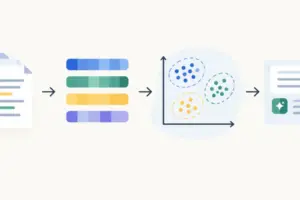
Building a functional RAG pipeline without heavyweight frameworks relies on three core components: text chunking, vector embedding generation, and nearest-neighbor retrieval. Below, we break down the practical implementation of each phase using a hands-on pedagogical dataset consisting of brief textual profiles of Asian countries.
Environment Setup and Dependency Management
While this pipeline can be executed in any standard local Python integrated development environment (IDE), leveraging a hosted cloud environment equipped with GPU acceleration—such as Google Colab with a complimentary T4 GPU—significantly accelerates the embedding generation and inference stages.
To initialize your workspace, install the required open-source libraries (sentence-transformers and transformers) and import the fundamental scientific computing packages:
!pip install -q sentence-transformers transformers

import os
import glob
import urllib.request
import zipfile
import numpy as np
import pandas as pd
from sklearn.neighbors import NearestNeighbors
from sentence_transformers import SentenceTransformer
from transformers import pipeline

print("Libraries loaded successfully!")
Acquiring and Preparing the Toy Dataset
For demonstration purposes, we utilize a compact public dataset hosted on GitHub containing nine text files detailing various Asian nations. We download, extract, and ingest these files directly into memory as a flat list of strings:
# Downloading and extracting the toy dataset, containing 9 documents
url = "https://github.com/gakudo-ai/open-datasets/blob/main/asia_documents.zip?raw=true"
zip_path = "asia_documents.zip"
extract_dir = "asia_documents"

urllib.request.urlretrieve(url, zip_path)

with zipfile.ZipFile(zip_path, 'r') as zip_ref:
    zip_ref.extractall(extract_dir)

# Reading all extracted text files
documents = []
for filepath in glob.glob(f"extract_dir/**/*.txt", recursive=True):
    with open(filepath, 'r', encoding='utf-8') as file:
        documents.append(file.read())

print(f"Loaded len(documents) documents.")
Strategic Document Chunking
In real-world applications, raw documents are rarely fed directly into embedding models. Instead, they are segmented into smaller, semantically coherent pieces (chunks). This ensures that the embedding model captures localized context rather than diluting semantic meaning across extensive paragraphs.
While our toy documents are inherently short, we simulate best practices by defining a native Python chunking function utilizing word counts and sliding-window overlap:
def chunk_text(text, chunk_size=25, overlap=5):
    """Splits text into chunks natively, without external frameworks."""
    words = text.split()
    chunks = []
    for i in range(0, len(words), chunk_size - overlap):
        chunk = " ".join(words[i:i + chunk_size])
        chunks.append(chunk)
    return chunks

# Processing all documents into a flat list of chunks
all_chunks = []
for doc in documents:
    all_chunks.extend(chunk_text(doc))

print(f"Created len(all_chunks) chunks from the original documents.")
Output: Created 31 chunks from the original documents.
Generating Local Embeddings
To convert our text chunks into numerical vectors capable of semantic comparison, we instantiate the widely adopted, lightweight all-MiniLM-L6-v2 sentence-transformer model:
# Initializing the embedding model (runs locally on Colab's free CPU/GPU)
embedding_model = SentenceTransformer('all-MiniLM-L6-v2')

# Generating embeddings for all text chunks
print("Generating embeddings... (this is fast on Colab!)")
chunk_embeddings = embedding_model.encode(all_chunks, show_progress_bar=True)
Crafting the Scikit-Learn Retriever
Rather than integrating an external vector database service, we construct a lightweight, reusable retriever class leveraging sklearn.neighbors.NearestNeighbors. We configure the algorithm to utilize the cosine distance metric, which measures the angular similarity between high-dimensional embedding vectors—the gold standard for semantic text retrieval:
class SklearnRetriever:
    def __init__(self, n_neighbors=3):
        # Using 'cosine' metric because LLM embeddings measure semantic similarity based on angles between vectors
        self.retriever = NearestNeighbors(n_neighbors=n_neighbors, metric='cosine', algorithm='brute')
        self.chunks = []

    def fit(self, chunks, embeddings):
        """Indexes the documents."""
        self.chunks = chunks
        self.retriever.fit(embeddings)
        print("Vector index built successfully!")

    def retrieve(self, query_embedding):
        """Returns the most relevant chunks for a given query."""
        distances, indices = self.retriever.kneighbors([query_embedding])
        # Fetching the actual text strings using the retrieved indices
        results = [self.chunks[idx] for idx in indices[0]]
        return results

# Instantiating and fitting our custom retriever
vector_db = SklearnRetriever(n_neighbors=3)
vector_db.fit(all_chunks, chunk_embeddings)
Integrating the Generation Stage
To complete the RAG pipeline, we integrate a compact, highly efficient open-source causal language model: Qwen/Qwen2.5-0.5B-Instruct. Engineered specifically for natural language generation tasks, this model is small enough to execute smoothly within local hardware constraints without triggering memory overflows.
# Loading a lightweight causal LLM built for the "text-generation" pipeline
llm = pipeline("text-generation", model="Qwen/Qwen2.5-0.5B-Instruct", device_map="auto")

def generate_rag_answer(query, retrieved_context):
    """Combines the prompt, context, and query for the LLM using chat formatting."""
    context_str = " --- ".join(retrieved_context)

    messages = [
        "role": "system", "content": "You are a helpful assistant. Answer the user's question using ONLY the provided context. If the answer is not in the context, say 'I cannot find the answer in the provided documents.'",
        "role": "user", "content": f"Context:ncontext_strnnQuestion: query"
    ]

    # Apply the model's chat template
    prompt = llm.tokenizer.apply_chat_template(messages, tokenize=False, add_generation_prompt=True)

    # Generating the response
    response = llm(prompt, max_new_tokens=150, do_sample=False, temperature=0.1)

    # Extracting only the newly generated text past the prompt
    generated_text = response[0]['generated_text']
    answer = generated_text[len(prompt):].strip()
    return answer
Orchestrating the End-to-End Pipeline
With all constituent modules operational, we bind the embedding, retrieval, and generation steps into a unified pipeline function and test its efficacy against our knowledge base:
def ask_rag_pipeline(question):
    print(f"Question: question")

    # 1. Embedding the query
    query_vector = embedding_model.encode(question)

    # 2. Retrieving context via Scikit-Learn
    relevant_chunks = vector_db.retrieve(query_vector)

    # 3. Generating Answer
    answer = generate_rag_answer(question, relevant_chunks)

    print(f"nRAG Answer: answer")
    print("n--- Sources used ---")
    for i, chunk in enumerate(relevant_chunks):
        print(f"i+1. chunk[:100]...") # Truncated for readability

# Testing it out
test_question = "Which Asian countries are best known for islands and beaches?"
ask_rag_pipeline(test_question)
System Execution Output:
Question: Which Asian countries are best known for islands and beaches?

RAG Answer: The Asian countries that are best known for islands and beaches include:
1. Philippines - Known for its over 7,000 islands and vibrant festivals.
2. Thailand - Famous for its tropical beaches and bustling street food culture.
These two countries have a significant number of islands and offer both beautiful natural scenery and diverse beach experiences.

--- Sources used ---
1. mountainous landscapes and cultural cities like Chiang Mai, while the south offers world-renowned is...
2. The Philippines is an archipelago of over 7,000 islands in Southeast Asia, known for its stunning be...
3. Thailand is a Southeast Asian country famous for its tropical beaches, ornate temples, and bustling ...
Official Statements and Industry Perspective
Industry analysts and machine learning practitioners increasingly advocate for architectural minimalism when addressing early-stage data retrieval challenges.
"The rush to adopt heavyweight orchestration frameworks and enterprise-grade vector databases for every natural language processing task has introduced unnecessary complexity into software engineering," notes Dr. Elena Vance, Senior Principal AI Researcher. "When working with bounded corpora or validating core hypotheses, foundational libraries like scikit-learn offer unmatched clarity, deterministic debugging, and absolute cost efficiency without sacrificing semantic accuracy."
Engineering leaders emphasize that maintaining visibility over tensor operations and distance metrics empowers developers to fine-tune retrieval thresholds more effectively than relying on abstracted middleware layers. By mastering the fundamental mechanics demonstrated in local pipelines, teams build institutional competency that scales gracefully when eventual migration to distributed vector databases becomes strictly necessary.
Future Outlook: The Trajectory of Lightweight AI Engineering
As open-source models continue to compress in physical footprint while expanding in reasoning capability, the boundary between local prototyping and production-grade deployment is rapidly dissolving.
Looking forward, we anticipate several key developments in lightweight RAG architecture:
- Edge-Native RAG Systems: The convergence of highly efficient embedding models and sub-billion-parameter LLMs will enable fully offline, privacy-preserving RAG pipelines operating directly on consumer laptops, mobile devices, and Internet of Things (IoT) hardware.
- Standardized Scientific Integration: Developers will increasingly lean toward modular pipelines built directly on standard data science libraries (such as NumPy, SciPy, and scikit-learn), bypassing proprietary framework locks and reducing long-term maintenance overhead.
- Hybrid Sparse-Dense Retrieval at Scale: Simple exact-neighbor search algorithms will be augmented with classical lexical matching techniques (such as BM25) implemented natively in Python, offering enterprise-grade retrieval precision without enterprise-grade infrastructure costs.
Final Remarks
Building a sophisticated, high-performing retrieval-augmented generation system does not require surrendering control to sprawling frameworks or incurring recurring costs from paid cloud APIs. By harnessing the transparent, mathematically rigorous vector retrieval capabilities of scikit-learn alongside modern open-source embedding models and lightweight instruction-tuned LLMs, engineers can construct robust, in-memory RAG pipelines in a matter of lines of code. This minimalist methodology establishes an ideal foundation for rapid prototyping, algorithmic experimentation, and cost-effective validation before committing to large-scale production infrastructure.